Bot Loc Tom Thit: Hue's Translucent Tapioca Dumplings with Shrimp and Pork
Translucent tapioca dumplings filled with whole shrimp and pork, served in a sweet-savory fish sauce. A Hue specialty that looks delicate but delivers serious flavor.

What is bot loc tom thit?
"Bot loc tom thit" is a Hue specialty — translucent tapioca dumplings shaped like small purses, each one encasing a whole shrimp and minced pork in a savory filling. The wrapper itself is made from tapioca starch and water, steamed until it turns almost glass-like. The real pleasure is in the contrast: bite through that thin, slippery skin and hit a burst of umami from the pork and the sweetness of the shrimp, plus a pinch of aromatic black pepper.
The name breaks down simply: "bot" (tapioca flour), "loc" (to sieve or strain), "tom" (shrimp), "thit" (pork).
It's not a dish that photographs like a plate of gold leaf and microgreens. It's modest, humble, and entirely dependent on the quality of the filling and the precision of the steaming. A well-made bot loc tom thit shouldn't taste greasy or heavy — just clean, savory, and a little sweet.
How it differs from other bot loc varieties
Hue (후에 / 顺化 / フエ) has three main types of tapioca dumplings, and locals will order them by name.
Bot loc tom thit — what we're discussing here — has a folded tapioca skin (shaped like a tiny sack or money bag) and is served plain, sitting in a bowl with the dipping sauce alongside.
Bot loc tran (also called "bot loc rang") comes without a wrapper. The shrimp and pork filling is steamed directly in a small ceramic mold or on a bed of banana leaf, then turned out onto a plate. The top is often drizzled with oil and fish sauce, and sometimes garnished with fried shallots. The texture is slightly more compact because there's no tapioca skin holding it together.
Bot loc goi is wrapped in fresh banana leaf instead of tapioca, then steamed. The banana leaf gives it a subtle fragrance and keeps the filling moist. It's often served in the leaf wrapper, which you peel back to eat.
All three taste similar — the filling is usually made the same way — but the presentation and mouthfeel change significantly depending on which wrapper (or no wrapper) you choose.
The filling and the wrapper
The filling is straightforward. Pork — usually shoulder or leg — is minced fine and mixed with whole or halved shrimp, a touch of fish sauce, a pinch of black pepper, and sometimes a small amount of cornstarch or tapioca for binding. Some vendors add a little sugar to balance the salt. The mixture sits for an hour or two so the flavors meld.
The wrapper is where skill matters. Tapioca starch is mixed with water to a smooth paste, then a small ball is flattened in a mold or by hand into a thin disk. The filling is spooned in, the edges are brought up and pleated, and the whole thing is steamed in a wok or bamboo basket. If the starch is too thick or the steaming time is off, the skin will tear or become gummy. If it's done right, it's translucent, tender, and slightly bouncy on the tooth.
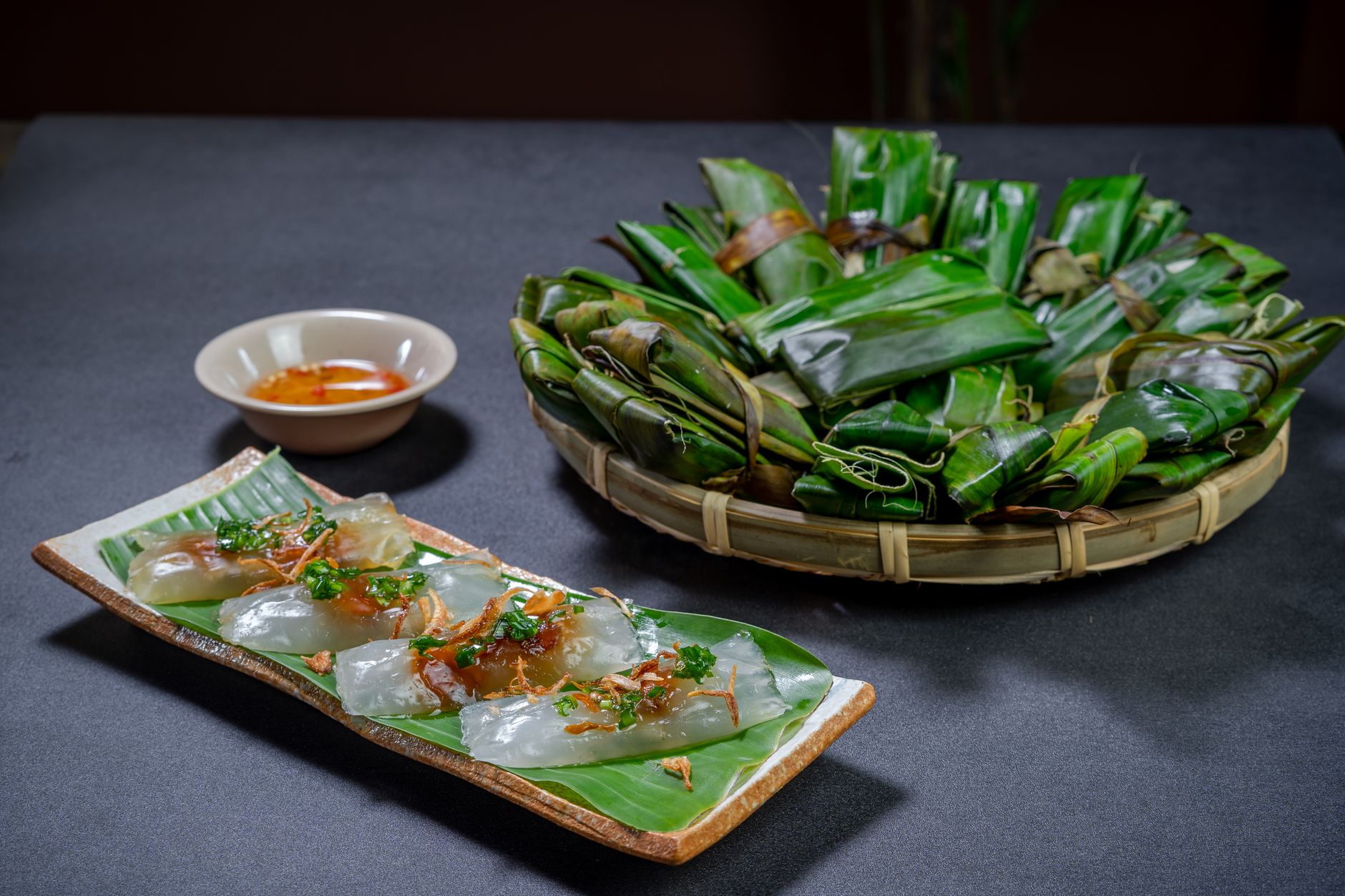
Photo by Hải Nguyễn on Pexels
The dipping sauce
Bot loc tom thit is always served with a small bowl of "nuoc cham" — a sweet-savory fish sauce made from fish sauce, lime juice, sugar, water, and crushed garlic and chili. Some versions add a little vinegar or even star fruit for tang. The sauce should taste balanced: salty, sour, sweet, and spicy all at once. You dip each dumpling into the sauce, sometimes grabbing a bit of pickled onion or daikon on the side.
Where to eat it in Hue
Bot loc tom thit isn't hard to find in Hue, but quality varies. The most reliable spots are the market stalls and small restaurants clustered around Dong Ba Market, near the Perfume River. Here you'll find vendors selling bot loc from around 8:00 AM until early afternoon — the dumplings are best eaten fresh and warm.
Thanh Huong is a long-running bot loc specialist on Tran Cao Van Street, near the citadel. A small plate of six dumplings costs around 25,000–35,000 VND (roughly US$1–1.40). The filling is generous, the tapioca skin is consistently thin, and the sauce is well-balanced. It's often crowded around mid-morning.
Com Hen, a vendor in Dong Ba Market, also serves solid bot loc tom thit alongside its signature corn-and-mussel rice ("com hen"). You can eat standing at a plastic stool or take it away. Similar price range.
If you're staying near the Old Town (around Hang Buom Street or the Perfume River), ask your hotel — many places will point you to a nearby stall that operates from a cart or a shopfront. Hue is small enough that good bot loc is rarely more than a five-minute walk away.
Photo by Hải Nguyễn on Pexels
Cost and timing
A plate of six to eight dumplings typically costs 25,000–40,000 VND, depending on the vendor and how generous the shrimp is. A plate of bot loc tran (without wrapper) might run slightly more, sometimes 30,000–45,000 VND, because it's plated as a more substantial dish.
Bot loc tom thit is a breakfast or mid-morning food in Hue. Most stalls stop selling by 11:00 AM or noon, and it's rare to find it fresh in the evening. If you're planning to eat it, go early — vendors often sell out, and leftover batches from earlier in the day are never as good as those steamed-to-order.
Bottom line
Bot loc tom thit is a textbook example of Hue's approach to food: refinement through restraint. There are only a few ingredients, the preparation is precise, and the result is a dumpling that tastes like shrimp and pork, nothing more. Eat it warm, dip it generously in fish sauce, and you'll understand why locals order it over and over.
Going to Vietnam? Eat and travel smarter.
Monthly: new dishes, off-the-beaten-path destinations, and itineraries — straight to your inbox. No spam. Unsubscribe anytime.
Join 0 expats. (We just launched.)
More from Hue
Other articles covering this city.

Best Banh Nam in Hue: Where Locals Send You
Hue's version of "banh nam" is a steamed rice cake pocket stuffed with shrimp and pork—nothing like its northern cousin. Here's where locals actually eat it.

Best Banh Khoai in Hue: Where Locals Send You
Hue's "banh khoai" — crispy, half-moon savory crepes — taste different here than anywhere else in Vietnam. Here's where locals actually eat them.

Where to Stay in Hue: Citadel vs South Bank vs Beach
Hue splits into three distinct neighborhoods for travelers. Each offers different trade-offs between history access, dining, and atmosphere—here's how to choose.
More from Central Vietnam
Other articles covering the same region.

Paradise Cave, Quang Binh: The 31km Marble Cave That Beats Phong Nha for Photographers
Paradise Cave runs 31km through Quang Binh's karst and delivers the kind of cathedral-scale formations that Phong Nha's boat tour simply can't match. Here's how to see it properly.

Son Doong Cave: What the $3,000 Oxalis Expedition Actually Includes
Son Doong is the world's largest cave and only one operator is legally allowed to take you inside. Here is what the permit-only expedition covers and whether it is worth it.

Phong Nha Cave: Wet Cave, Dry Cave, and How to Choose
Phong Nha has two main caves worth your time — one you reach by river boat, one on foot. Here's how to pick, what each costs, and when to go.
More in Food & Drink
More articles from the same category.

Best Tau Hu in Hoi An: Where Locals Send You
Tau hu—silky tofu soup—tastes different in Hoi An. Here's where locals actually eat it, and why.

Best Pho Chua in Ha Giang: Where Locals Send You
Ha Giang's take on sour pho is sharper, tangier, and less known than the southern version. Here's where locals actually eat it.

Best Pho Saigon in Ho Chi Minh City: Where Locals Send You
Pho Saigon is thinner, sweeter, and faster than its northern cousin. Here's where to find the real thing in HCMC, plus what makes it different and how to order.

Best Banh Xeo in Nha Trang: Where Locals Send You
Nha Trang's banh xeo scene is rowdier and greasier than the south. Here's where locals actually eat, what to order, and why the crispy rice pancakes here taste different.

Best Banh Uot Thit Nuong in Buon Ma Thuot: Where Locals Send You
Banh uot thit nuong — steamed rice rolls with grilled pork — is a breakfast staple in Buon Ma Thuot's Central Highlands. Here are the spots locals actually eat.

Best Banh Canh Ca in Da Nang: Where Locals Send You
Da Nang's version of "banh canh ca" — thick tapioca noodles in crab broth — tastes different from Hanoi or Saigon. Here's where locals actually eat it, what to order, and why timing matters.
Comments
Loading…