What makes cao lau different
"Cao lau (까오러우 / 高楼面 / カオラウ)" is a noodle dish from Quang Nam province, but you'll only find the authentic version in Hoi An. The noodles are thick, chewy, and yellow — not from turmeric or food coloring, but from lye water made with ash from a local tree. Traditionally, the rice is soaked in water from a specific ancient well in Hoi An, which locals insist gives the noodles their texture.
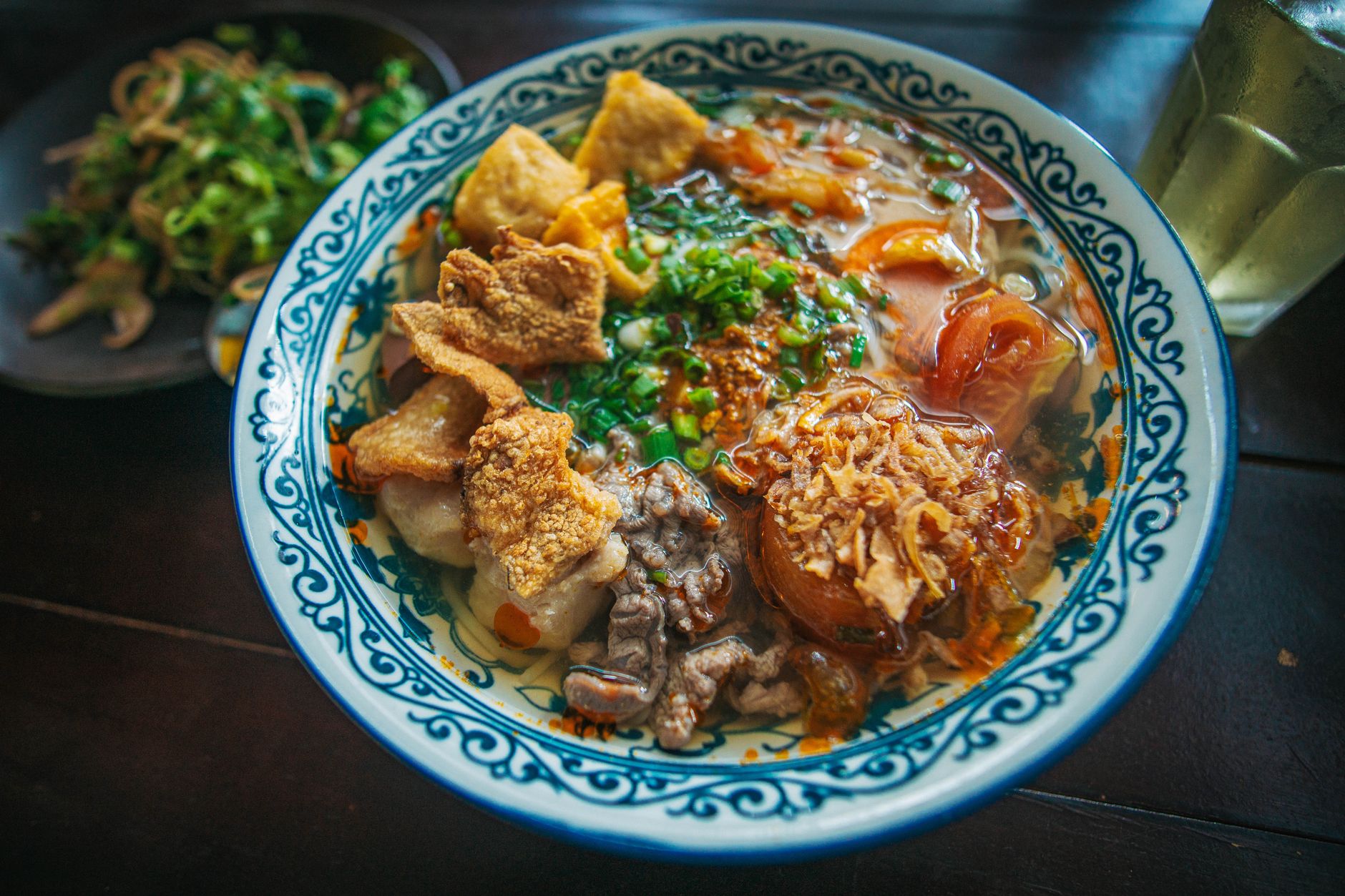
You get char siu-style pork ("xa xiu"), shrimp, fresh herbs (mint, basil, cilantro, lettuce), crispy croutons or pork cracklings, and just enough broth to moisten everything. It's not a soup — think dry noodle salad. The minimal broth lets each ingredient stand out instead of drowning in liquid.
If you've eaten "pho" in Hanoi or "bun bo Hue" in Hue, cao lau will feel like a different food category entirely. Those are broth-forward dishes. Cao lau is texture-forward — the chew of the noodle, the crunch of the crouton, the snap of fresh herbs. It has more in common with a composed salad than a noodle soup.
The history: Chinese and Japanese traders, 17th-century Hoi An
Cao lau showed up in Hoi An in the 1600s, when the city was a major Southeast Asian trading port. Chinese and Japanese merchants brought their own noodle traditions — cao lau is essentially a fusion of those influences, adapted over time to Central Vietnamese tastes.
The name translates to "high floor" or "upstairs," supposedly because diners originally ate it on upper floors of shophouses, looking down at the street. Whether that's true or folklore, the name stuck.
The Japanese connection shows up in the noodle itself. The thick, firm texture and the use of lye water echo certain Japanese udon and soba preparation methods. The char siu pork, on the other hand, is unmistakably Chinese — Cantonese traders brought that technique. Over four centuries in Hoi An's tropical climate, the dish absorbed local Vietnamese herbs and "nuoc mam"-based seasoning, becoming something none of the original trading cultures would fully recognize as their own. Walk across the Japanese Covered Bridge in the Ancient Town and you're literally crossing between the old Chinese and Japanese merchant quarters where cao lau was born.

Image by Christopher Crouzet via Wikimedia Commons (CC BY-SA)
Ingredients: why the noodles are yellow, and what else goes in
The noodles: Rice flour mixed with lye water (ash + water from a specific tree). The chemical reaction turns them yellow and gives them a firm, springy bite. Some vendors still swear by water from the Ba Le well in the Old Town, though modern cao lau shops use treated tap water with the same ash process. The ash traditionally comes from the "cau lao" tree found on the Cham Islands, about 18 km offshore from Hoi An (호이안 / 会安 / ホイアン). Vendors who still source from the islands consider it a point of pride.
Xa xiu pork: Marinated, slow-cooked, slightly sweet and savory. Cut into thin slices. The marinade typically includes five-spice powder, soy sauce, honey, and a touch of red fermented bean curd — the same base you'd find in a Cantonese char siu recipe, with minor local adjustments.
Shrimp: Usually boiled or sauteed, added whole or halved.
Herbs and greens: Mint, Thai basil, cilantro, lettuce. Fresh, not wilted. Some stalls add banana blossom or bean sprouts, though purists consider these additions from "mi Quang" territory.
Crispy bits: Either fried wonton strips or pork cracklings. Essential for texture. The best versions use pieces of the cao lau noodle itself, deep-fried until golden. These shatter on contact and soak up the broth without going soggy for about 30 seconds — which is why you should eat quickly after mixing.
Broth: Barely there — maybe 2-3 tablespoons of concentrated pork-shrimp stock, just enough to coat the noodles. This is not "pho".

Image by Steffen Schmitz (more photos) via Wikimedia Commons (CC BY-SA)
Where to eat cao lau in Hoi An
Cao lau is everywhere in Hoi An — street stalls, tourist restaurants, family kitchens. Here are three consistently good spots:
Quan Cao Lau Thanh (26 Thai Phien): Local favorite. Open early morning to mid-afternoon. Cash only. 30,000-40,000 VND per bowl.
Cao Lau Ba Le (45/3 Tran Hung Dao): Tiny shopfront, no English menu, excellent. Lunch and dinner. 35,000 VND.
Most Old Town restaurants: If you're eating at a sit-down place in the Ancient Town, they'll have cao lau on the menu. Expect 50,000-60,000 VND and slightly larger portions. Quality varies — look for places with a crowd of locals at lunch.
Street stalls along Tran Phu and Nguyen Thi Minh Khai also serve solid versions for 30,000-40,000 VND. If the noodles look pale white instead of yellow, walk away — that's not real cao lau.
The Hoi An Central Market (Cho Hoi An), on the corner of Tran Phu and Nguyen Hue, is another reliable option. Several food stalls inside the market serve cao lau from around 6:00 AM to 2:00 PM. Expect to share a low plastic table with locals eating breakfast. A bowl here runs 25,000-35,000 VND. Point at what someone else is eating if you can't read the menu — nobody minds.
How to eat it
Mix everything together before you take the first bite — noodles, pork, shrimp, herbs, crispy bits. The dish is designed to be tossed like a salad. Add lime juice (usually provided on the side) and chili sauce if you want heat. Some people add a splash of "nuoc mam", though the broth is already seasoned.
Don't expect slurpable soup. This is a dry noodle dish with just enough liquid to keep it from being bone-dry. If your bowl arrives swimming in broth, you're not eating cao lau — you're eating "mi Quang" with the wrong noodles.
A useful ordering phrase: "Cho toi mot to cao lau" (Give me one bowl of cao lau). If you want extra crispy bits, try "Them banh trang gion" — most vendors will toss in a handful for free or charge an extra 5,000 VND.
Cao lau vs. mi Quang: the Central Vietnamese noodle confusion
Visitors to Hoi An and Da Nang often mix up cao lau and "mi Quang" because both are yellow noodle dishes from Quang Nam province. They are not the same thing, and ordering one expecting the other will leave you confused.
Mi Quang uses flat, wide rice noodles dyed yellow with turmeric. Cao lau noodles are round, thicker, and turned yellow by lye water — completely different texture and flavor. Mi Quang comes with more broth (still not a full soup, but noticeably wetter), and the protein varies wildly: chicken, pork, shrimp, snakehead fish, frog, even eel depending on the region. Mi Quang is served with a large sesame rice cracker ("banh trang") on top, which you break into the bowl. Cao lau has no rice cracker — its crunch comes from fried wonton strips or pork cracklings.
The simplest test: if there's a big round cracker balanced on top of the bowl, it's mi Quang. If the noodles are firm and round with crispy shards mixed in, it's cao lau. Both are worth eating. Da Nang is a better city for mi Quang; Hoi An is the only place for real cao lau.
What surprises foreigners about cao lau
It's a breakfast dish. Most locals eat cao lau in the morning or at lunch. By 3:00 PM, the best stalls have sold out and closed. If you show up at dinner expecting peak cao lau, you'll get a restaurant version made for tourists — fine, but not the same.
The portion is small. A bowl of cao lau is not a meal for most Western appetites. It's maybe 250-300 grams total. Locals often eat it alongside a "banh mi" or follow it with a Vietnamese iced coffee") and a "banh xeo" from a nearby stall. Budget for two dishes at lunch if you're hungry.
You can't get the real thing outside Hoi An. Restaurants in Saigon and Hanoi occasionally put "cao lau" on the menu, but the noodles are wrong — they don't have the lye-water ash treatment, and the texture is soft instead of chewy. Some Hoi An noodle-making families have tried to ship their product to other cities, but the noodles don't travel well. They stiffen and crack within a day. This isn't gatekeeping; the dish is genuinely tied to its place of origin in a way that "com tam" in Saigon or "bun cha" in Hanoi are not.
The well matters less than the ash. Tour guides love the story about Ba Le Well and its magical water. The reality: the alkaline ash is what changes the noodle. The well water may have some mineral differences, but modern cao lau makers who use filtered tap water with the correct ash ratio produce noodles that taste and feel identical. The well is still worth a look — it's on an alley off Phan Chu Trinh street — but don't assume the noodle quality tracks to the water source.
There's no vegetarian version by default. The pork broth, xa xiu, and shrimp are standard. A few tourist-oriented restaurants in the Ancient Town offer tofu-based cao lau, but it's not traditional. If you're vegetarian, ask "Co cao lau chay khong?" (Do you have vegetarian cao lau?). Some places will accommodate; most street stalls won't.
Quick reference
- Dish: Cao lau — thick yellow lye-water rice noodles with char siu pork, shrimp, herbs, crispy croutons, minimal broth
- Where: Hoi An only. Not reliably available elsewhere in Vietnam.
- Price range: 25,000-40,000 VND at street stalls and markets; 50,000-60,000 VND at sit-down restaurants
- Best time to eat: Morning to early afternoon (6:00 AM - 2:00 PM). Many stalls close by 3:00 PM.
- Pair with: "Banh mi", "goi cuon" (fresh spring rolls), or a glass of "ca phe sua da"
- Nearby dishes to also try: "Mi Quang" (different noodle, more broth, turmeric-based), "com ga" (Hoi An chicken rice), "banh bao banh vac" (white rose dumplings)
- Ordering phrase: "Cho toi mot to cao lau" (Give me one bowl of cao lau)
- Dietary note: Not vegetarian by default. Ask for "cao lau chay" at tourist restaurants.
- Getting to Hoi An: 30 km south of Da Nang (45 minutes by taxi or Grab, roughly 250,000-350,000 VND). Da Nang has the nearest airport.
Final note
Cao lau is one of those dishes that rewards you for going to the source. You can read about the lye-water noodles and the centuries of Chinese-Japanese-Vietnamese layering, but none of it clicks until you're sitting on a plastic stool in Hoi An at 7:00 AM, tossing the noodles with chopsticks and hearing them creak against each other. Eat it early, eat it at a stall, and don't skip the crispy bits.
Last updated · May 29, 2026 · independently researched, never sponsored.