What pho is
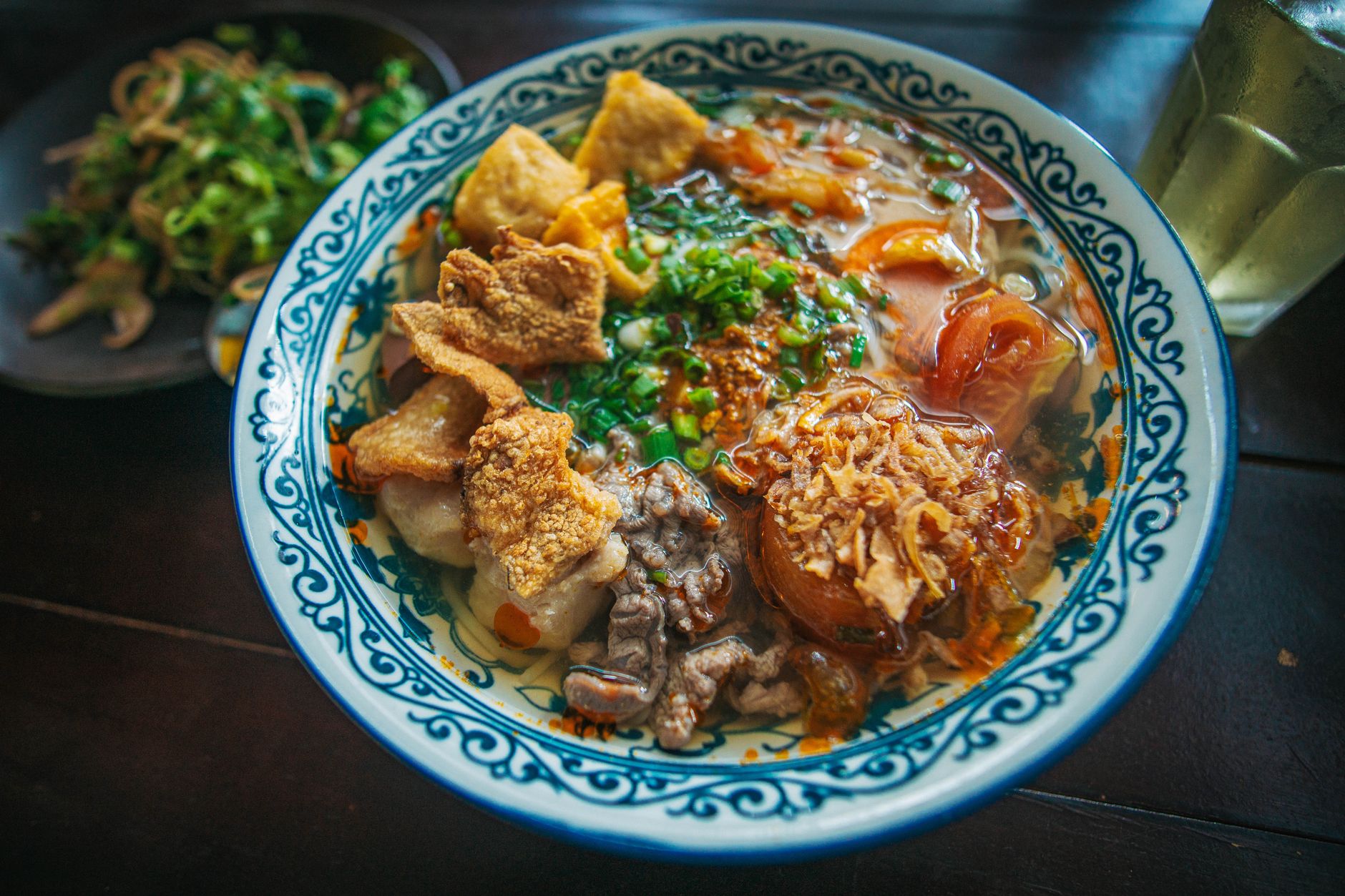
Pho (쌀국수 / 越南河粉 / フォー) is a bowl of flat rice noodles in bone broth with sliced beef or chicken, topped with green onions. The broth — beef bones, star anise, cinnamon, grilled ginger, black cardamom — is the whole game. You add lime, chili sauce, fish sauce, pepper at the table.
In Hanoi, you get the bowl straight. In the south, it arrives with a plate of bean sprouts, cilantro, basil, saw-leaf herb. You eat it for breakfast or after midnight. In big cities, vendors run all day.
Beef pho ("pho bo") and chicken pho ("pho ga") dominate, but you'll find "pho cuon" (rolled sheets, no broth), "pho sot vang" (wine-braised beef), "pho kho" (dry noodles), duck pho in Cao Bang, roasted pork pho in the northern mountains, sour pho in Gia Lai.
The broth
A good broth takes 12-18 hours. Beef leg bones, scrubbed clean, boiled once and drained to kill the funk. Second boil is the keeper. Add grilled ginger, grilled onion. High heat to rolling boil, then drop to bare simmer. Skim foam obsessively until the liquid runs clear.
Spices: star anise, cinnamon stick, black cardamom, coriander seed, cloves. Ratios are trade secrets. Before MSG, cooks used mantis shrimp ("tom he") for umami. Some throw in oxtail or dried shrimp.
The noodles are fresh rice sheets, cut into ribbons. Always served hot.

Image by Cheong. Original uploader was Cheong Kok Chun at en.wikipedi via Wikimedia Commons (CC BY-SA)
Where pho started
The earliest written reference is from 1827 — Pham Dinh Ho's Sino-Vietnamese dictionary annotates the Chinese phrase for a type of pancake with the Nom script for "banh pho bo" (beef noodle cake).
Modern pho likely emerged early 1900s in Hanoi or Nam Dinh. One story says Van Cu village (now Nam Dong commune, Ninh Binh (닌빈 / 宁平 / ニンビン) province) — the Co family cooked it and their descendants spread the recipe nationwide. The dish took off when Nam Dinh Textile Factory opened and workers needed cheap, filling breakfast.
In Hanoi, pho appeared around O Quan Chuong gate during French colonial times. That neighborhood was a dump site for beef bones from French households — locals scavenged them, simmered broth, sold bowls on the street. Some say pho descends from Cantonese "ngau yuk fan". Others point to French pot-au-feu — the beef-boiling method minus the European vegetables, plus Vietnamese spices.
Another theory: pho evolved from "xao trau" (buffalo soup with vermicelli), later adapted to beef and rolled rice sheets.
Writer Nguyen Cong Hoan recorded eating pho in 1913 in Hanoi at 8 Hang Hai street — 2 xu per bowl, some 3 xu, some 5 xu. Street vendors sang "pho day, pho o!" The word "pho" first appeared in print in the 1930 Viet Nam tu dien dictionary, defined as "thin noodles cooked with beef."
Chicken pho debuted 1939. Mondays and Fridays were no-beef days (likely tied to old feudal restrictions on slaughtering cattle — Vietnam's wet-rice agriculture needed the oxen). Vendors couldn't sell beef pho those days, so they switched to chicken. Both types have coexisted since.
Nutrition
18-20 ingredients per bowl. Calcium and gelatin from bones — good for joints, growth. Broth dissolves minerals (iron, zinc) and vitamins (B2, B3, B5) from spices. Beef brings amino acids, creatinine, carnitine, potassium for muscle. About 50% unsaturated fat, vitamin B12. Fresh noodles add 3 mg protein, 0.5 mg B1, 1.2 mg B5 per serving.
Herbs and lime on the side help regulate cholesterol.

Image by CEphoto, Uwe Aranas via Wikimedia Commons (CC BY-SA)
How to make the broth at home
- Parboil bones. Beef leg bones, cold water, full boil, drain. This kills the smell.
- Second boil. Fresh water, bones back in. Char ginger and onion over open flame until blackened, add to pot.
- Skim. High heat to rolling boil. Skim foam continuously. Add a splash of cold water, bring back to boil, skim again. Repeat until liquid is clear.
- Spices. Black cardamom (2-3 pods), star anise (3-4), cinnamon stick (5 cm), coriander seeds (1 tsp), cloves (3-4). Toast dry in a pan 2 minutes, then add to pot.
- Simmer. Drop to bare simmer — bubbles breaking surface every few seconds, not rolling. 12-18 hours. Top off water as it evaporates.
- Season. Fish sauce, rock sugar, salt to taste in the last hour.
- Strain. Discard bones and spice solids. Broth should be clear, pale amber.
Serve over fresh "banh pho" noodles, top with paper-thin raw beef (it cooks in the hot broth) or poached chicken, green onions, cilantro.
Where to eat it
Hanoi: Pho Thin (13 Lo Duc), Pho Gia Truyen Bat Dan (49 Bat Dan), Pho Suong (24B Trung Liet). Morning only, sold out by 10 a.m.
Ho Chi Minh City: Pho Hoa Pasteur (260C Pasteur), Pho Le (413-415 Nguyen Trai), Pho 2000 (1-3 Phan Chu Trinh — where Bill Clinton ate in 2000).
Nam Dinh: Pho Co Huong (Vi Xuyen ward) — descendants of the original Van Cu family recipe.
30,000-60,000 VND per bowl at street stalls, 80,000-150,000 VND in sit-down spots with A/C.
Last updated · May 29, 2026 · independently researched, never sponsored.