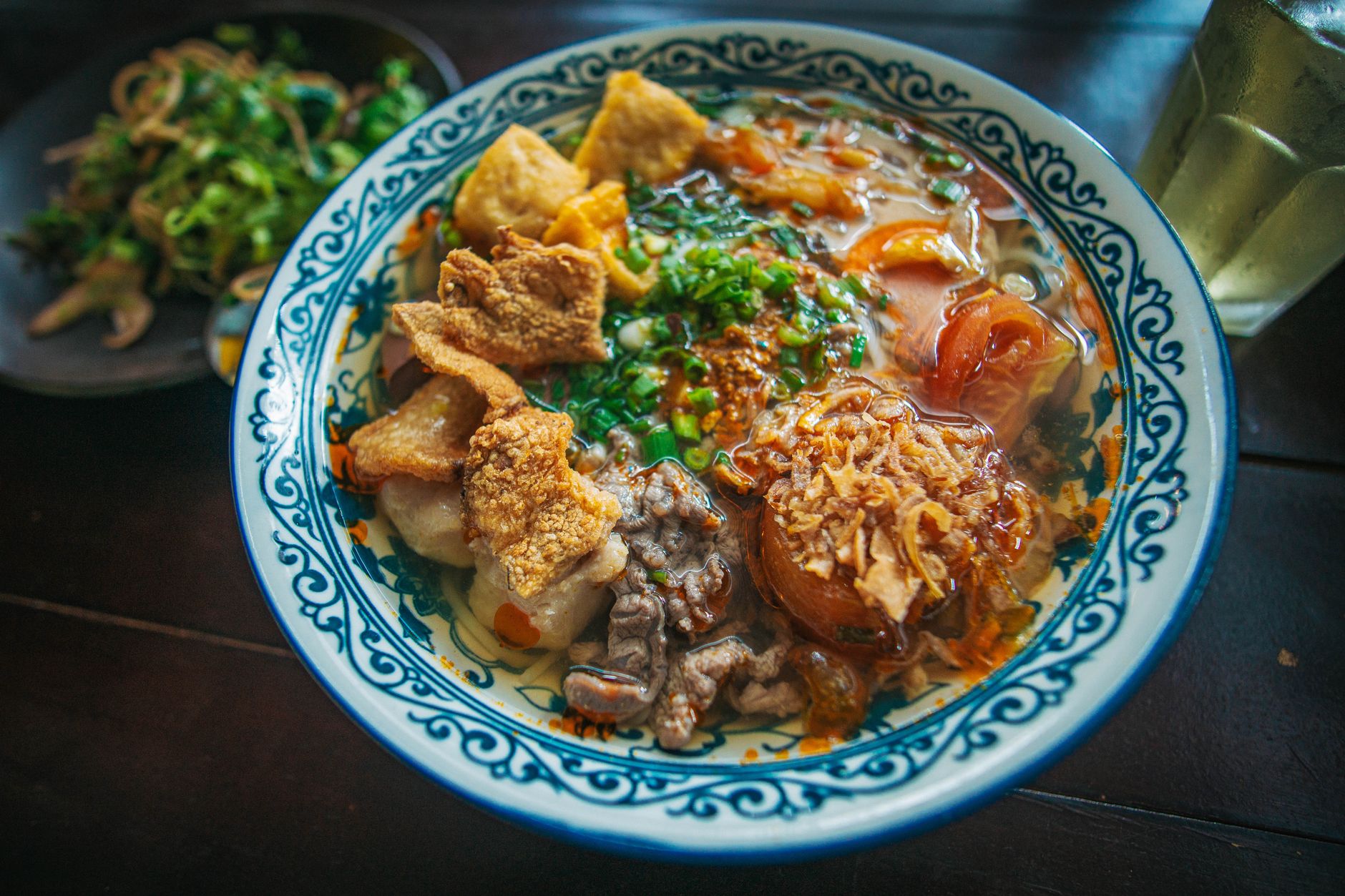
"Banh canh" is a noodle soup you'll find in every region of Vietnam, but the details — noodle flour, broth base, toppings — shift dramatically depending on where you order it. The dish originated in the southeast, likely in the Mekong Delta (메콩 델타 / 湄公河三角洲 / メコンデルタ) or Saigon area, and the standard formula is thick, short noodles (made from tapioca, rice flour, or a blend) cooked directly in a broth of shrimp, fish, or pork hock. What makes it distinct from "pho" or "bun" is the noodle texture: slippery, bouncy, almost chewy, with a diameter closer to udon than rice vermicelli.
The broth and toppings vary wildly. You might get "banh canh (반깐 / 粗米粉汤 / バインカイン) gio heo" (pork hock), "banh canh cha ca" (fish cake), "banh canh cua" (crab), or "banh canh ca loc" (snakehead fish). Each city has a version that locals defend as superior. Below, I'll walk through the most recognized regional styles, starting with the one that became a national brand.
Banh Canh Trang Bang — The Two-Bowl Method
Trang Bang is a district in Tay Ninh province, near the Cambodian border, and its banh canh is the only version that has earned official recognition: in 2021, the Vietnam Record Association named it to the Top 100 Vietnamese Specialty Dishes 2020-2021. The origin story, as locals tell it, goes back to the early 20th century when a woman in Trang Bang sold noodle soup from an earthenware pot, ladling broth with a coconut shell. Her children and neighbors learned the recipe, and over decades it became synonymous with the town.
What makes Trang Bang's version different is the noodle flour. Traditionally, cooks used Mong Chim, Bang Phet, or Bang Mien rice — Cambodian varieties that produce terrible steamed rice but excellent noodles with a springy, chewy texture that lasts two to three days without refrigeration. Those rice types are low-yield, so most vendors now use Nang Thom, Nang Mien, or Cho Dao rice instead. The noodles are still thick, white, and slippery.
The broth is pork-based, simmered with pork hock until the collagen thickens it slightly. You get a bowl of noodles and broth, plus a second small bowl with sliced boiled pork hock, coriander ("ngo ri", not the sawtooth variety), fried shallots, and a dish of fish sauce spiked with black pepper, lime, and chili. The two-bowl setup — one for noodles, one for meat and herbs that you dip separately — is the signature Trang Bang move, and locals call it "banh canh hai to" (two-bowl banh canh). You'll often see it served with "banh trang phoi suong", a translucent rice paper cracker that's another Tay Ninh specialty.
If you're in Tay Ninh or passing through on the way to the Cao Dai temple, stop in Trang Bang town. Most vendors are along the main road; look for the two-bowl setup and the stack of rice paper crackers on the table.
Banh Canh Gio Heo — Pork Hock Everywhere
Outside Trang Bang, the most common version nationwide is banh canh gio heo. You'll find it in Saigon, Binh Duong (especially Thu Dau Mot), and scattered across the south. The noodles are usually tapioca-based, thicker and more translucent than the rice-flour Trang Bang style. The broth is pork hock stock, sometimes with a splash of shrimp or crab paste for umami. Toppings: sliced pork hock, quail eggs, "cha lua" (Vietnamese pork sausage), green onions, and black pepper.
In Binh Duong, the local style leans heavier on the hock — you get bigger, meatier pieces, and the broth is richer, almost gelatinous from the collagen. Saigon vendors tend to lighten it up with more herbs and lime.

Image by Nijumania at English Wikipedia via Wikimedia Commons (CC BY-SA)
Coastal Versions — Fish Cake and Snakehead Fish
On the central coast, banh canh shifts toward seafood.
Banh canh "cha ca" Phan Rang (Phan Rang-Thap Cham, Ninh Thuan) uses mackerel or flying fish pounded into a paste, shaped into cakes, and poached in the broth. The noodles are tapioca, and the broth is fish stock with a faint sweetness from rock sugar. You'll get sliced fish cake, sometimes whole shrimp, and a handful of sawtooth coriander.
Banh canh cha ca Phu Quoc (Phu Quoc island) is similar but uses local reef fish — often red snapper or grouper — and the fish cakes are firmer, less airy. The broth is lighter, closer to a clear fish soup than the heavier pork-based southern versions.
Banh canh ca loc (snakehead fish) is popular in Quang Binh, Quang Tri, and Saigon. The fish is grilled or fried first, then flaked into the broth. The result is smoky, oily, with a darker, more caramelized flavor than raw-fish versions. Saigon vendors often add tomato slices, which isn't traditional but cuts the richness.
Central and Northern Outliers
Banh canh xu Hue (Hue style) is thinner, closer to "bun bo Hue" in flavor — lemongrass, annatto oil, beef or pork hock, and a spicy, sour broth. The noodles are tapioca but cut thinner than southern versions. You'll find it at Hue street stalls in the morning, often labeled "banh canh Hue" to distinguish it from the southern styles.
Banh canh Bich Son (Binh Dinh province) uses a pork-and-shrimp broth with quail eggs and pork sausage. The noodles are somewhere between Trang Bang and standard tapioca — slightly thicker, slightly chewier.
Banh canh Ben Co (Tra Vinh province) is a Mekong Delta version with crab and pork ribs in the broth. It's saltier, less sweet than Saigon styles, and the noodles are rice-flour, not tapioca.
Banh canh Phu Yen is another coastal variant, similar to Phan Rang but with more emphasis on whole shrimp and crab claws in the bowl.

Image by E. Dufrénoy (Paris) via Wikimedia Commons (CC BY-SA)
What to Expect When You Order
Banh canh is almost always a breakfast or lunch dish, sold from street stalls or small shopfronts. Expect to pay 30,000–50,000 VND in the provinces, 40,000–70,000 VND in Saigon or Hanoi. The noodles should be chewy but not gummy; if they're mushy, the vendor overcooked them. The broth should taste like whatever protein is in it — pork, shrimp, fish — not like MSG and water.
Most vendors will ask if you want your bowl "du" (full toppings) or "it" (light). Go du the first time. You'll get a plate of herbs on the side — usually sawtooth coriander, Thai basil, lime wedges, and sliced chili. Add them yourself.
If you see banh trang phoi suong on the table, dip it in the broth. It softens just enough to stay crispy at the edges, and the slight sweetness balances the salty broth.
Where to Start
If you're in Tay Ninh, go to Trang Bang town and look for stalls on Quoc lo 22. Most open at 6:00 a.m. and sell out by noon.
In Saigon, try the banh canh ca loc vendors in District 5 (Cho Lon) or the banh canh gio heo stalls in District 1 around Ben Thanh Market.
In Phan Rang, ask for banh canh cha ca near the central market (Cho Phan Rang). Most stalls open early, around 5:30 a.m.
In Hue, look for banh canh xu Hue near Dong Ba Market. It's spicier than you expect.
Banh canh isn't a single dish — it's a noodle-broth template that every region has adapted to local ingredients and preferences. If you eat it in three different cities, you'll get three different bowls. That's the point.
Last updated · May 29, 2026 · independently researched, never sponsored.