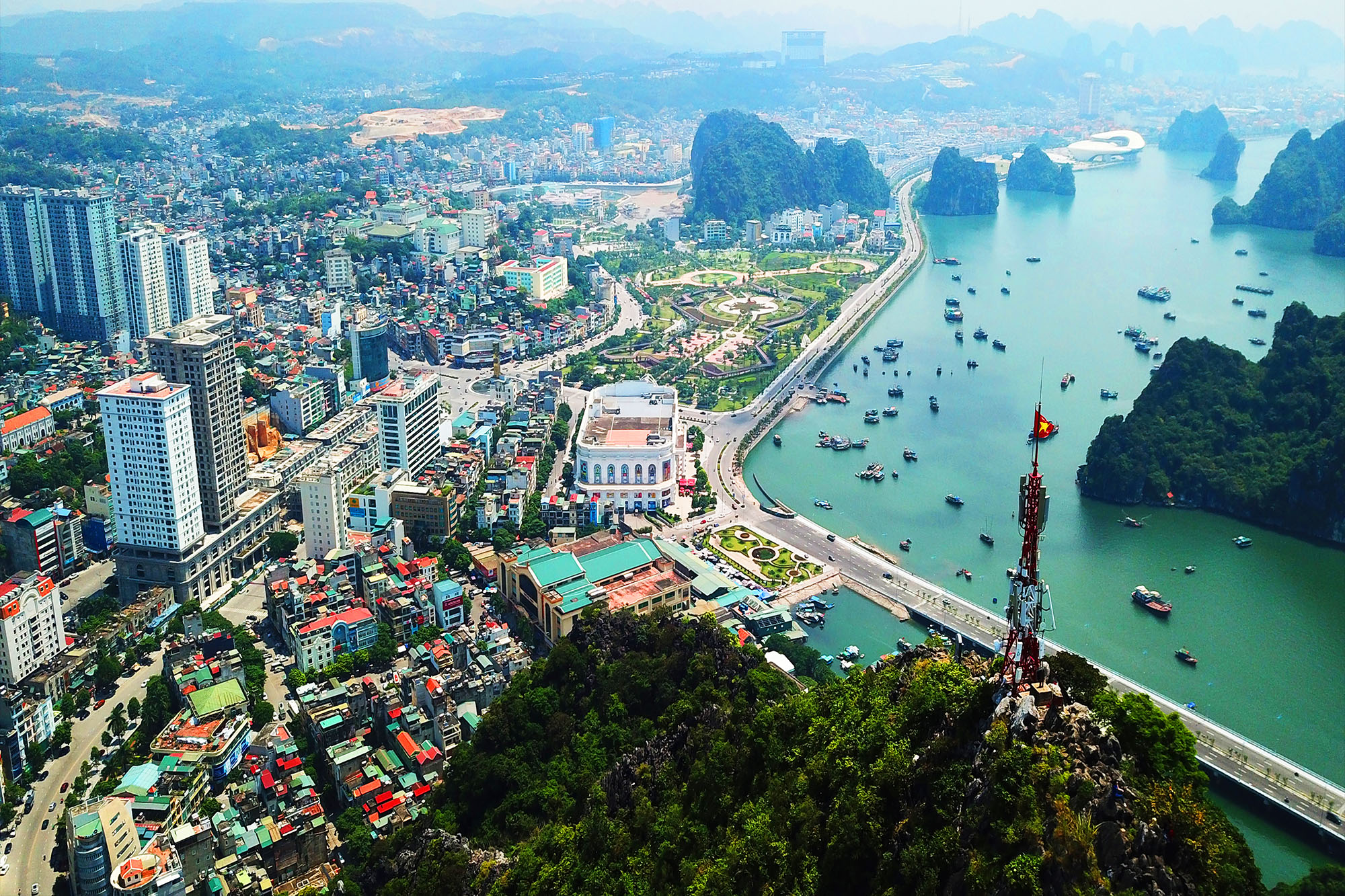
Ha Long City, the capital of Quang Ninh province, is the primary gateway to Ha Long Bay—one of Vietnam (베트남 / 越南 / ベトナム)'s most visited natural attractions. Located approximately 178 km (111 miles) east of Hanoi, this coastal city has undergone a dramatic economic transformation since 2012, shifting from coal mining to tourism. With a 2019 population of 270,054, Ha Long functions as both a major tourist hub and a strategic economic center in northern Vietnam.
The city was officially formed in 1993 by merging Hon Gai (the old administrative capital) with Bai Chay (the tourist zone). This dual structure remains visible today: Hon Gai to the east houses government buildings and residential neighborhoods, while Bai Chay to the west concentrates hotels, resorts, and cruise ports. The Bai Chay Bridge connects the two halves, literally and symbolically bridging the city's administrative and tourism functions.
Hon Gai: The Administrative Heart
Hon Gai is where locals live and government operates. You'll find traditional markets, residential blocks, and a slower pace than Bai Chay. The Hon Gai Catholic Church, perched on a hill near the main post office, remains an active place of worship with Sunday evening masses and services on Christian holidays. For visitors seeking authentic daily life away from cruise-ship crowds, walking Hon Gai's streets offers a genuine glimpse of how residents navigate this former industrial city.
The neighborhood around Ha Long Market on the Hon Gai side is worth a morning. Vendors start setting up around 5:30 AM, and by 7:00 AM the seafood section is in full swing—live crabs, prawns, and clams pulled from the bay that morning. Prices here run noticeably lower than anything on the Bai Chay waterfront. A kilo of fresh prawns goes for around 150,000–250,000 VND depending on size and season, roughly half of what tourist restaurants charge for a cooked plate. If you want breakfast the way locals eat it, look for the "pho" stalls clustered on the streets south of the market. A bowl runs 35,000–50,000 VND, and the broth tends to be lighter and more seafood-influenced than what you get in Hanoi's Old Quarter.
Bai Chay: The Tourism Zone
Bai Chay is purpose-built for visitors. Hotels and resorts cluster here; cruise operators launch tours from its waterfront; the Bai Chay Trading Center and Hoang Gia Park occupy prime locations. The Sun World complex offers rides and entertainment. The contrast between these two districts is stark—and worth experiencing both to understand Ha Long's transformation.
Most travelers book their Ha Long Bay cruises from Bai Chay's tourist wharf or the newer Tuan Chau Marina about 8 km west. Budget day-trip boats depart from the tourist wharf starting around 8:00 AM—expect to pay 250,000–400,000 VND per person for a basic 4-hour loop. Mid-range and luxury overnight cruises typically depart from Tuan Chau between 11:30 AM and 12:30 PM. If you arrive the night before your cruise, Bai Chay has accommodation at every price point: hostels from 150,000 VND per bed, mid-range hotels in the 500,000–900,000 VND range, and resort rooms starting around 1,500,000 VND. The Bai Chay beach promenade is pleasant for an evening walk, though the beach itself is man-made and compact. Street food vendors line the walkway after dark, selling grilled squid ("muc nuong") for 40,000–80,000 VND a skewer and "banh mi" loaded with pate and pickled vegetables for 20,000–30,000 VND.

Image by Thomas Hirsch / User:Ravn via Wikimedia Commons (CC BY-SA)
Location and Accessibility
Ha Long's 50 km of coastline and position on Ha Long Bay gives it natural advantages. The city sits roughly 160 km northeast of Hanoi, 60 km east of Hai Phong, and 180 km southwest of the Mong Cai border gate with China. Van Don International Airport, 50 km east, offers air connections. Highway links to Hanoi, Hai Phong, and Mong Cai (completed in 2022) make overland travel straightforward for domestic and international visitors.
The most common route from Hanoi (하노이 / 河内 / ハノイ) is the Ha Long–Hai Phong Expressway, which has cut travel time to around 2.5 hours by car or shuttle bus. Limousine vans depart from My Dinh bus station and various Old Quarter pickup points throughout the day, charging 200,000–350,000 VND one way. Standard public buses from Bai Chay bus station connect to Hai Phong (about 1.5 hours, 80,000 VND), Ninh Binh (about 4 hours), and Mong Cai (about 3 hours). If you are heading south afterward, Hai Phong is your transfer hub for trains and flights to Da Nang, Hue, and Saigon.
Historical Arc
The Ha Long area has been inhabited since the Stone Age. Archaeological evidence points to the Soi Nhu, Ha Long, and Cai Beo cultures as early residents. The site was once a fishing village called Bai Hau ('Oyster Coast'), later renamed Mau Le during the Nguyen Dynasty. French colonial rule (from 1883) brought coal mining and the name Hon Gai, which stuck. After 1945, Hon Gai became the hub of a vast coal mining district; by 1963, it was designated the capital of newly formed Quang Ninh province. On December 27, 1993, Hon Gai gained city status and was renamed Ha Long, incorporating Bai Chay. In 2019, the city expanded again to include Hoanh Bo district.

Image by Syced via Wikimedia Commons (CC BY-SA)
Economy: From Coal to Tourism
The shift from mining to tourism accelerated in 2012. Today, Ha Long's economy spans five sectors: trading and services, industry and forestry, seaports, tourism, and agriculture-fishery. By 2002, the city generated over VND 16 trillion (at 1994 prices), contributing 38% of Quang Ninh's provincial output. Tourism and services accounted for 53% of that figure; industry and construction, 31%. The city hosts around 1,470 manufacturing units including shipbuilding, building materials, mechanics, wood processing, food, and garments. Industrial zones at Cai Lan (home to Cai Lan Port, one of North Vietnam's largest), Dong Dang, and Ha Khanh remain active. The Tuan Chau cruise port underscores the maritime-tourism priority.
Eating in Ha Long City
Ha Long is not a famous food city the way Hanoi or Hoi An are, but the seafood here is genuinely good and cheap by coastal Vietnam standards. The local specialty is "cha muc"—grilled or fried squid cake, dense and bouncy, served with chili sauce and rice. You will see it on nearly every restaurant menu in both Hon Gai and Bai Chay; a plate runs 60,000–120,000 VND. The night market area along Bai Chay's waterfront has sit-down seafood restaurants where you pick your fish, crab, or shellfish from tanks and pay by the kilo. Expect to spend 300,000–600,000 VND per person for a full seafood dinner with beer.
Beyond seafood, the standard northern Vietnamese lineup is well represented. "Bun cha" stalls appear mostly on the Hon Gai side, particularly along Nguyen Van Cu street—a plate with noodles and a side of "cha gio" (fried spring rolls) comes to about 50,000–70,000 VND. For "com tam" (broken rice) and southern-influenced dishes, check the streets around Loong Toong lake. Morning "banh cuon" (steamed rice rolls) vendors are scattered across both districts, charging 25,000–40,000 VND per serving.
Coffee culture here mirrors the rest of northern Vietnam. "Ca phe" shops are everywhere, and "ca phe sua da" (iced milk coffee) costs 20,000–35,000 VND at local spots. If you want to try "egg coffee"—Hanoi's signature drink—a few newer cafes along the Bai Chay promenade have added it to their menus, though purists will tell you to wait until you reach Hanoi for the real thing.
When ordering at local restaurants, a few Vietnamese phrases go a long way: "Cho toi xem menu" (Can I see the menu), "Tinh tien" (The bill, please), and "Khong bo ot" (No chili) if you need to dial down the heat. Most tourist-zone restaurants have picture menus or basic English, but Hon Gai eateries rarely do.
Beyond the Bay: Local Attractions
Mount Bai Tho, with its nearly vertical limestone face overlooking the bay's southern edge, is the most striking landmark. Historically, local poets drew inspiration from its views; today, it offers panoramic vistas and diverse flora. Tuan Chau Island is accessible for island tours. The Quang Ninh Museum and Library provide regional history. The Vietnam-Japan Cultural House and Children's Cultural House host exhibitions and events. Ha Long Market buzzes with local produce, seafood, and goods—a visceral introduction to daily commerce.
The Quang Ninh Museum deserves a specific mention. Designed by Spanish architect Salvador Perez Arroyo, the building itself is worth seeing—a black glass cube sitting on the waterfront. Inside, exhibits cover the geological formation of Ha Long Bay, the region's coal mining heritage, and ethnic minority cultures of Quang Ninh province. Entry is 30,000 VND for adults. It is open Tuesday through Sunday, 8:00 AM to 5:00 PM (closed Mondays). Budget about 1.5 hours for a full visit. The attached library, in a matching adjacent building, is free to enter and has a reading room with bay views—a good spot to escape the midday heat.
For travelers with an extra day, consider a trip to Yen Tu Mountain, about 55 km west of Ha Long City. This is one of Vietnam's most important Buddhist pilgrimage sites, home to a network of pagodas and temples dating back to the Tran Dynasty (13th century). The cable car runs from the base to the Hoa Yen Pagoda station (one way around 200,000 VND), though committed hikers walk the 6 km trail to the summit at 1,068 meters. Go on a weekday if you can—weekends and festival periods (especially Lunar New Year through March) draw enormous crowds.
Common Mistakes and What Surprises Foreigners
Booking the wrong cruise port. Some travelers assume all cruises leave from the same place. They do not. Budget day boats leave from the Bai Chay Tourist Wharf, while most mid-range and luxury overnight cruises depart from Tuan Chau Marina or Got Pier. Confirm your pickup point with your operator the day before.
Skipping Ha Long City entirely. Many visitors treat the city as a transit point—arrive, board cruise, leave. That is fine if you are short on time, but you miss the seafood, the market, and the Quang Ninh Museum. Even one extra night gives the city a chance to show more than a hotel lobby.
Expecting Bai Chay beach to rival central Vietnam. The beach is small and man-made. If beach time is your priority, you are better off heading to Da Nang, Phu Quoc, or even Cat Ba Island next door. Bai Chay beach works for a quick dip or a sunset walk, not a beach holiday.
Overpaying for seafood. Tourist-facing restaurants in Bai Chay can charge double what you would pay in Hon Gai or at local spots a few blocks inland. Always check the per-kilo price before ordering live seafood, and confirm the total before the kitchen starts cooking. This is standard practice, not rude.
Ignoring weather windows. Ha Long City has cool, foggy winters (December through February) when bay visibility can drop sharply and some cruise operators reduce schedules. The best weather window for bay cruises is October through early December—clear skies, cooler temperatures, lower humidity. The summer months (June through August) are warm and busy; afternoon thunderstorms are common but usually pass quickly.
Not bringing cash. Bai Chay hotels and upscale restaurants accept cards, but Hon Gai markets, street food vendors, and smaller shops are cash-only. ATMs are scattered across both districts. Withdraw VND in Hanoi or at the airport if you want to avoid any hassle on arrival.
Quick Reference: Ha Long City at a Glance
- Location: 178 km east of Hanoi, 60 km east of Hai Phong, Quang Ninh province
- Getting there: 2.5 hours by expressway from Hanoi; limousine vans 200,000–350,000 VND one way; Van Don Airport 50 km east
- Districts: Hon Gai (east, local life) and Bai Chay (west, hotels and cruises), connected by Bai Chay Bridge
- Cruise departure points: Bai Chay Tourist Wharf (day trips), Tuan Chau Marina (overnight cruises), Got Pier (some luxury operators)
- Budget hotel: 150,000–500,000 VND/night (Bai Chay hostels and guesthouses)
- Mid-range hotel: 500,000–1,500,000 VND/night
- Local meal: 40,000–80,000 VND)
- Seafood dinner: 300,000–600,000 VND per person
- Best weather for cruises: October–early December
- Must-see in city: Quang Ninh Museum (30,000 VND entry, closed Mondays), Ha Long Market, Mount Bai Tho
- Day trip: Yen Tu Mountain (55 km west, cable car ~200,000 VND one way)
- Currency note: Cash preferred outside Bai Chay hotels; ATMs available in both districts
Frequently Asked Questions
How far is Ha Long City from Hanoi, and how do I get there?
Ha Long City sits approximately 178 km east of Hanoi. Most travelers reach it by road, with the journey taking roughly 3 to 4 hours depending on traffic and transport type. Once there, the Bai Chay district handles most tourist arrivals, with cruise operators running tours from the tourist wharf or Tuan Chau Marina, located about 8 km west of central Bai Chay.
What is the difference between Hon Gai and Bai Chay districts in Ha Long City?
Ha Long City was formed in 1993 by merging two areas with distinct functions. Hon Gai, to the east, is the administrative side — government buildings, residential neighborhoods, local markets, and pho stalls where a bowl costs 35,000–50,000 VND. Bai Chay, to the west, is the tourism zone, concentrated with hotels, cruise departure points, and entertainment complexes. The Bai Chay Bridge connects the two districts.
When do Ha Long Bay cruise boats depart from Ha Long City?
Departure time depends on cruise type. Budget day-trip boats leave from the Bai Chay tourist wharf starting around 8:00 AM, covering a basic 4-hour loop for 250,000–400,000 VND per person. Mid-range and luxury overnight cruises depart from Tuan Chau Marina between 11:30 AM and 12:30 PM. Staying in Bai Chay the night before is practical, with accommodation ranging from 150,000 VND per hostel bed to 1,500,000 VND for resort rooms.
Final Note
Ha Long City is not just a dock where you wait for your cruise. It is a real, working northern Vietnamese city with its own neighborhoods, food, and rhythm. Give it a night, eat the squid cake, walk the Hon Gai market at dawn, and you will understand why the locals here are proud of more than just the bay outside their window.
Last updated · May 29, 2026 · independently researched, never sponsored.