Linh Ung Pagoda Son Tra: The 67m Lady Buddha Watching Over Da Nang Bay
On the forested slopes of Son Tra peninsula, a 67-metre white Buddha figure stands visible from almost anywhere in Da Nang — and the pagoda grounds are free to enter.

Standing at 67 metres, the Lady Buddha at Linh Ung Pagoda is the tallest statue of its kind in Vietnam (베트남 / 越南 / ベトナム) — and on a clear day, she's visible from the beach, the bridges, and half the city. The pagoda sits on the western slope of Son Tra peninsula, about 10 km northeast of Da Nang's centre, and admission costs nothing.
Getting There
By Motorbike
This is the best option if you want to enjoy the Son Tra peninsula route properly. From Da Nang (다낭 / 岘港 / ダナン) city centre, cross the Han River heading east toward My Khe Beach, then follow Hoang Sa road north as it curves onto the peninsula. The road climbs steadily through dense jungle, with the sea appearing through the trees on your left. Budget around 20–25 minutes from the centre depending on where you start. Parking at the pagoda is 5,000–10,000 VND.
The road is well-paved but has tight bends as it gains elevation. Go slowly — not just for safety, but because red-shanked douc langurs (the peninsula's resident primate population) sometimes cross the road or sit in the canopy along the upper stretches. These are not monkeys you'll see anywhere else in the Da Nang area; Son Tra holds one of the last significant douc populations in central Vietnam. If you stop and stay quiet, you have a reasonable chance of spotting them, especially in the early morning.
By Taxi or Grab
A Grab car from central Da Nang runs 80,000–120,000 VND one way depending on your starting point. A Grab Bike is cheaper — around 40,000–60,000 VND — though the winding road makes the back of a motorbike uncomfortable if you're not used to it. Most drivers know Linh Ung Son Tra; if there's confusion, clarify "Son Tra" since there are two other Linh Ung pagodas in the Da Nang area (one on the Marble Mountains, one on Bana Hills).
Getting a return ride can be tricky. The pagoda doesn't have taxis waiting. Either arrange your Grab driver to wait (negotiate a fare), or book a return trip from the parking area — signal is generally fine at the top.
The Pagoda Grounds
Linh Ung Son Tra was completed in 2010, so this is not an ancient site. What it lacks in historical depth it makes up for in scale and setting. The complex is built across several levels on the hillside, with ornate gates, a large lotus pond, and 18 Arhat statues lining a long covered corridor — each figure painted in detail and slightly different from the last.
The Lady Buddha herself — Quan The Am Bo Tat, the Bodhisattva of Compassion — faces out to sea, one hand raised toward Da Nang Bay. She's hollow: there are 17 floors inside with small altars on each level, though access to the interior is not always open to the public. Even from the base, the scale is genuinely impressive. The white figure against blue sky or morning mist is the view most photos from Da Nang are taken from.
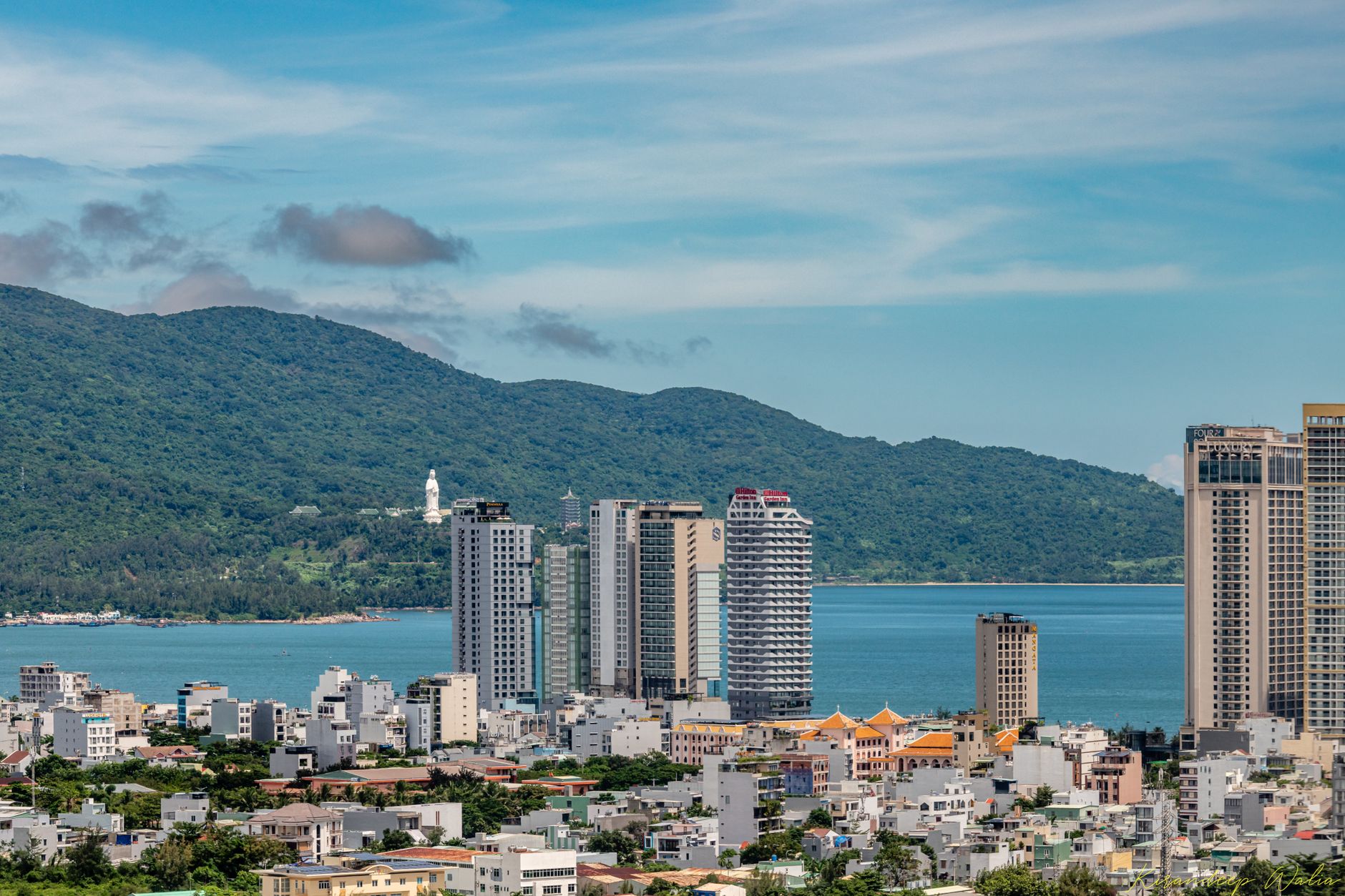
Photo by Kirandeep Singh Walia on Pexels
The View
From the main terrace in front of the statue, you can see the full arc of My Khe Beach stretching south, the Han River mouth, Da Nang city spreading inland, and on clear days the Marble Mountains sitting low on the southern horizon. To the east, the South China Sea opens out. The viewing angle is wide enough that you don't need to scramble anywhere — just stand at the base of the statue.
The view is best in the morning before haze builds. By midday in the dry season (roughly February to August), heat shimmer reduces visibility and direct sun makes the white stone uncomfortable to stand near. Late afternoon has softer light for photos.
Best Time to Visit
Early morning (7–9am) is the quietest and coolest window. Tour buses from Da Nang and Hoi An typically arrive from around 9:30am onward, and by 10am the main terrace gets crowded.
Avoid visiting during heavy rain. The access road has exposed sections with steep drops, and wet conditions make the drive up genuinely risky on a motorbike. Da Nang's rainy season runs roughly October to January — visiting during this period is possible but check forecasts.
The pagoda is an active place of worship and sees large local crowds on the 1st and 15th of each lunar month, and during major festivals including Tet. These days bring atmosphere but also serious traffic on the mountain road.

Photo by Kirandeep Singh Walia on Pexels
What to Know Before You Go
Dress modestly. Shoulders and knees should be covered inside the prayer halls. Sarongs are sometimes available to borrow at the entrance, but bringing your own is more reliable.
There are small food stalls and drink vendors in the parking area — iced tea and coconut water for around 15,000–20,000 VND. Don't expect a proper cafe.
The pagoda is free to enter. No booking, no guided tour required.
Combine the visit with a loop of Son Tra peninsula if you have a motorbike and a morning free — the coastal road offers views of the bay from multiple angles and takes around 45 minutes to complete the full circuit from Da Nang and back.
Practical Notes
Linh Ung Pagoda Son Tra is open daily from around 7am to 9pm. The drive up takes 20–25 minutes from Da Nang's centre; allow at least 90 minutes total for a relaxed visit. If you're also spending time in Da Nang, it pairs well with an afternoon on My Khe Beach or a meal along the Han River waterfront.
Going to Vietnam? Eat and travel smarter.
Monthly: new dishes, off-the-beaten-path destinations, and itineraries — straight to your inbox. No spam. Unsubscribe anytime.
Join 0 expats. (We just launched.)
More from Da Nang
Other articles covering this city.

Best Banh Xeo in Da Nang: Where Locals Send You
Crispy "banh xeo" pancakes in Da Nang are thinner and more delicate than the southern versions, with a lighter turmeric bite. Here's where locals actually eat them.

Grab vs Be vs Xanh SM: Which Ride-Hailing App to Use in Vietnam
Three ride-hailing apps dominate Vietnam. Here's how they differ on price, coverage, payment, and which one makes sense depending on where you are and what you value.

5 Days in Hoi An and Phu Quoc: A Honeymoon Itinerary
A romantic five-day itinerary blending Hoi An's lantern-lit riverside charm with Phu Quoc's island beaches and water activities—designed for couples.
More from Central Vietnam
Other articles covering the same region.

Ca Phe Buon Ma Thuot: Where Vietnamese Robusta Comes From
Buon Ma Thuot in Dak Lak province grows roughly 30% of the world's robusta coffee. Here's what that means for your cup and how to explore it on the ground.

Muc Mot Nang Phan Thiet: The Half-Dried Squid Vietnam's Coast Obsesses Over
Half-dried under a single sun, squid from Phan Thiet and Mui Ne hits a texture no fresh or fully dried version can match — here's what it is, where to buy it, and how to cook it.

Yen Sao Khanh Hoa: Edible Bird's Nest, the Real Thing vs the Tourist Trap
Khanh Hoa produces some of the world's most prized edible bird's nests — but the tourist market is full of fakes. Here's how to buy the real thing.
More in Destinations
More articles from the same category.

Bat Trang vs Phu Lang vs Chu Dau: Vietnam's Three Ceramic Villages Compared
Three villages, three completely different traditions in clay. Here's how Bat Trang, Phu Lang, and Chu Dau compare — and how to visit each from Hanoi.

Tet Nguyen Dan: What Really Happens During Vietnam's Lunar New Year Week
Tet shuts Vietnam down and lights it back up simultaneously. Here's what actually unfolds day by day — and how to navigate it as a visitor.

Hat Xam: The Blind Beggar Music of Vietnam Making a Comeback
Hat xam was sung by blind street performers for centuries — then nearly vanished. Here's where to hear it live in Hanoi today.

Vietnamese Calligraphy: The Ong Do Tradition and Where to Commission a Piece
Vietnam's 'ong do' calligraphy tradition peaks at Tet but survives year-round. Here's the history, where to find calligraphers in Hanoi and Saigon, and how to commission a piece.

Van Phuc Silk Village: The 1000-Year Loom Town Just Outside Hanoi
Twelve kilometers southwest of Hanoi's Old Quarter, Van Phuc has been weaving silk for over a millennium — and it's still the best place in the north to buy the real thing.

Son Mai: Vietnam's Lacquer Art, From Temple Walls to Hanoi Galleries
Son mai lacquerware is one of Vietnam's most technically demanding crafts. Here's how it's made, who the key artists are, and where to find the real thing in Hanoi.
Comments
Loading…