Hoa Lu Ancient Capital: Vietnam's First Kingdom and How to Visit from Ninh Binh
Hoa Lu was Vietnam's first royal capital, and the two temple complexes that survive are among the most atmospheric historical sites in the north.

Hoa Lu was Vietnam's first royal capital, seat of the Dinh and Early Le dynasties in the 10th century. The two surviving temple complexes sit inside a natural fortress of karst peaks about 12 km north of Ninh Binh (닌빈 / 宁平 / ニンビン) town — quiet enough on weekday mornings that you can hear the incense smoke.
The History Worth Knowing Before You Arrive
In 968, Dinh Bo Linh unified a fractured Vietnam (베트남 / 越南 / ベトナム) after decades of warlord chaos and declared himself emperor here, naming his state Dai Co Viet — the first time the country operated as a fully independent kingdom after a thousand years of Chinese rule. He chose this valley deliberately: the limestone cliffs form near-impassable natural walls on three sides, and the Song Ma and Song Hoang Long rivers cover the rest.
The Dinh dynasty lasted only twelve years before Dinh Bo Linh and his crown prince were assassinated. Le Hoan, a general who married the widowed empress, took power and founded the Early Le dynasty in 980. He ruled from the same capital, repelled two Chinese invasions, and then died in 1005, leaving squabbling sons who eventually lost the kingdom to the Ly dynasty, which moved the capital north to present-day Hanoi in 1010.
Virtually nothing of the original 10th-century structures survives — the temples you visit today are 17th-century reconstructions built on the old foundations. That sounds like a caveat but it doesn't diminish the site. The setting alone — hemmed in by forested cliffs, with old frangipani trees shading the courtyards — makes it worth the detour.
The Two Temples
Dinh Tien Hoang Temple
This is the larger of the two complexes, dedicated to Dinh Bo Linh. The approach through a series of stone gates leads to a main hall containing a bronze statue of the emperor flanked by his surviving sons. To the right of the main courtyard, a stone stele on the back of a carved tortoise dates to 1696. The mountain directly behind the temple is Nui Ma Yen — you can climb roughly 300 stone steps to a small shrine at the top for a clear view across the valley. The climb takes about 20 minutes each way and is steep enough that flip-flops are a bad idea.
Le Dai Hanh Temple
A few hundred meters from the Dinh temple, this complex honors Le Hoan and his empress, Duong Van Nga, who appears in both temples given her role in both dynasties. The architecture is similar — multiple gated courtyards, carved woodwork, incense burners — but the crowds are thinner here. Worth spending time in the back hall.
Combined entrance to both temples: 20,000 VND per person. There's a ticket booth at the main gate.

Photo by Hugo Guillemard on Pexels
Getting There and Getting Around
Hoa Lu sits about 12 km from Ninh Binh town. The most practical options:
Bicycle or motorbike: This is the best approach. The road from Ninh Binh toward Hoa Lu is flat and passes through rice paddies and limestone scenery the whole way. A bicycle from a guesthouse in town typically rents for 50,000–80,000 VND per day; a semi-automatic motorbike runs 100,000–150,000 VND. The ride takes 25–35 minutes by bicycle.
Xe om or Grab: A motorbike taxi from town runs roughly 50,000–70,000 VND one way. Grab is available in Ninh Binh and is more predictable on price.
Organized tour: Most guesthouses and tour operators in Ninh Binh bundle Hoa Lu with Tam Coc or Trang An into a half-day or full-day package, often including a boat ride. Prices start around 150,000–200,000 VND per person for a group tour, not counting boat fees.
Combining Hoa Lu with Tam Coc or Trang An
Hoa Lu pairs naturally with either Tam Coc or Trang An, both of which are within a few kilometers.
Trang An is the closer option and arguably the better one — a UNESCO-listed landscape of flooded valleys and cave passages navigated by rowboat. The round trip takes about 2–3 hours on the water. Boat tickets cost 200,000 VND per person (the price covers a boat for up to three people, so solo travelers often get grouped). Trang An is about 2 km south of Hoa Lu.
Tam Coc is the more famous name, about 7 km southwest of Hoa Lu. The scenery is similar to Trang An — karst peaks, rice paddies, river caves — but the route is more trafficked and the touts at the dock are persistent. The boat ride here costs 150,000 VND per person. If you haven't pre-committed, Trang An tends to feel less hectic.
A workable day by bicycle: Leave Ninh Binh town by 7:30 am, reach Hoa Lu by 8:00 am, spend 1.5–2 hours at the temples, ride to Trang An, take the boat, eat lunch at one of the simple com (rice) restaurants near the Trang An entrance, and be back in town by mid-afternoon. Total cycling distance is roughly 25–30 km with minimal elevation change.
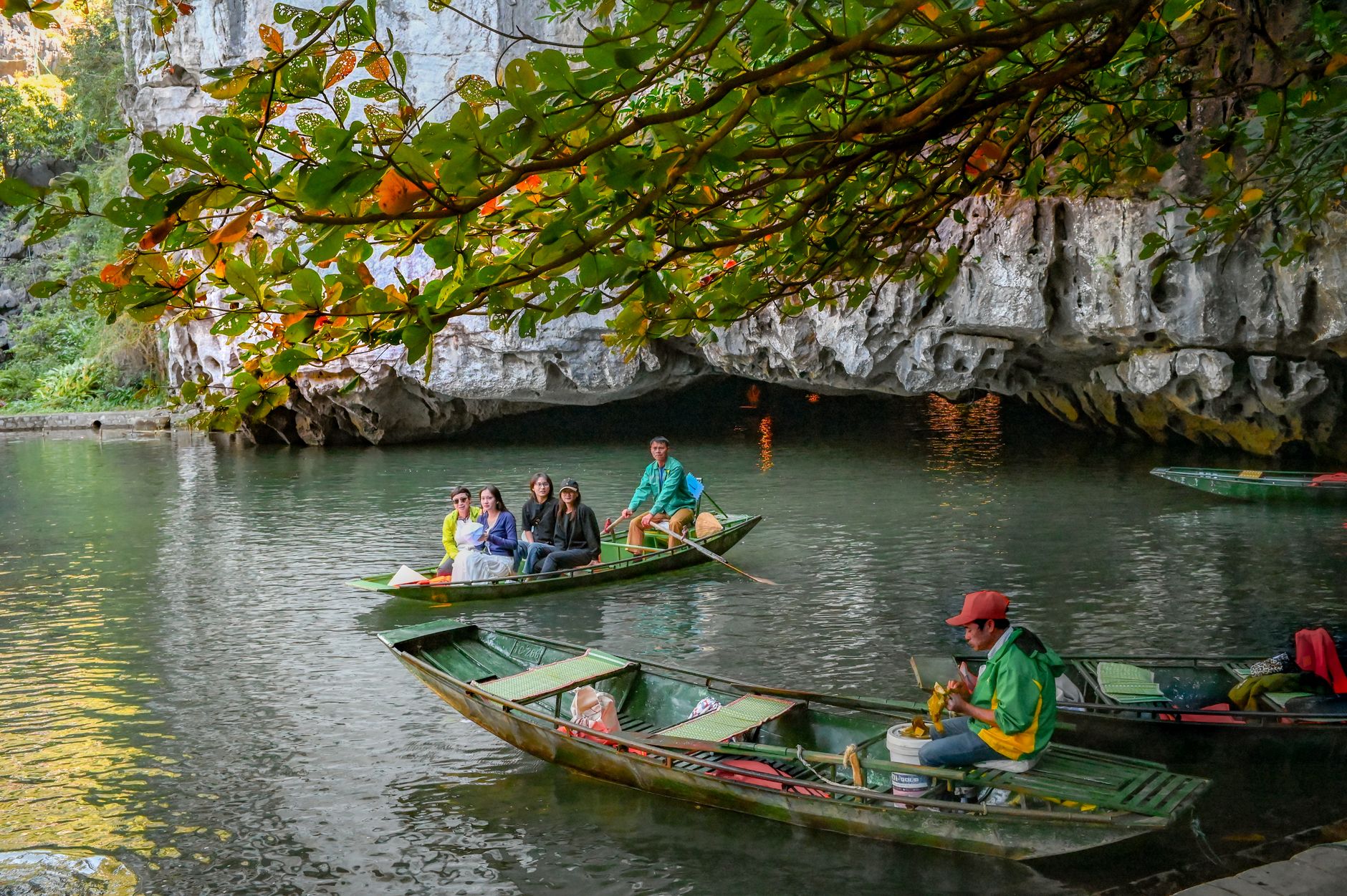
Photo by Nguyen Ngoc Tien on Pexels
Best Time of Day
Morning. The temples are busiest between 9:00 and 11:00 am when tour groups arrive from Hanoi (하노이 / 河内 / ハノイ). If you get there before 8:30 am, you'll likely have the courtyards nearly to yourself. Afternoon light also works if you're coming from Trang An and doubling back, but you'll be sharing the space with more people.
Avoid national holidays and weekends in spring — the site draws significant domestic pilgrimage traffic in the first months of the lunar year after Tet.
Practical Notes
The temples are active religious sites, so dress appropriately — shoulders and knees covered. There's a small drink stall near the ticket booth but no proper food inside the complex; eat in Ninh Binh town before you go or save it for the Trang An area. Ninh Binh is easily done as a day trip from Hanoi (roughly 90 km south), though an overnight stay gives you the morning slot at Hoa Lu without rushing.
Going to Vietnam? Eat and travel smarter.
Monthly: new dishes, off-the-beaten-path destinations, and itineraries — straight to your inbox. No spam. Unsubscribe anytime.
Join 0 expats. (We just launched.)
More from ninh-binh
Other articles covering this city.

Where to Stay in Ninh Binh: Tam Coc vs Trang An vs Cuc Phuong
Three distinct corners of Ninh Binh offer different vibes: Tam Coc for backpacker energy, Trang An for quieter limestone scenery, Cuc Phuong for forest immersion. Here's how to pick.

5 Days Northern Vietnam by Private Car: Hanoi, Ha Long, Sapa, Ninh Binh
A slow itinerary through Hanoi, Ha Long Bay, and Sapa without motorbikes—ideal for families, older travelers, and anyone who prefers a car over two wheels.

5 Days for Vietnam Photographers: Light, Lenses, Locations
A photographer's itinerary across Sapa rice terraces, Ninh Binh karsts, and Hoi An lanterns—with practical gear advice, golden hour timing, and permission etiquette for each location.
More from Northern Vietnam
Other articles covering the same region.

Bat Trang vs Phu Lang vs Chu Dau: Vietnam's Three Ceramic Villages Compared
Three villages, three completely different traditions in clay. Here's how Bat Trang, Phu Lang, and Chu Dau compare — and how to visit each from Hanoi.

Hat Xam: The Blind Beggar Music of Vietnam Making a Comeback
Hat xam was sung by blind street performers for centuries — then nearly vanished. Here's where to hear it live in Hanoi today.

Van Phuc Silk Village: The 1000-Year Loom Town Just Outside Hanoi
Twelve kilometers southwest of Hanoi's Old Quarter, Van Phuc has been weaving silk for over a millennium — and it's still the best place in the north to buy the real thing.
More in Destinations
More articles from the same category.

Tet Nguyen Dan: What Really Happens During Vietnam's Lunar New Year Week
Tet shuts Vietnam down and lights it back up simultaneously. Here's what actually unfolds day by day — and how to navigate it as a visitor.

Vietnamese Calligraphy: The Ong Do Tradition and Where to Commission a Piece
Vietnam's 'ong do' calligraphy tradition peaks at Tet but survives year-round. Here's the history, where to find calligraphers in Hanoi and Saigon, and how to commission a piece.

Son Mai: Vietnam's Lacquer Art, From Temple Walls to Hanoi Galleries
Son mai lacquerware is one of Vietnam's most technically demanding crafts. Here's how it's made, who the key artists are, and where to find the real thing in Hanoi.

Long Hai and Ho Coc: The Quieter Beach Alternatives to Vung Tau
When Vung Tau feels too crowded, Saigon drivers push another 30-50 km east to Long Hai and Ho Coc — two coastal stretches that still feel like weekends used to.

Vinh Long Mekong Homestay: Orchards, Brick Kilns, and the Slow Boat Life
Vinh Long sits an hour from Can Tho but feels a world apart — island homestays, working orchards, and crumbling brick kilns that most Mekong tourists never reach.
Ben Tre: Coconut Country, Canal Boats, and the Mekong's Quietest Corner
Ben Tre moves slower than the rest of the Mekong Delta — fewer tour buses, more waterways, and coconut palms as far as you can see. Here's how to spend two days properly.
Comments
Loading…