5 Days for Vietnam Photographers: Light, Lenses, Locations
A photographer's itinerary across Sapa rice terraces, Ninh Binh karsts, and Hoi An lanterns—with practical gear advice, golden hour timing, and permission etiquette for each location.

Vietnam's landscape and light reward photographers willing to wake before dawn and ask permission before shooting. This five-day itinerary chains three regions with distinct visual signatures: the sculpted rice terraces of Sapa, the limestone drama of Ninh Binh (닌빈 / 宁平 / ニンビン), and the lantern-lit streets of Hoi An. Each demands different lenses, timing, and respect for local protocol.
Day 1 — Sapa Arrival and Terraces at Dusk
Fly Hanoi to Lao Cai early morning, then drive 40 km to Sapa (사파 / 沙坝 / サパ) town (roughly 1.5 hours). Settle into your hotel—The Sapa Rooms or another walkable base—by early afternoon. Eat a simple lunch; you'll need energy for evening light.
Head to Cat Cat Village or the terraces above Muong Hoa Valley around 16:00. The Sapa terraces are best shot from the fields themselves, not from roadsides. A local guide (cost ~200,000 VND / USD 8 for a half-day) will take you down stone paths and, crucially, brief you on which terraces belong to which families—and whether you can photograph them. Some villagers, especially in Cat Cat, have grown weary of tourists; a guide smooths those interactions. Your guide will also know the precise angle for the 17:30–18:30 golden hour glow that turns the flooded fields into mirrors.
Gear focus: 24–70 mm zoom lens covers the wide terraces and tight detail shots of water reflections. A polarizing filter cuts glare off the flooded paddies. Bring a tripod if you're comfortable carrying it down muddy slopes—the light is still and the composition rewards stability. By 18:45, light fades fast; pack out by dusk.
Day 2 — Sapa Sunrise and Trekking
Alarm 04:30. Breakfast is instant noodles or whatever your hotel offers; you want to reach the viewpoint by 05:45. Most sunrise shoots in Sapa cluster around Tram Ton Pass and the village of Ta Phin. Ta Phin is 15 km from town; a motorbike or hired car is essential (roughly 400,000 VND / USD 16 for a full day rental with driver).
The sunrise light at Ta Phin hits the terraces between 06:15–07:15, depending on cloud cover and season. Bring a second, wider lens (14–24 mm) for the sweeping view. If you want to trek down into active terraces—and you should—go with your driver-turned-guide. Red Dao and Hmong farmers are up and working early; they're more receptive to a polite nod and a photo request than to a camera shoved in their face. Many carry permits or sell handicrafts; a small purchase (a bracelet, 50,000–100,000 VND / USD 2–4) buys goodwill and photos.
Break for late breakfast around 08:30 (try "banh cuon" rolls at a local stall), then trek or drive to Tram Ton for midday aerial perspective—less dramatic light, but good for stitched panoramas or drone shots if you have a license (see "Drone rules" below).
Return to Sapa by early afternoon. Rest, edit, charge batteries. Dinner at one of the town's Vietnamese or tourist-friendly restaurants (Com Pho, Kucking Pho).
Day 3 — Ninh Binh Sampans and Karsts
Early morning, drive south from Sapa toward Hanoi (하노이 / 河内 / ハノイ) (4–5 hours; consider an overnight in Hanoi or a direct transfer). Arriving Ninh Binh by afternoon, check into a hotel or home-stay near Tam Coc, the gateway to the limestone karst landscape. River Ngo Dong winds through three caves and past steep cliffs—it's the "Halong Bay of the north," and you'll shoot it from the water.
Book a sampan (traditional wooden boat with a ferryman) for 16:00–18:30. Cost is roughly 300,000–500,000 VND (USD 12–20) per boat for up to two people. The ferryman poles the boat by foot, standing at the stern—an iconic image, but photograph them with a nod of permission first. By late afternoon, the karsts throw long shadows on the water. Shoot from the bow, bow-left, and stern to capture the 3D scale of the cliffs. A 50–85 mm lens suits the intimate rock details; your 24–70 mm covers the wider drama.
As light dims around 18:00, the karsts silhouette against a fading sky—often the most striking frame of the day. Aim for a sampan tour that ends just before dusk, so you're still on the water (not walking back in the dark).
Return by 19:00. Dinner at a Ninh Binh restaurant serving "com tam (껌땀 / 碎米饭 / コムタム)" (broken-rice) or local fish dishes.
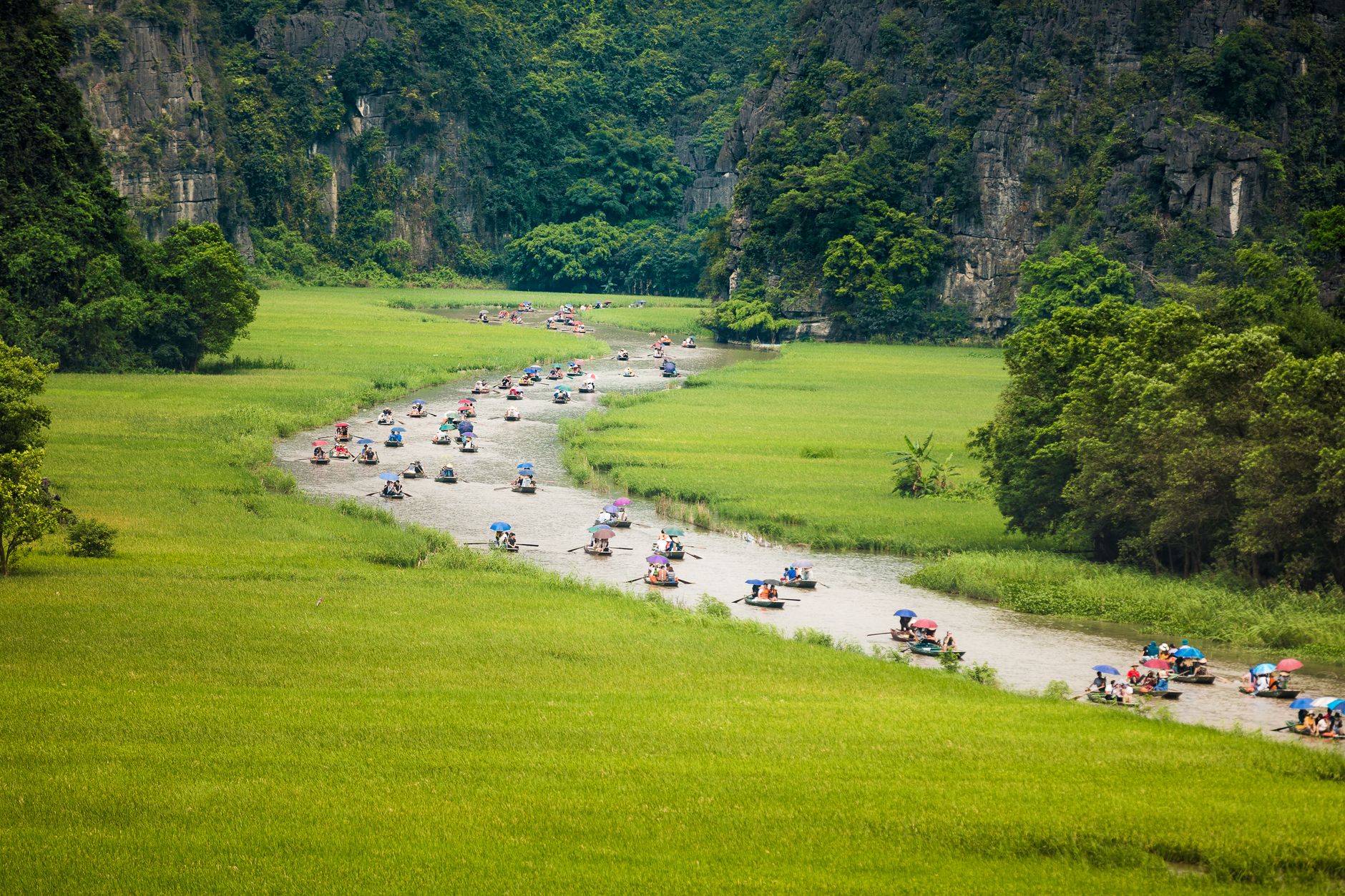
Photo by Son Tung Tran on Pexels
Day 4 — Hoi An Lanterns at Dusk
Morning drive from Ninh Binh to Hoi An (roughly 4 hours; or fly Hanoi–Da Nang (다낭 / 岘港 / ダナン), 1 hour, then drive Da Nang to Hoi An, 30 km, 45 minutes). Check in by early afternoon. Rest and walk the Old Town to scout locations: Cau Bridge (iconic lantern-lit arch), Tan Ky House courtyard, Temple of Assembly of Chinese Congregation, local market alleys.
Hoi An (호이안 / 会安 / ホイアン) has strict photography rules in the Old Town (a UNESCO site). A tourist permit (150,000 VND / USD 6) allows you entry and covers casual photography for personal use. For tripod work, commercial or semi-professional shooting, you need written permission from Hoi An's Quang Nam Tourism Board (quang-nam-tourism.vn or a local hotel concierge can arrange). Respect these rules; authorities enforce them and foreign photographers are sometimes asked to leave or delete images.
Key evening shots:
- Cau Bridge (17:30–19:00): The Japanese Covered Bridge lights up with lanterns. Crowds peak 18:00–19:30; shoot 17:30–18:15 for fewer tourists, or post-20:00 for lantern color without crowds (but lower light). Use a 35–50 mm lens for street-level intimacy.
- Riverside walk (17:45–19:30): The Thu Bon River reflects lantern light off moored boats. A slower shutter (1–3 seconds, use an ND filter if needed) turns water into silk. 24–35 mm covers the width.
- Market alleys (18:30–20:00): Narrow streets off Tran Phu Street have lantern-hung stalls and vendor activity. No tripod allowed (too narrow, too crowded); use ISO 1600–3200 and fast aperture (f/1.8–2.8) to hand-hold.
Dinner after shooting, then a second evening pass if energy permits (Hoi An light is beautiful again 21:00–22:00 as the town quiets).
Day 5 — Hoi An Boats and Departure
Early morning, return to the riverside before dawn (05:30). Boats moor overnight; the light before sunrise silhouettes their prows and fishing nets against a pale sky. Bring a 50–85 mm lens for detail, and a wide zoom for context. Fishermen and boat owners are usually friendly; a small gift (coffee, snack) or a print of their boat later builds rapport.
Breakfast around 07:00. Spend the late morning photographing Hoi An's architecture in soft morning light—window details, tile work, weathered doorframes. A macro or 50 mm prime (f/1.4–2.0) excels at texture. Many homes are private, but Tan Ky House, Quan Thang House, and the Assembly Halls allow photos if you buy a ticket or ask the caretaker respectfully.
Depart by 13:00 for Da Nang Airport (45 km, 1 hour drive) or stay another night if your flight is late.
Gear: Lenses and Essentials
Must-have:
- 24–70 mm f/2.8 (or f/4): your workhorse. Versatile from terraces to boats to lanterns.
- 50 mm f/1.8 (or 35 mm f/2): lightweight, fast, superb for portraits, detail, low light.
- ND and polarizing filters: the polarizer cuts water glare; ND (8–10 stop) enables long exposures in daylight.
Nice-to-have:
- 14–24 mm wide zoom: for karsts and sweeping rice-terrace vistas.
- 85–135 mm telephoto: compresses distance, isolates subjects, useful for candid farmer portraits without intrusion.
- Sturdy tripod: lighter carbon-fiber tripod suits Sapa's muddy slopes; full tripod for Ninh Binh sampan compositions (if the ferryman allows it—ask first).
Lighting:
- Portable LED panel (Neewer or Aputure): overkill for most shots, but invaluable if you want a fill flash on a portrait in Hoi An dusk. Runs on batteries; compact.
- Spare batteries (4–6) and two memory cards: Vietnam's humidity and overnight shoots drain power fast.

Photo by Võ Văn Tiến on Pexels
Drone Rules and Permission Etiquette
Legal status: Drones under 250 g are theoretically tolerated in Vietnam, but regulations remain murky. Officially, you need permission from the Civil Aviation Authority of Vietnam (CAAV) to operate any drone for any purpose, including personal use. In practice, tourists rarely face trouble for small drones in rural areas, but urban zones (Hanoi, Saigon (사이공 / 西贡 / サイゴン), Da Nang) are monitored.
Sapa: Drones are not strictly banned, but the terrain is remote and hilly. Getting CAAV clearance is impractical for a short trip. If you bring a small drone, keep flights low (under 50 m) and away from towns. Avoid flying near the border (Sapa is close to Laos). Do not fly over people or villages without explicit permission.
Ninh Binh: Karst drones are tempting—aerial shots of Tam Coc are spectacular. Same rule: get permission or stay sub-50 m and avoid crowds. Flying near a sampan tour group is risky and disruptive.
Hoi An: City center, UNESCO site, heavy tourism. Do not fly a drone in Hoi An. Period. Authorities will seize it and fine you.
Best practice: Leave the drone at home unless you have a work permit and local contacts who've cleared operations. Ground-based telephoto lenses and clever positioning often deliver better images anyway.
Permission and Etiquette Summary
- Farmers in Sapa: Always ask a guide to introduce you. Smile, speak quietly, take one or two shots, and move on. A small gift (candy, fruit) is appreciated but not mandatory.
- Ferrymen and boat owners in Ninh Binh: Nod and say "xin phep" ("may I?") before raising your camera. They almost always say yes. If they ask for a photo print later, keep their address and send one.
- Shop owners, street vendors: Same rule. Many are used to tourists; a brief smile and gesture suffices. If they object, respect it immediately.
- Sacred sites (temples, pagodas in Hoi An, Ninh Binh): Remove shoes, ask permission, avoid photographing altars or rituals without express consent. Dress respectfully (covered shoulders and knees).
- Old Town Hoi An: Honor the UNESCO permit rules. Tripods draw attention; hand-hold when possible.
Practical Notes
This itinerary moves fast—five days across three regions leaves little margin for bad weather or missed flights. Build in a spare day if you can, especially in Sapa (clouds and rain are common). Pack a lightweight waterproof bag for cameras and lenses; humidity and sudden rain are real. Book domestic flights and car transfers in advance during high season (Oct–Mar). Budget 2,000,000–2,500,000 VND (USD 80–100) per day for transport, guides, and basic lodging; food and camera gear are extras.
Going to Vietnam? Eat and travel smarter.
Monthly: new dishes, off-the-beaten-path destinations, and itineraries — straight to your inbox. No spam. Unsubscribe anytime.
Join 0 expats. (We just launched.)
More from Hanoi
Other articles covering this city.

Hoi An Old Town Walking Guide: Yellow Walls, Lantern Alleys, and the Japanese Bridge
A street-level route through Hoi An's UNESCO core — old merchant houses, assembly halls, the famous Japanese Bridge, and when to walk each stretch for the best light.

Linh Ung Pagoda Son Tra: The 67m Lady Buddha Watching Over Da Nang Bay
On the forested slopes of Son Tra peninsula, a 67-metre white Buddha figure stands visible from almost anywhere in Da Nang — and the pagoda grounds are free to enter.

Hoa Lu Ancient Capital: Vietnam's First Kingdom and How to Visit from Ninh Binh
Hoa Lu was Vietnam's first royal capital, and the two temple complexes that survive are among the most atmospheric historical sites in the north.
More from All of Vietnam
Other articles covering the same region.
Best Tau Hu in Hoi An: Where Locals Send You
Tau hu—silky tofu soup—tastes different in Hoi An. Here's where locals actually eat it, and why.

7 Days in Vietnam: A Yoga and Meditation Itinerary
A week-long route through Vietnam's quietest corners: Sapa's mountain silence, a meditation center in the Mekong, and coastal stillness in Da Lat. Real costs, transport, and retreat recommendations.

7 Days in Vietnam: A Solo Backpacker Itinerary
A tested week-long route through Hanoi, Ha Long Bay, and Saigon with budget lodging, street food, and overland transport. Real costs and booking tips included.
More in Itineraries
More articles from the same category.

5 Days in Vietnam During Monsoon Season: What Actually Works
A tested itinerary for traveling Vietnam in the wet season. Choose destinations that stay dry, time activities around rain patterns, and eat your way through slack-season food.

10 Days on the Northern Frontier Loop: Hanoi to Ha Giang and Back
A tested itinerary covering Hanoi, Mai Chau, Sapa, Ha Giang, and back—with transport, guesthouses, food costs, and what actually works on the ground.

3 Days Escaping Saigon: Da Lat and Surrounding Highlands
Leave Saigon behind for Da Lat's cool mountain air, pine forests, and French colonial architecture. This tested itinerary covers transport, where to stay, what to eat, and realistic costs for a long weekend.

7 Days in Vietnam's Ethnic Minority Villages: A Northern Loop
A tested itinerary through Ha Giang, Sapa, and Mai Chau targeting Hmong, Dao, and Thai villages. Routes, homestays, transport, food stops, and real costs in VND.

5 Days in the Mekong Delta: Beyond Can Tho
Skip the tourist boat tours. This itinerary takes you into smaller canals, family orchards, and riverside towns where most visitors don't go—five days based on routes locals actually use.

10 Days Motorbike Loop: Hanoi to Ha Long to Ninh Binh
A tested 10-day motorbike route through northern Vietnam, starting in Hanoi, skirting Ha Long Bay, and looping back through the limestone karsts of Ninh Binh. Budget, road conditions, and real stops included.
Comments
Loading…