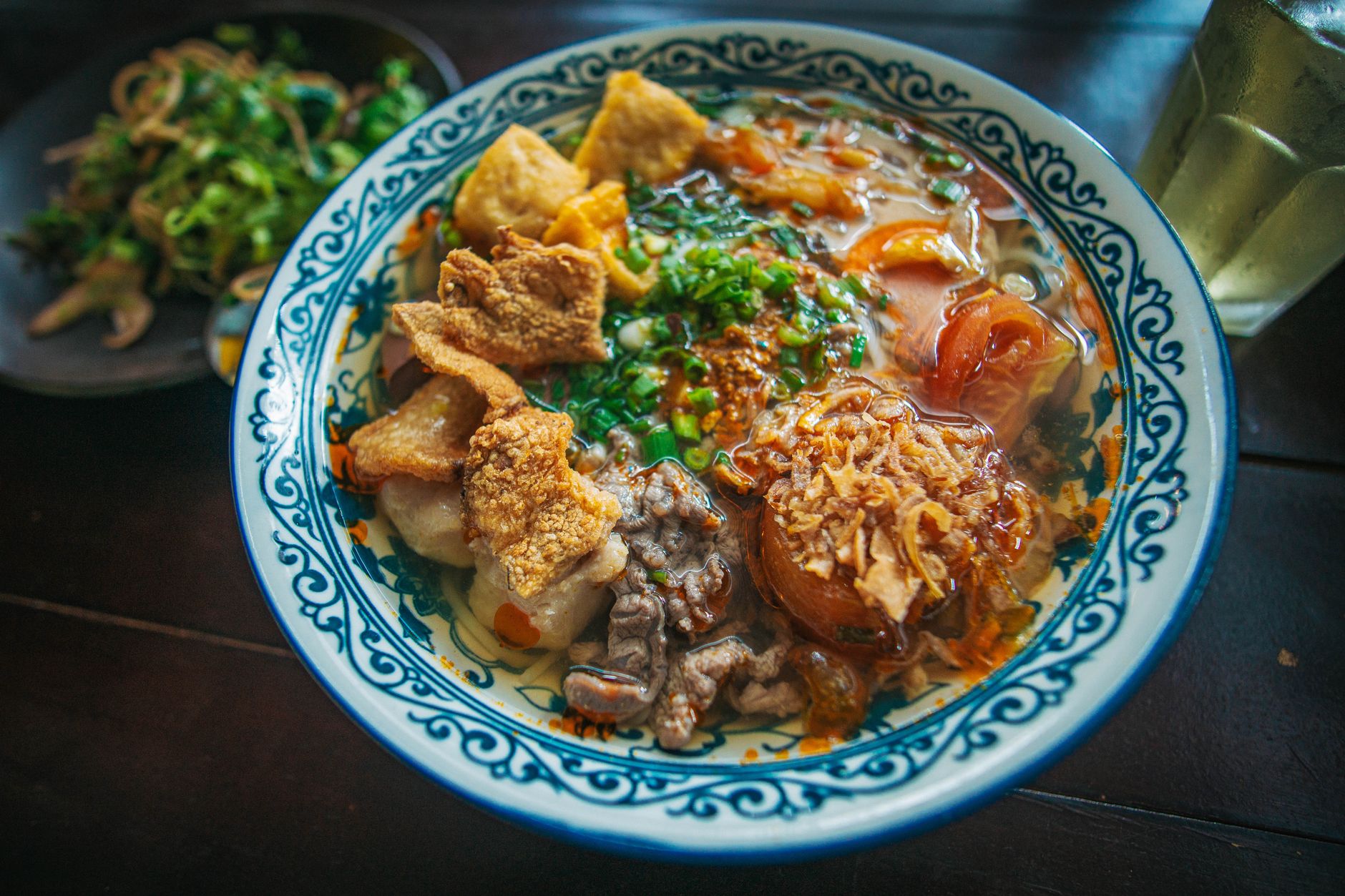
What Is Banh Cuon?
"Banh cuon (반꾸온 / 蒸米卷 / バインクオン)" is a steamed rice flour sheet, thin enough to see through, typically rolled around minced pork, wood ear mushrooms, and shallots. You eat it with "nuoc cham" (sweet-sour fish sauce), crispy fried shallots, and slices of "cha lua" (Vietnamese pork sausage). In the north, the dipping sauce is lighter and wood ear mushrooms dominate the filling. Southern versions pile on more ingredients and serve a richer, darker nuoc cham.
The dish goes back at least to the 13th century. Historian Le Tac noted in An Nam Chi Luoc that banh cuon were given as gifts during the Cold Food Festival. A 1291 poem by King Tran Nhan Tong mentions "spring vegetable cakes" ("banh xuan thai"), which the Chi Nam Ngoc Am Giai Nghia confirms is another name for banh cuon. During the Tran Dynasty—possibly earlier in the Ly—people ate them during the festival and exchanged them as presents, before "banh troi" became the default.
Today, banh cuon is breakfast or a midmorning snack. Light, not filling, and gone in ten minutes if you eat at the stall.
Cao Bang: Minced Pork + Bone Broth
In Cao Bang, the filling is finely minced pork, pre-sauteed until dry. You get it in a bowl with pork bone broth, a finger-length piece of "gio lua", and sometimes an egg. The broth is the defining element—clear, light, simmered for hours. No herbs to speak of, just the pork flavor and the slick, soft rice sheet.
Lang Son: Egg Yolk Bursts in Your Mouth
Lang Son's version wraps a chicken egg and shredded braised pork inside the rice sheet. The egg is steamed just enough to form a thin membrane around the yolk, so when you bite into the roll, the yolk breaks and mixes with the hot, fragrant pork. The broth—pork bone again, seasoned with spring onions, cilantro, pepper, chili, bamboo shoots—gets poured directly over the rolls. You don't dip. Many vendors use the pork braising liquid for a richer, darker flavor.
You need to bite carefully. If you squeeze too hard, the yolk shoots out.

Image by Cheong. Original uploader was Cheong Kok Chun at en.wikipedi via Wikimedia Commons (CC BY-SA)
Hai Phong: Bone Broth Dipping Sauce
Hai Phong flips the script. The dipping sauce is pork bone broth seasoned with Cat Hai fish sauce, not the usual nuoc cham. The rice flour traditionally comes from Moc Tuyen rice, which gives the sheets a stronger rice aroma and a chewier texture than other varieties. You get two types of sausage: "cha que" (cinnamon pork sausage) and "cha vien" (pork balls). The bone broth sauce is fragrant, subtly sweet, with a coastal umami punch. No sourness, no chili oil floating on top—just warm, savory depth.
Hanoi: The Standard Bearer
Hanoi's banh cuon uses wet-milled rice flour. The filling is minced pork, wood ear mushrooms, and shiitake mushrooms, cooked until dry. After steaming, the maker uses a bamboo stick to divide each rolled sheet into four short segments, arranges them on a plate, then sprinkles dried shrimp floss ("ruoc tom") on top. A few sprigs of mint or cilantro. You dip into a bowl with sliced cha lua and crispy fried shallots floating in nuoc cham.
This is the version most people mean when they say banh cuon.
Thanh Tri: Paper-Thin, No Filling
Thanh Tri banh cuon, from Thanh Dam village in Vinh Hung ward, is the most delicate. Made from Gie Canh and Tam Thom rice, the sheets are steamed so thin they're translucent. No filling. Vendors stack the sheets in bamboo baskets lined with lotus or banana leaves, carry them on their heads, and walk through the Old Quarter. When you order, the vendor peels each layer off carefully to avoid tearing, cuts the stack in half with scissors, then stacks one half on top of the other so you can see the layers. Golden fried shallots on top. The dipping sauce varies by vendor. You can add cha que, gio lua, fried tofu, and cilantro.
If you're in Hanoi, find a Thanh Tri vendor early in the morning—before 8 a.m.—when the sheets are still warm and soft.

Image by CEphoto, Uwe Aranas via Wikimedia Commons (CC BY-SA)
Me So (Phu Thi): Pre-Rolled, Eat by Hand
Me So banh cuon, from Phu Thi hamlet in Hung Yen province, uses lean pork stir-fried with fish sauce, MSG, shiitake, wood ear mushrooms, and pepper. The wrapper can be stacked and rolled later—unlike most versions, which are made to order. The filling is spread across one end of the sheet, then the whole thing is rolled. You can eat it by hand or cut it into pieces and use a fork.
Less fussy than Thanh Tri, more portable.
Hai Duong: Rendered Pork Fat + Cha Que
In Hai Duong, especially in the Han Giang and Bac Son neighborhoods, the sheets are drizzled with rendered pork fat from belly fat—not leaf fat, not cooking oil—and fried shallots. The sheets are stacked in a banana-leaf-lined basket and kept warm until served. You peel them off by hand, cut them into bite-sized pieces, and dip them in a clear, golden fish sauce with chili, coarsely ground black pepper, vinegar, and calamansi. Served with cha que, sliced diagonally into thin diamonds, chewy skin with a crispy, sweet, nutty interior.
Banh cuon with filling comes with cha que. Plain banh cuon ("banh cuon chay") just gets fried shallots.
Where to Start
If you're in Hanoi, start with Thanh Tri banh cuon from a basket vendor in the Old Quarter. Then try a filled version at any stall near Ho Guom with ruoc tom on top. If you're in Hai Phong, find a place that uses bone broth dipping sauce and serves cha que. In Lang Son, ask for the egg version and bite carefully.
Each region's version is different enough that you're not repeating yourself.
Last updated · May 26, 2026 · independently researched, never sponsored.