Tet Nguyen Dan: What Really Happens During Vietnam's Lunar New Year Week
Tet shuts Vietnam down and lights it back up simultaneously. Here's what actually unfolds day by day — and how to navigate it as a visitor.

Vietnam (베트남 / 越南 / ベトナム) doesn't celebrate Tet so much as it suspends ordinary life for a week. Cities empty out, streets go quiet, and then — on New Year's Eve — everything erupts in fireworks and noise. If you're here for it, you need to know what's coming.
The Calendar: When Things Actually Happen
Tet (뗏 (베트남 설날) / 越南春节 / テト (ベトナム旧正月)) Nguyen Dan falls on the first day of the lunar calendar, usually late January or early February. The official public holiday runs three days, but in practice the country shifts into a different gear from around the 23rd day of the 12th lunar month — when the Kitchen Gods depart — through to at least the 7th day of the new year.
For a concrete reference: in 2025, New Year's Day (Mung 1) falls on January 29. The week before (roughly January 20–28) is the run-up. The first five days of February are the core celebration period.
Ong Cong Ong Tao: The Week Before
Seven days before Tet, Vietnamese households send off the Kitchen Gods — "ong cong ong tao" — with a ritual that involves burning paper offerings and releasing live carp into a river or lake. In Hanoi, Hoan Kiem Lake becomes a popular release point, and you'll see families carrying plastic bags of fish on the 23rd. It's one of the more quietly beautiful pre-Tet rituals, and easy to observe without intruding.
The week before Tet is also when markets go into overdrive. Hang Ma Street in Hanoi (하노이 / 河内 / ハノイ)'s Old Quarter fills with red-and-gold decorations, kumquat trees, and peach blossom branches (dao). In Saigon, Ben Thanh Market and the surrounding streets stack up with dried fruits, "mut" (candied ginger, coconut, lotus seeds), and boxed gift sets. Prices spike. Go early in the day.
Banh Chung and the Food Preparation
The most labor-intensive Tet tradition is making "banh chung" — square sticky rice cakes filled with pork and mung bean, wrapped in dong leaves and boiled for eight to ten hours. Families that still make them from scratch start two to three days before Tet. The smell of banh chung simmering overnight is one of those Tet sensory markers that Vietnamese people carry with them their whole lives.
Alongside banh chung (반쯩 / 粽子 / バインチュン), households prepare "mut" trays for guests, stock up on bia hoi or bottled beer, and cook large batches of braised pork, pickled vegetables, and soup. If you're invited to a Vietnamese home during Tet — and the invitation is worth accepting — expect the table to be stacked.
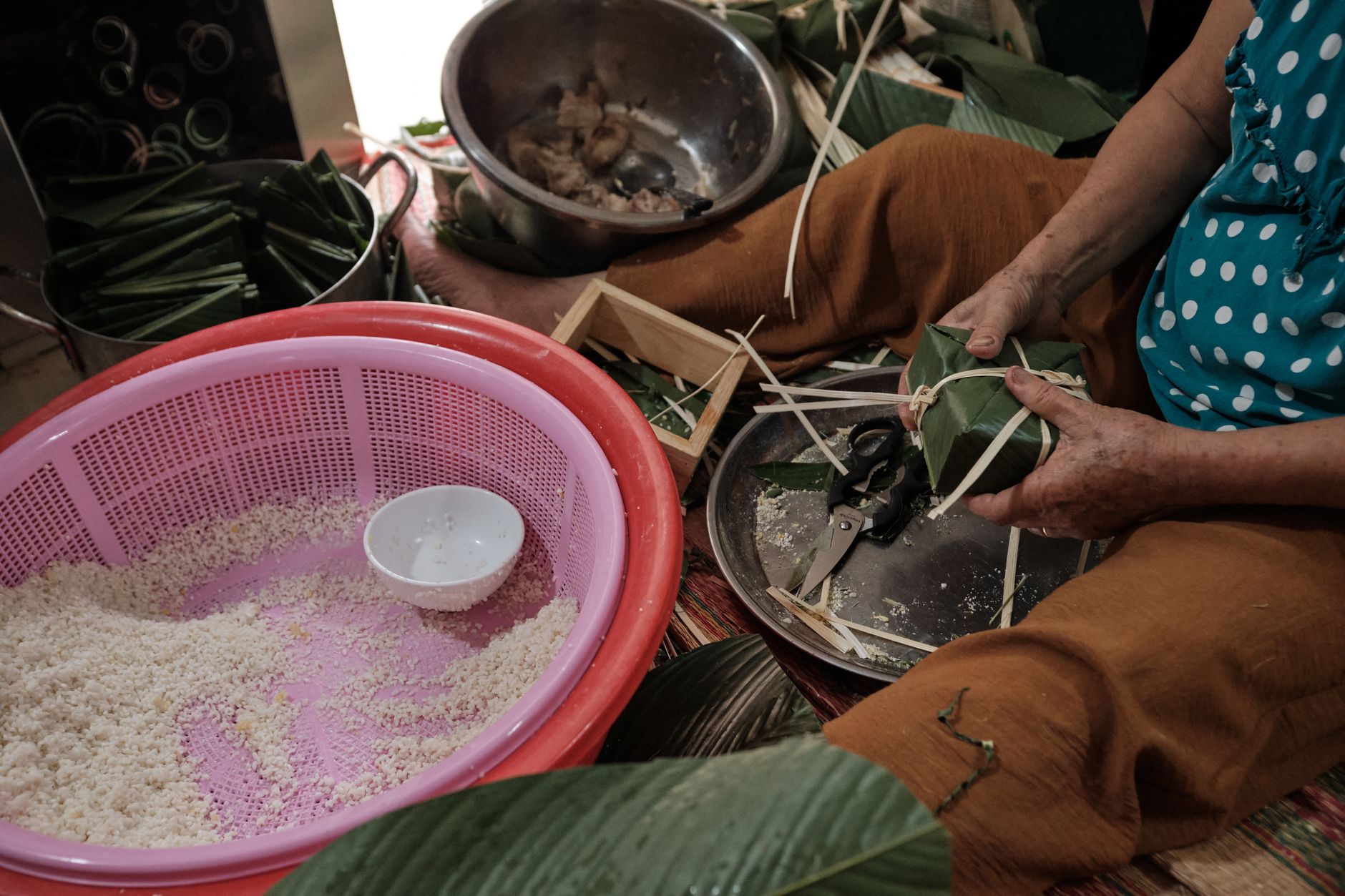
Photo by Nguyen Truong Khang on Pexels
New Year's Eve and Mung 1
The night before Tet (Giao Thua) is the emotional center of the holiday. Families gather for a reunion dinner, then crowds head to temples or city centers for midnight. In Hanoi, the streets around Hoan Kiem Lake and the Tran Quoc Pagoda area draw large crowds. In Saigon (사이공 / 西贡 / サイゴン), Nguyen Hue Walking Street hosts official fireworks.
Mung 1 — the first day — is the quietest day of the year. Most shops are shut. Many restaurants are closed. Streets that are normally gridlocked with motorbikes feel eerie and open. Families stay home or visit the paternal grandparents. If you're a visitor, this is not the day to hunt for a bowl of pho (쌀국수 / 越南河粉 / フォー); it's the day to walk an empty city and take it in.
Mung 2 and Mung 3: The Social Days
Mung 2 is traditionally the day to visit the wife's family. Mung 3 is for teachers, mentors, close friends. The cycle of visits — laden with fruit baskets, boxed mut, and bottles of wine — continues through the first week. "Li xi," the red envelopes stuffed with cash, go to children and elderly relatives. The amounts are modest by custom (20,000–50,000 VND is normal for a child you don't know well), but the gesture matters more than the sum.
By Mung 2 or 3, some food stalls and smaller restaurants begin reopening, particularly in tourist areas of Hanoi's Old Quarter and Saigon's District 1. Convenience stores (Circle K, GS25, Winmart) tend to stay open throughout.
What's Open, What's Shut
Expect closures from Tet Eve through at least Mung 3. Banks, government offices, and most local businesses are closed for the full official holiday. Large supermarkets and international hotels stay operational. Tourist sites — the Temple of Literature in Hanoi, the Imperial Citadel Thang Long, the Cu Chi Tunnels outside Saigon — are generally open from Mung 1 onward and often busier than usual, since Vietnamese families visit cultural sites during Tet.
ATMs sometimes run dry in the days just before Tet. Withdraw cash at least three days in advance.
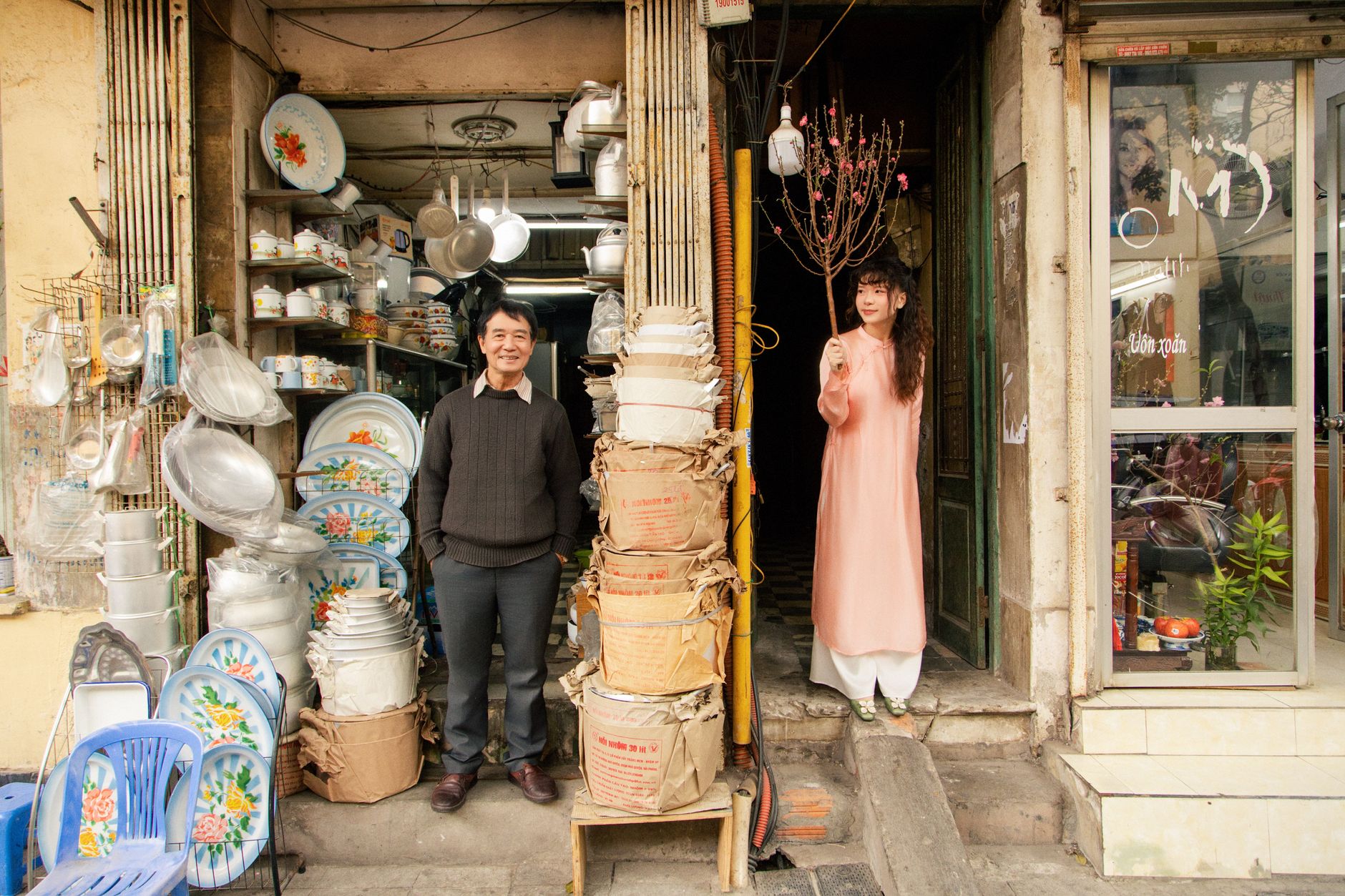
Photo by Dang Hong on Pexels
Best Places to Experience Tet as a Visitor
Hanoi rewards Tet visitors more consistently than Saigon. The Old Quarter goes quiet on Mung 1 in a way that almost no other time of year allows — you can walk down Hang Dao or stand on Long Bien Bridge without fighting traffic. Temple visits are genuine and atmospheric rather than staged. The flower markets along Hang Luoc and around Nhat Tan in the days before Tet are worth the trip alone.
Saigon is louder and more commercially festive. The flower street on Nguyen Hue (후에 / 顺化 / フエ) is heavily produced but draws enormous crowds. District 5 (Cholon) has its own Chinese New Year parallel celebration layered over Tet, with dragon dances and a different energy entirely.
Smaller cities like Hue and Hoi An (호이안 / 会安 / ホイアン) offer a more intimate version — Hue in particular takes Tet seriously, with ancestral rites tied to its royal history.
If You're Invited to Someone's Home
Bring fruit — a five-fruit tray (mam ngu qua) is the traditional choice, available at any market. Alternatively, a box of mut or a small basket of premium tea works well. Don't bring a clock (associated with death) or shoes for an elder without being asked. Dress on the conservative side, avoid black or white, and accept whatever food or drink is offered at least once — refusing immediately reads as dismissive.
Practical Notes
Book transport (trains, buses, flights) at least three weeks out — Tet travel is the most heavily booked period of the Vietnamese calendar. Accommodation in major cities is easier to find than expected, since most domestic tourists are traveling to their home provinces rather than staying in Hanoi or Saigon. Budget an extra buffer for inflated prices on taxis, grab rides, and tourist-facing services in the days immediately after Tet.
Going to Vietnam? Eat and travel smarter.
Monthly: new dishes, off-the-beaten-path destinations, and itineraries — straight to your inbox. No spam. Unsubscribe anytime.
Join 0 expats. (We just launched.)
More from Hanoi
Other articles covering this city.

Vietnamese Calligraphy: The Ong Do Tradition and Where to Commission a Piece
Vietnam's 'ong do' calligraphy tradition peaks at Tet but survives year-round. Here's the history, where to find calligraphers in Hanoi and Saigon, and how to commission a piece.

Van Phuc Silk Village: The 1000-Year Loom Town Just Outside Hanoi
Twelve kilometers southwest of Hanoi's Old Quarter, Van Phuc has been weaving silk for over a millennium — and it's still the best place in the north to buy the real thing.

Son Mai: Vietnam's Lacquer Art, From Temple Walls to Hanoi Galleries
Son mai lacquerware is one of Vietnam's most technically demanding crafts. Here's how it's made, who the key artists are, and where to find the real thing in Hanoi.
More from All of Vietnam
Other articles covering the same region.

Best Tau Hu in Hoi An: Where Locals Send You
Tau hu—silky tofu soup—tastes different in Hoi An. Here's where locals actually eat it, and why.

7 Days in Vietnam: A Yoga and Meditation Itinerary
A week-long route through Vietnam's quietest corners: Sapa's mountain silence, a meditation center in the Mekong, and coastal stillness in Da Lat. Real costs, transport, and retreat recommendations.

7 Days in Vietnam: A Solo Backpacker Itinerary
A tested week-long route through Hanoi, Ha Long Bay, and Saigon with budget lodging, street food, and overland transport. Real costs and booking tips included.
More in Destinations
More articles from the same category.

Long Hai and Ho Coc: The Quieter Beach Alternatives to Vung Tau
When Vung Tau feels too crowded, Saigon drivers push another 30-50 km east to Long Hai and Ho Coc — two coastal stretches that still feel like weekends used to.

Vinh Long Mekong Homestay: Orchards, Brick Kilns, and the Slow Boat Life
Vinh Long sits an hour from Can Tho but feels a world apart — island homestays, working orchards, and crumbling brick kilns that most Mekong tourists never reach.
Ben Tre: Coconut Country, Canal Boats, and the Mekong's Quietest Corner
Ben Tre moves slower than the rest of the Mekong Delta — fewer tour buses, more waterways, and coconut palms as far as you can see. Here's how to spend two days properly.

Ba Den Mountain, Tay Ninh: Cable Car, Pagodas, and a Saigon Day Trip Worth Making
At 986 metres, Ba Den is the highest point in southern Vietnam — a pilgrim mountain with a Sun World cable car, active pagodas, and easy access from Saigon.

Tram Chim National Park: Where to Watch Sarus Cranes in Dong Thap
Tram Chim is the Mekong Delta's best wetland for birdwatching, home to Vietnam's largest population of sarus cranes during the dry season from December to April.

Nam Du Islands: Kien Giang's Quieter Alternative to Phu Quoc
Nam Du is a cluster of 21 islands off the Kien Giang coast where fishing boats still outnumber tourists and the reefs haven't been loved to death yet.
Comments
Loading…