The Oldest Temple in Hanoi
Tran Quoc Pagoda sits on Kim Ngu (Golden Fish) islet in West Lake, a causeway-connected sliver of stone that's felt sacred for roughly 1,500 years. The temple was originally built around 544–548 CE under Emperor Ly Nam De, originally called Khai Quoc (National Founding) and positioned on the Red River's banks. But the Red River doesn't respect history — its relentless shift forced a move. In 1615, monks relocated the entire operation to this island sanctuary, where it's remained ever since.
The last major renovation happened in 1815, when the main hall, reception area, and the chamber housing monks' ashes were all restored. Walk the grounds today and you're treading the same paths monks have walked for centuries — some of the pagoda structures themselves date to the 1600s.
To put 1,500 years in perspective: when Khai Quoc was founded, the Tang Dynasty hadn't started yet. The Temple of Literature in Hanoi, which most visitors think of as ancient, wouldn't be built for another five hundred years. Tran Quoc predates almost every standing religious structure in Southeast Asia.
The Monks and Their Daily World
Monks have called this place home for over fifteen hundred years. Their day begins before tourists arrive, in pre-dawn prayer at shrines scattered across the compound. These men follow a celibate lifestyle — no families, no marriage — and their commitment to teaching Buddhist principles to visitors is the temple's backbone.
Over time, Tran Quoc accumulated other names: An Quoc (Pacification of the Realm) and Tran Bac (Guardian of the North). Each name carries weight in Vietnamese spiritual history. When you walk here, you're in the presence of living Buddhist practice, not a museum.
The resident monks eat two vegetarian meals a day — one around 6:00 AM, the second before noon. After midday, no solid food. If you arrive early enough (before 7:00 AM), you might hear chanting drift across the water while the rest of Hanoi is still waking up over bowls of "pho" and glasses of "ca phe".

Image by Jakub Hałun via Wikimedia Commons (CC BY-SA)
Symbolism in Stone and Lotus
Every detail here speaks. The eight-spoked wheel carved into doorways represents the Noble Eightfold Path — Buddhism's roadmap to enlightenment. Lotus flowers are everywhere: in statuary, etched into the stone wall that flanks the pagoda, blooming in the temple pond itself. "Lotus" flowers symbolize purity of mind, body, and speech, and they're a visual anchor for the principle that enlightenment can emerge from murky water.
If you visit the main shrine, monks will offer you incense. Burn it in odd numbers — three, five, seven — because odd numbers bring luck in Vietnamese culture. Never four: the Vietnamese word for four (tu) sounds too much like the word for death (tu), so visitors and monks alike avoid it.
All offerings here are vegetarian, a quiet show of respect for the monks who live on the grounds. You'll see fruit, rice, flowers — never meat or fish.
The main tower — the eleven-story brick stupa in the rear courtyard — is the structure you see in every photo of the pagoda. Each tier holds a white Buddha statue seated in a niche. The tower was rebuilt in its current form during the 1998 restoration, but the design follows the 1639 original. Smaller "bao thap" (precious stupas) surrounding it contain the ashes of deceased monks, some dating back several centuries.

Image by Jakub Hałun via Wikimedia Commons (CC BY-SA)
The Goddesses and the Bodhi Tree
Tran Quoc blends Buddhism with something older: worship of the "Mau" (Mothers), ancient Vietnamese goddesses. Their shrines occupy the front courtyard. The Mau Thuong Ngan (the green Mother) rules mountains and forests. The Mau Thoai (the white Mother) holds dominion over water. The Mau Thuong Thien (the red Mother) governs sky. These are among the oldest deities in Vietnamese religious practice — they predate Buddhism itself.
One tree on the grounds carries international weight: a Bodhi tree grown from a cutting of the original sacred fig under which Buddha attained enlightenment in Bodh Gaya, India. It arrived in 1959 as a gift marking Indian President Rajendra Prasad's visit, a living thread connecting Hanoi to Buddhism's birthplace.
You'll find the Bodhi tree in the rear garden, fenced off but clearly visible. It's not especially large — the Hanoi (하노이 / 河内 / ハノイ) climate is cooler than the Indian plains where the species thrives — but it's healthy, leafy, and unmistakable. Locals sometimes tie red ribbons to the fence as prayers.
When to Go, What to Expect
The best time to visit is during the first month of the lunar calendar, when worshipers flock here. But monks accept visitors year-round — come at any time to pray, burn incense, sit by the water. The sunset views are justly famous: West Lake turns gold, the temple's silhouette goes dark, and the noise of Hanoi's streets feels very far away.
Bring incense if you want to offer it (or the monks will provide some). Dress modestly — shoulders and knees covered. Leave your shoes at the shrine entrance. And if you see monks praying, step back quietly and let them work.
The statuary inside includes pieces from 1639, tangible proof of how long this place has stood. That's not nostalgia — that's weight. Tran Quoc isn't a tourist attraction first. It's a living temple, still teaching, still praying, still reaching toward enlightenment the way it did five centuries ago.
Late afternoon — around 4:30 to 5:30 PM — is the sweet spot for photography. The sun drops behind the pagoda from the east-facing causeway, backlighting the stupa. Weekday afternoons are noticeably quieter than weekends. During Tet (Vietnamese New Year, usually late January or February) and the Vu Lan festival (July or August, lunar calendar), expect crowds and flower offerings covering every surface.
Getting There and Practical Details
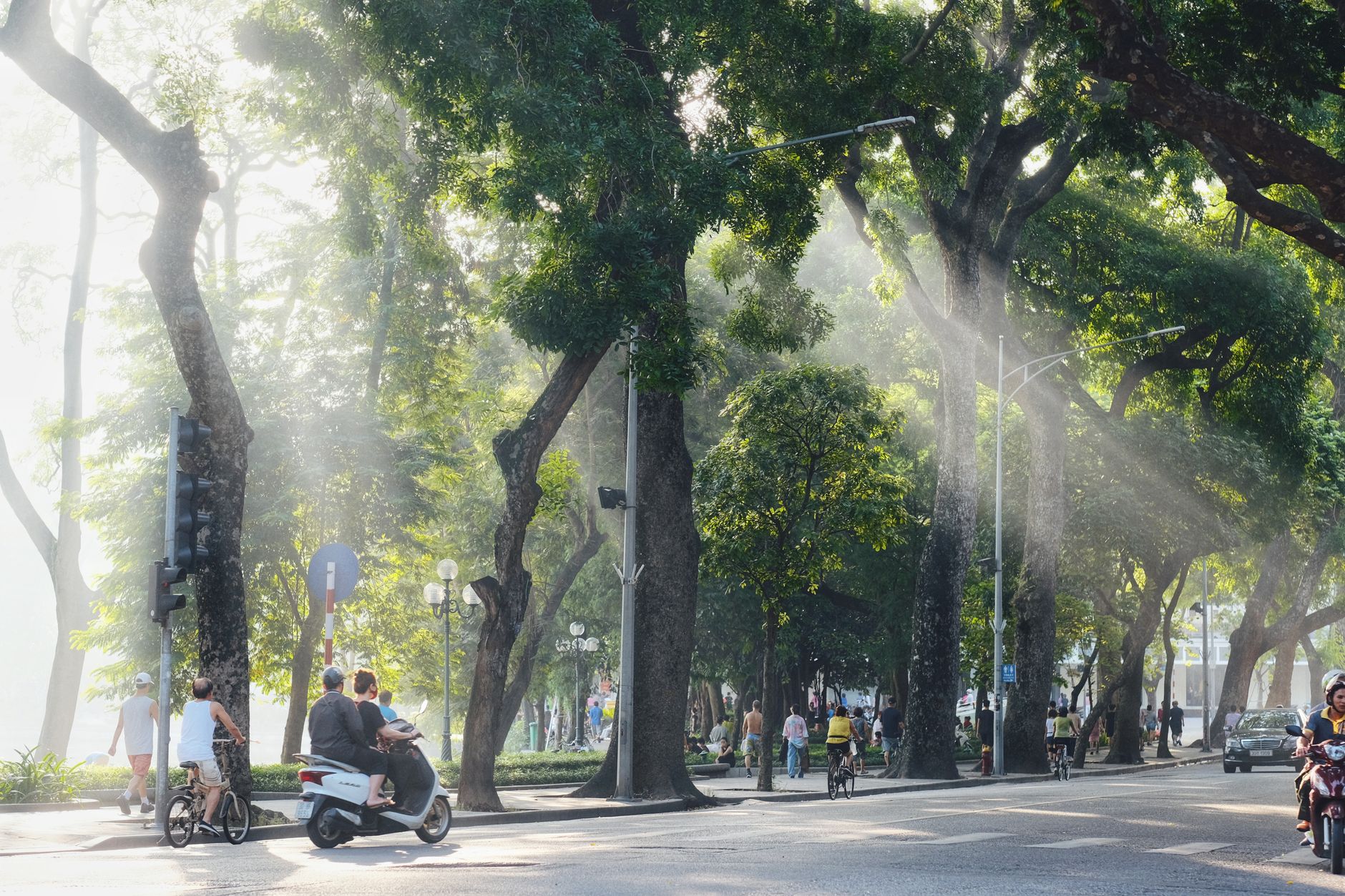
Tran Quoc Pagoda is on Thanh Nien Road, the tree-lined causeway that splits West Lake from Truc Bach Lake. The address is 46 Thanh Nien, Yen Phu Ward, Tay Ho District.
From the Old Quarter, it's about 2.5 km — a 10-minute taxi ride (around 30,000–50,000 VND by meter) or a 30-minute walk along the lakeshore. Grab and Be are reliable here; just pin the pagoda on the map since drivers sometimes confuse it with other West Lake temples. If you're staying near Truc Bach, it's barely a 5-minute walk across the causeway.
Opening hours are 7:30 AM to 11:30 AM and 1:30 PM to 5:30 PM daily. The midday closure catches people off guard — monks rest and eat during this window, so the gates close. There is no admission fee. The pagoda is free to enter, though donation boxes sit near the main shrine. A reasonable offering is 20,000–50,000 VND.
Parking for motorbikes is available just south of the causeway entrance for 5,000–10,000 VND. There is no car parking directly at the pagoda; taxis drop you at the causeway and you walk the last 50 meters.
What to Eat and Drink Nearby
West Lake and Truc Bach have some of Hanoi's best food within walking distance of the pagoda.
"Banh mi" carts line Thanh Nien Road in the mornings — a filled baguette runs 20,000–35,000 VND. For something more substantial, Truc Bach Lake's north shore has several "bun cha" joints where grilled pork and noodles cost 40,000–60,000 VND per set.
The egg coffee (에그커피 / 蛋咖啡 / エッグコーヒー) phenomenon started at Cafe Giang in the Old Quarter, but you can get a good "ca phe trung" at lakeside cafes on Thanh Nien for 35,000–55,000 VND without the tourist queue. Several spots along the causeway have second-floor terraces overlooking the water — decent coffee, solid views.
If you're visiting around lunchtime and get locked out by the midday closure, use the break to eat "pho" at Pho Thin on Lo Duc Street (about 3 km southeast, 60,000 VND a bowl) or grab "bun rieu" (crab noodle soup) from one of the small shops on Yen Phu Street, just north of the pagoda.
For dinner after a sunset visit, the Xuan Dieu strip along West Lake's east bank — about 1.5 km north — has everything from Korean barbecue to Vietnamese "com tam" (broken rice plates, 50,000–80,000 VND).
Common Mistakes Visitors Make
Arriving at noon. The pagoda closes from 11:30 AM to 1:30 PM. At least once a week, tourists show up at 12:00 and find locked gates. Plan around the break.
Wearing shorts or tank tops. This is an active monastery, not a ruin. Guards at the entrance will turn you away if your knees or shoulders are bare. Carry a light scarf or long-sleeve layer in your bag.
Lighting even-numbered incense sticks. Odd numbers only — three is standard. If you're unsure, watch what locals do and follow their lead.
Skipping the rear courtyard. Most visitors photograph the main stupa from the front and leave. The rear garden holds the Bodhi tree, the oldest monk-ash stupas, and a quiet terrace overlooking the lake. It takes five extra minutes and it's the most peaceful part of the compound.
Confusing Tran Quoc with Quan Thanh Temple. Quan Thanh is the Taoist temple at the south end of the same causeway, about 300 meters away. They're different sites, different religions, both worth visiting. Budget 30–45 minutes for each.
Taking selfies during prayer. If monks are chanting or a ceremony is underway, put your phone away. You can photograph the architecture freely, but pointing a camera at monks mid-prayer is considered disrespectful.
Quick Reference
- Full name: Tran Quoc Pagoda (originally Khai Quoc)
- Founded: circa 544–548 CE
- Moved to current site: 1615
- Address: 46 Thanh Nien, Yen Phu, Tay Ho, Hanoi
- Hours: 7:30–11:30 AM, 1:30–5:30 PM daily
- Admission: Free (donations welcome)
- Dress code: Shoulders and knees covered
- Best time for photos: 4:30–5:30 PM
- Busiest periods: Tet / 越南春节 / テト), Vu Lan Festival, weekends
- Nearby landmark: Quan Thanh Temple (300 m south on Thanh Nien Road)
- Distance from Old Quarter: ~2.5 km
- Taxi from Old Quarter: 30,000–50,000 VND
Bottom Line
Tran Quoc is one of the few places in Hanoi where fifteen centuries of continuous use actually feel real — not reconstructed, not reimagined for tourists, just quietly maintained by monks who've never left. Give it an hour, respect the dress code and the silence, and time your visit for late afternoon. You'll leave understanding why this small island has outlasted every empire that tried to claim the city around it.
Last updated · May 29, 2026 · independently researched, never sponsored.