U Minh Ha National Park: Peat Swamps, Monkeys, and the Tip of Vietnam
U Minh Ha is one of the last intact peat swamp forests in Southeast Asia — a slow-boat ecosystem of cajuput trees, crab-eating macaques, and brackish canals at Vietnam's southern edge.

Ca Mau sits at the bottom of the map in a way that feels genuinely remote — not manufactured remoteness, but the real kind where the land is still becoming land. U Minh Ha National Park, about 45 km southwest of Ca Mau city, protects one of the rarest forest types left in Southeast Asia: a functioning peat swamp.
Why Peat Swamp Matters
Most visitors to the Mekong Delta (메콩 델타 / 湄公河三角洲 / メコンデルタ) stick to Can Tho or the fruit orchards around Ben Tre. Few make it this far south, which is part of why U Minh Ha still exists in anything close to its original form. Peat swamp forest is built on layers of partially decomposed organic matter — in some spots here the peat goes 2 to 3 meters deep — and it functions as a massive carbon sink. The water runs dark brown from tannins, tea-colored and surprisingly clear once your eyes adjust. It looks prehistoric, and in ecological terms it basically is.
U Minh Ha covers around 8,900 hectares of cajuput forest (tram trees, locally), seasonally flooded grassland, and open water. The park is a UNESCO biosphere reserve and sits alongside the larger U Minh Thuong park to the north in Kien Giang province — together they form the most significant remaining peat swamp block in Vietnam (베트남 / 越南 / ベトナム).
Getting There from Can Tho
Can Tho (껀터 / 芹苴 / カントー) is the logical staging point for the southern Mekong. From Can Tho bus station, take a sleeper or express bus to Ca Mau city — roughly 4 to 5 hours, around 120,000–150,000 VND. From Ca Mau city, xe om (motorbike taxi) or a hired car gets you to the park entrance at Lam Vien U Minh Ha in about 45 minutes. Most guesthouses in Ca Mau city can arrange a driver for 300,000–400,000 VND return.
Alternatively, a small number of tour operators in Can Tho run overnight trips combining U Minh Ha with Mui Ca Mau — worth considering if your time is tight and logistics feel overwhelming.
The Boat Route Through the Cajuput Forest
The main way to experience the park is by flat-bottomed boat through the canal network. You hire a boat at the park entrance — expect to pay around 150,000–200,000 VND per person for a 2-hour circuit, though prices shift depending on group size and season. The boats are narrow, low, and quiet.
The cajuput trees grow straight out of the water on either side, their pale trunks stripped of bark at the waterline from seasonal flooding. The forest canopy is dense enough that the light comes in filtered and greenish. You'll hear more than you'll see at first — frogs, water birds, the occasional crash of something moving through branches overhead.
Bird life is serious here. The park shelters painted storks, little cormorants, purple herons, and several species of kingfisher. If you visit between November and April — the dry season, when water levels drop and wildlife concentrates near the canals — sightings are more reliable. Bring binoculars.
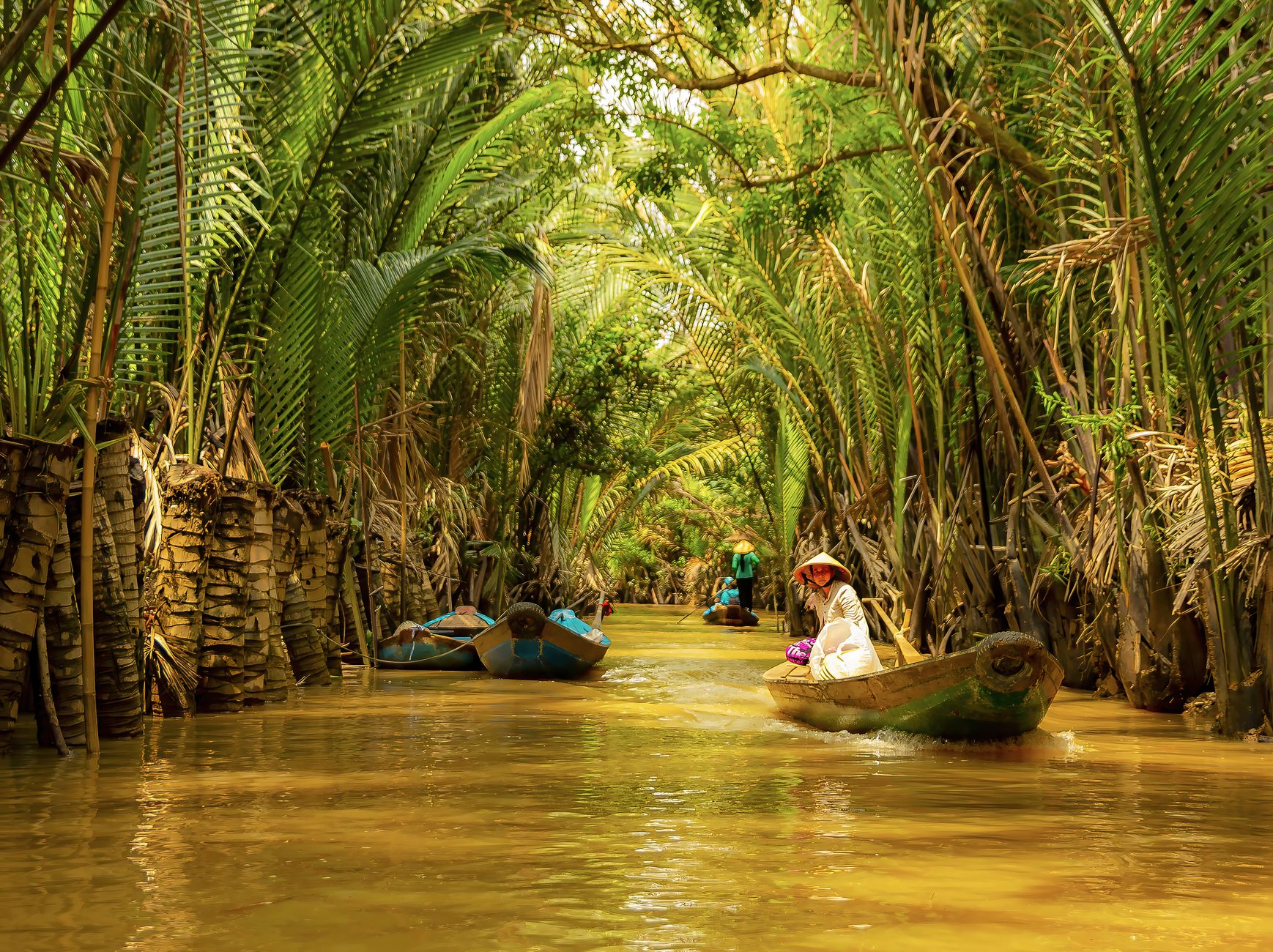
Photo by Alberto Capparelli on Pexels
The Monkey Colonies
U Minh Ha has a healthy population of crab-eating macaques, and they are not shy. The boat operators know where the colonies congregate, typically in the taller cajuput stands toward the park interior. The macaques move in groups of 20 to 40 animals, and when they're active in the canopy above your boat the noise is considerable.
A practical note: do not feed them. Not for abstract ecological reasons, but because macaques that associate boats with food become aggressive, and getting bitten in a swamp an hour from any hospital is a bad afternoon.
Mui Ca Mau — Vietnam's Southernmost Point
If you've come this far, tacking on Mui Ca Mau is worth the extra half-day. The cape sits about 100 km south of Ca Mau city by road and boat — the last stretch crosses the Dat Mui peninsula by road through shrimp farms and mangrove channels, then a short boat ride to the tip itself.
The landmark is a large monument marking the southernmost coordinate of Vietnamese territory on the mainland. It's not dramatic scenery in a postcard sense — the coast here is flat, mangrove-fringed, and working. But there's something that lands differently about standing at the actual bottom of a country. The Gulf of Thailand is on your left and the East Sea on your right, and the land just stops.
The area around Dat Mui village has a handful of simple guesthouses and seafood restaurants where grilled crab and "bun ca" (fish noodle soup) are the obvious orders. Prices are low — a full seafood meal for two runs 200,000–350,000 VND.

Photo by Michael Waddle on Pexels
When to Go
November through April is the dry season and the better window for both wildlife and road access. The wet season (May–October) floods sections of the park and makes some canal routes impassable, though the forest is lush and the bird nesting activity peaks in parts of this period. Avoid the week around Tet if you prefer fewer crowds at Mui Ca Mau — the monument draws Vietnamese domestic tourists heavily during that holiday.
Practical Notes
Bring cash — ATMs in Ca Mau city are fine, but there are none near the park or at Dat Mui. Accommodation in Ca Mau city is basic but functional, with options from 250,000–500,000 VND per night. The park has no English-language signage, so if you want context beyond what the boat operator provides, arranging a bilingual guide through your guesthouse in advance pays off.
Going to Vietnam? Eat and travel smarter.
Monthly: new dishes, off-the-beaten-path destinations, and itineraries — straight to your inbox. No spam. Unsubscribe anytime.
Join 0 expats. (We just launched.)
More from Southern Vietnam
Other articles covering the same region.

Long Hai and Ho Coc: The Quieter Beach Alternatives to Vung Tau
When Vung Tau feels too crowded, Saigon drivers push another 30-50 km east to Long Hai and Ho Coc — two coastal stretches that still feel like weekends used to.

Vinh Long Mekong Homestay: Orchards, Brick Kilns, and the Slow Boat Life
Vinh Long sits an hour from Can Tho but feels a world apart — island homestays, working orchards, and crumbling brick kilns that most Mekong tourists never reach.
Ben Tre: Coconut Country, Canal Boats, and the Mekong's Quietest Corner
Ben Tre moves slower than the rest of the Mekong Delta — fewer tour buses, more waterways, and coconut palms as far as you can see. Here's how to spend two days properly.
More in Destinations
More articles from the same category.

Bat Trang vs Phu Lang vs Chu Dau: Vietnam's Three Ceramic Villages Compared
Three villages, three completely different traditions in clay. Here's how Bat Trang, Phu Lang, and Chu Dau compare — and how to visit each from Hanoi.

Tet Nguyen Dan: What Really Happens During Vietnam's Lunar New Year Week
Tet shuts Vietnam down and lights it back up simultaneously. Here's what actually unfolds day by day — and how to navigate it as a visitor.

Hat Xam: The Blind Beggar Music of Vietnam Making a Comeback
Hat xam was sung by blind street performers for centuries — then nearly vanished. Here's where to hear it live in Hanoi today.

Vietnamese Calligraphy: The Ong Do Tradition and Where to Commission a Piece
Vietnam's 'ong do' calligraphy tradition peaks at Tet but survives year-round. Here's the history, where to find calligraphers in Hanoi and Saigon, and how to commission a piece.

Van Phuc Silk Village: The 1000-Year Loom Town Just Outside Hanoi
Twelve kilometers southwest of Hanoi's Old Quarter, Van Phuc has been weaving silk for over a millennium — and it's still the best place in the north to buy the real thing.

Son Mai: Vietnam's Lacquer Art, From Temple Walls to Hanoi Galleries
Son mai lacquerware is one of Vietnam's most technically demanding crafts. Here's how it's made, who the key artists are, and where to find the real thing in Hanoi.
Comments
Loading…