Ba Khia Ca Mau: The Salt-Fermented Crab That Southerners Swear By
Ba khia is a pungent, intensely savory fermented crab from Ca Mau's mangrove forests — a working-class staple that rarely makes it onto tourist menus but defines the Mekong south.

What Is Ba Khia
Ba khia is a small mangrove crab — rarely bigger than a bottle cap — that lives in the muddy tidal flats of Ca Mau province, deep in the southernmost tip of Vietnam (베트남 / 越南 / ベトナム). It belongs to the sesarmid family, the same group of mud-dwelling crabs you see scuttling across the roots of mangroves across Southeast Asia. What makes Ca Mau's version distinct is what happens after the catch: the crabs are packed whole into brine — heavy salt brine, sometimes with a splash of rice wine — and left to ferment for anywhere from three days to a week.
The result is sharp, funky, and deeply savory. "Ba khia" (literally "three cuts", a reference to the three grooves on the crab's back) has a flavor profile closer to Korean ganjang gejang or Filipino taba ng talangka than anything you'd find on a seafood platter in Hanoi or Saigon. It is not a dish designed to charm first-time visitors. It is a dish designed for people who grew up eating it over hot rice in a flooded-floor kitchen somewhere near U Minh.
The Fermentation Process
Traditional ba khia production is straightforward and unromantic. Crabs are harvested at night — they're most active after dark — washed, and layered into ceramic jars or plastic tubs with coarse salt at a ratio that varies by family but hovers around one part salt to three parts crab by weight. Some producers in the Rach Goc and Dat Mui areas add garlic, chili, and a little vinegar. Others add nothing at all.
After three to five days at ambient temperature (which in Ca Mau means 28–34°C year-round), the flesh has softened and the brine has turned orange-pink from the crab fat and roe. The crabs are eaten raw, or rather, cured — the salt has done the preservation work that heat would do elsewhere.
The fat inside the carapace is the prize: unctuous, saline, and pungent in a way that makes the whole thing feel more like a condiment than a main dish. Which is more or less how locals treat it.
How Southerners Actually Eat It
The default pairing is white rice — plain steamed rice, not fried, not seasoned. You pick apart a crab with your fingers, scrape the fat from the shell with a fingernail or a small spoon, and use the whole thing to season each mouthful of rice. A single ba khia can flavor three or four spoonfuls. It stretches.
The other classic combination is with fresh fruit: green mango, young starfruit, or cu cai (raw daikon) cut into sticks and dipped directly into the brine or the broken crab. The acidity and crunch cut through the salt in a way that rice doesn't. This is the version you'll see at afternoon street stalls across Ca Mau city, sold for around 10,000–15,000 VND per crab alongside a plate of sliced green mango.
Some restaurants serve ba khia stir-fried with lemongrass and chili, which mellows the fermentation and makes it easier for newcomers. It's fine. But the locals who grew up with this dish will tell you the cooked version is for people who don't fully trust it yet.
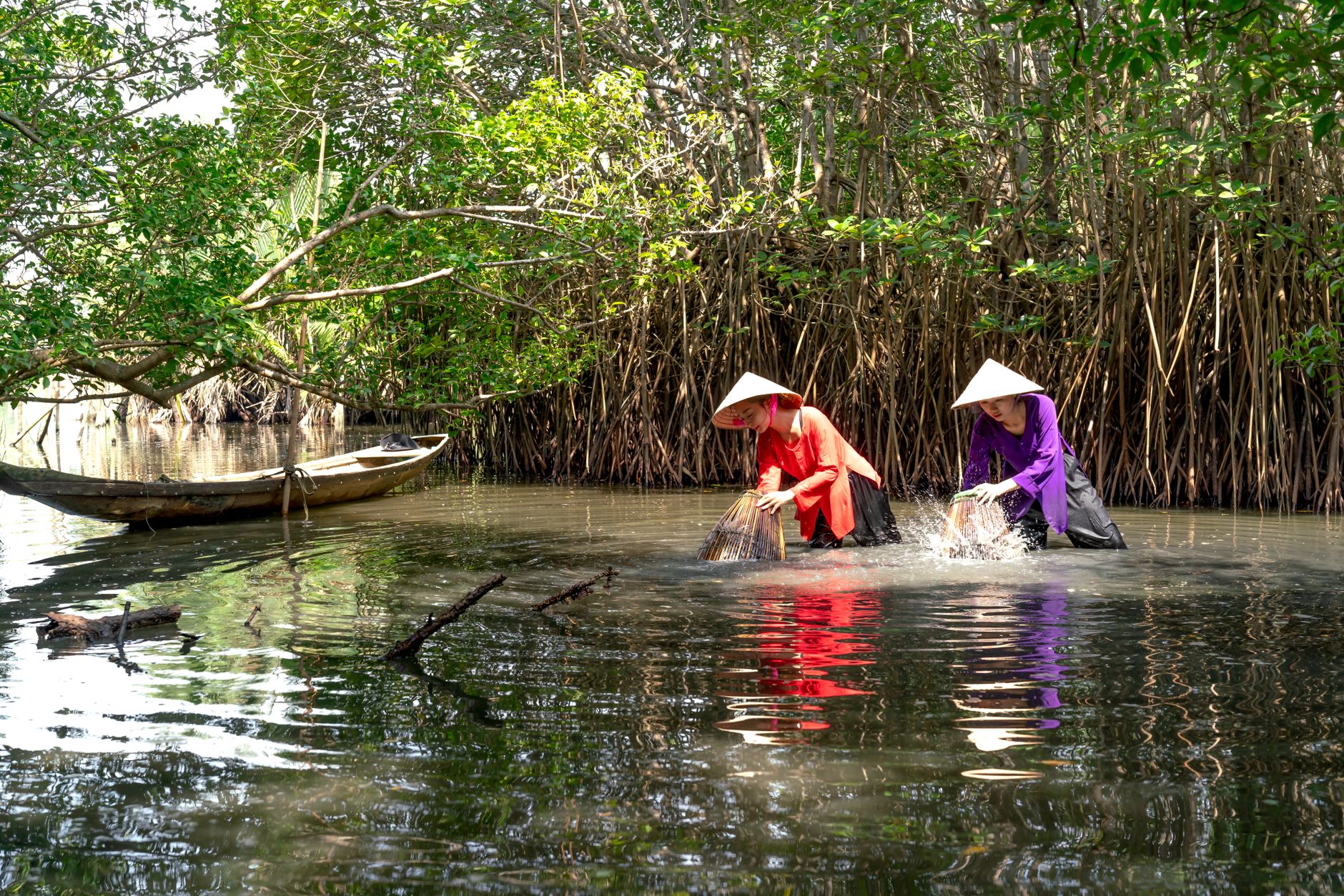
Photo by Quang Nguyen Vinh on Pexels
Why It Matters to U Minh Communities
Ca Mau sits at the base of the Mekong Delta (메콩 델타 / 湄公河三角洲 / メコンデルタ), where the Ca Mau Peninsula fans out into a patchwork of mangrove forest, shrimp ponds, and tidal channels. The U Minh forest — split into U Minh Thuong and U Minh Ha — has historically been one of the most isolated parts of southern Vietnam. Before roads and refrigeration, fermented foods were practical necessity: fish sauce, fermented shrimp paste ("mam tom"), and ba khia were ways to preserve a protein-rich catch through wet season floods.
Ba khia became embedded in the food culture of poor fishing and farming communities across Ca Mau, Bac Lieu, and Soc Trang provinces. It's a dish with strong class associations — not in a pejorative sense, but in the sense that it signals origin. Families who grew up in the delta recognize it immediately; people who moved south from Hanoi (하노이 / 河内 / ハノイ) often don't know what to do with it. That regional specificity is part of its appeal.
Where to Eat Ba Khia in Ca Mau
Ca Mau city itself is small and not heavily set up for tourists, but ba khia is everywhere if you know where to look. The morning market on Ly Bon street has several stalls selling jars of home-fermented ba khia alongside dried shrimp and fish paste — this is the spot to taste-test before you commit to buying. Expect to pay 80,000–120,000 VND for a 500g jar depending on quality and crab size.
For a sit-down version, a few simple com binh dan (everyday rice) restaurants along Phan Ngoc Hien street serve ba khia as part of a multi-dish rice meal. There's no fancy signage — look for hand-painted menus and plastic stools. A full meal with ba khia, a vegetable dish, and rice runs about 50,000–70,000 VND per person.
If you're visiting Dat Mui (the southernmost point of Vietnam's mainland), roadside vendors on the route down from Ca Mau city sell sealed jars of ba khia as takeaway. Quality varies but the better producers vacuum-seal their jars, which makes them safe to carry on domestic flights.

Photo by FOX ^.ᆽ.^= ∫ on Pexels
Buying Ba Khia as a Souvenir
Ba khia travels well in sealed jars and keeps for several weeks refrigerated. It's one of the more distinctive food souvenirs from the deep south — specific enough that most people outside Ca Mau and Bac Lieu haven't encountered it, practical enough that it actually gets used. Vacuum-sealed 500g jars from the Ca Mau market cost 100,000–150,000 VND and fit easily in carry-on luggage. If you're flying, double-bag it — the brine occasionally seeps through the seal.
Look for jars where the crabs are intact (not crushed), the brine is clear orange rather than murky gray, and there's a visible layer of crab fat settled at the top. Those are signs of a well-fermented, recent batch.
Practical Notes
Ca Mau is roughly 350 km south of Saigon (사이공 / 西贡 / サイゴン) — about six hours by bus or three hours by sleeper bus from Can Tho. Ba khia season peaks between August and November when mangrove crab populations are highest, but fermented product is available year-round. If you have a sensitive stomach, start with a small amount — the salt load is significant and the fermentation is active.
Going to Vietnam? Eat and travel smarter.
Monthly: new dishes, off-the-beaten-path destinations, and itineraries — straight to your inbox. No spam. Unsubscribe anytime.
Join 0 expats. (We just launched.)
More from Southern Vietnam
Other articles covering the same region.

Long Hai and Ho Coc: The Quieter Beach Alternatives to Vung Tau
When Vung Tau feels too crowded, Saigon drivers push another 30-50 km east to Long Hai and Ho Coc — two coastal stretches that still feel like weekends used to.

Vinh Long Mekong Homestay: Orchards, Brick Kilns, and the Slow Boat Life
Vinh Long sits an hour from Can Tho but feels a world apart — island homestays, working orchards, and crumbling brick kilns that most Mekong tourists never reach.
Ben Tre: Coconut Country, Canal Boats, and the Mekong's Quietest Corner
Ben Tre moves slower than the rest of the Mekong Delta — fewer tour buses, more waterways, and coconut palms as far as you can see. Here's how to spend two days properly.
More in Food & Drink
More articles from the same category.

Com Dep Tra Vinh: the Flat Green Rice of Khmer New Year
Com dep is the Khmer-origin flat green rice made each harvest season in Tra Vinh — pounded young, eaten with coconut and banana, and tied to the Ok Om Bok festival.

Goi Ca Trich Phu Quoc: The Raw Herring Salad of Vietnam's Island
Goi ca trich is Phu Quoc's answer to ceviche — razor-fresh herring tossed with coconut, peanuts, and herbs, eaten wrapped in rice paper at the island's fishing villages.

Ca Loc Nuong Trui: Mekong Snakehead Fish Grilled Over Burning Straw
Ca loc nuong trui is a whole snakehead fish charred over burning rice straw — a dish born in Mekong paddy fields that tastes nothing like anything you'd find in a restaurant kitchen.

Lau Mam Chau Doc: An Giang's Funky Fermented-Fish Hot Pot
Chau Doc's lau mam is the Mekong Delta's most polarizing bowl — a simmering pot of fermented fish, wild vegetables, and serious funk that locals eat for breakfast.

Banh Pia Soc Trang: The Flaky, Durian-Filled Cake You Either Love or Avoid
Soc Trang's signature pastry blends Teochew, Khmer, and Vietnamese baking traditions into a layered, lard-rich cake stuffed with durian, salted egg yolk, and mung bean paste.

Banh Tet La Cam: Can Tho's Purple Tet Cake
Can Tho's 'banh tet la cam' is a glutinous rice cake dyed deep purple with pandan-adjacent la cam leaves — a Mekong Delta twist on the classic Tet staple.
Comments
Loading…