Ca Loc Nuong Trui: Mekong Snakehead Fish Grilled Over Burning Straw
Ca loc nuong trui is a whole snakehead fish charred over burning rice straw — a dish born in Mekong paddy fields that tastes nothing like anything you'd find in a restaurant kitchen.

Whole snakehead fish, impaled on a bamboo skewer, held over a burning pile of rice straw until the skin turns to char and the flesh steams inside its own crust. That is "ca loc nuong trui" — no marinade, no prep, barely any equipment. It is field food, invented by farmers who had a fish, a fire, and ten minutes.
Where the Dish Comes From
The Mekong Delta (메콩 델타 / 湄公河三角洲 / メコンデルタ) floods every year between July and November. When the water rises, snakehead fish — ca loc — move out of the canals and into the paddies. Farmers working those fields would catch them bare-handed or with hand nets, then cook them on the spot using whatever was nearby: dried rice straw, left over from the harvest. The technique is not refined. You pile the straw, light it, hold the fish over the flame, and let the intense, fast-burning heat do the work. The straw fire is short and ferocious — it doesn't smolder, it flares. That's the point. The skin blackens and locks in moisture; the flesh inside stays dense and almost sweet.
The dish migrated from the fields into home cooking, then into restaurants. But the best versions still taste like the original — simple, smoky, with a slight bitterness from the char.
The Technique: Why Straw Matters
Rice straw burns at a high temperature and burns fast. Charcoal gives a slow, steady heat. Straw gives a violent, short blast. That difference matters. A ca loc grilled over charcoal is fine. Ca loc nuong trui, done properly over straw, has a specific texture: a thin, papery, blackened skin that peels away cleanly, and flesh that hasn't dried out because the cooking time is so short.
The fish used is always whole — gutted but with the head and tail on, typically 600g to 1kg. Smaller fish overcook too fast; larger fish don't get enough heat to the center. A skilled cook rotates the skewer constantly and reads the fire, pulling the fish back when the straw burns too high. There's no thermometer involved. It's the kind of technique that looks simple and takes practice to get right.
After grilling, the charred skin is scraped away at the table. What's underneath is white, slightly smoky flesh that you pull apart with chopsticks.

Photo by VINVIVU ® on Pexels
How It's Eaten
This is not a dish you eat with a fork. Ca loc nuong trui is a "banh trang" meal — you wrap everything in rice paper. At the table you get: a whole grilled fish on a plate, a tray of fresh herbs (perilla, mint, bean sprouts, sliced banana blossom, cucumber, green banana), dried rice paper rounds, and a bowl of "nuoc mam" — specifically, the southern-style nuoc mam cham, made with fish sauce, lime, sugar, garlic, and chili.
The move is to soften a sheet of dried rice paper briefly over steam or by dipping it quickly in water, then lay in a piece of fish, a few herb leaves, some bean sprouts, and roll it loosely. Dip in the nuoc mam. The bitterness of the char, the fat of the fish, the green freshness of the herbs, the salt-acid punch of the dipping sauce — it is a complete bite in a way that feels accidental but isn't.
Where to Eat It in the Delta
In Can Tho, the riverside strip along Hai Ba Trung has several restaurants that do ca loc nuong trui properly. Quan Ut Dzach, about 3km south of Ninh Kieu Wharf, is known locally for sourcing fish from the morning market rather than farmed stock — the difference in flavor is noticeable. Expect to pay 120,000–180,000 VND for a whole fish, depending on size and season.
In An Giang province, particularly around Chau Doc and the stretch of river near Sam Mountain, the dish is even more common — this area is deeper into flood-plain territory and ca loc is a local staple. Small family restaurants along the road between Chau Doc and Long Xuyen will have it on the menu most evenings. Prices here run cheaper: 90,000–130,000 VND per fish.
Look for places that actually grill over straw rather than charcoal. If you can smell the straw smoke before you sit down, you're in the right place. Some tourist-facing restaurants in Can Tho (껀터 / 芹苴 / カントー) use charcoal and still call it nuong trui — it's not the same thing and the locals know it.
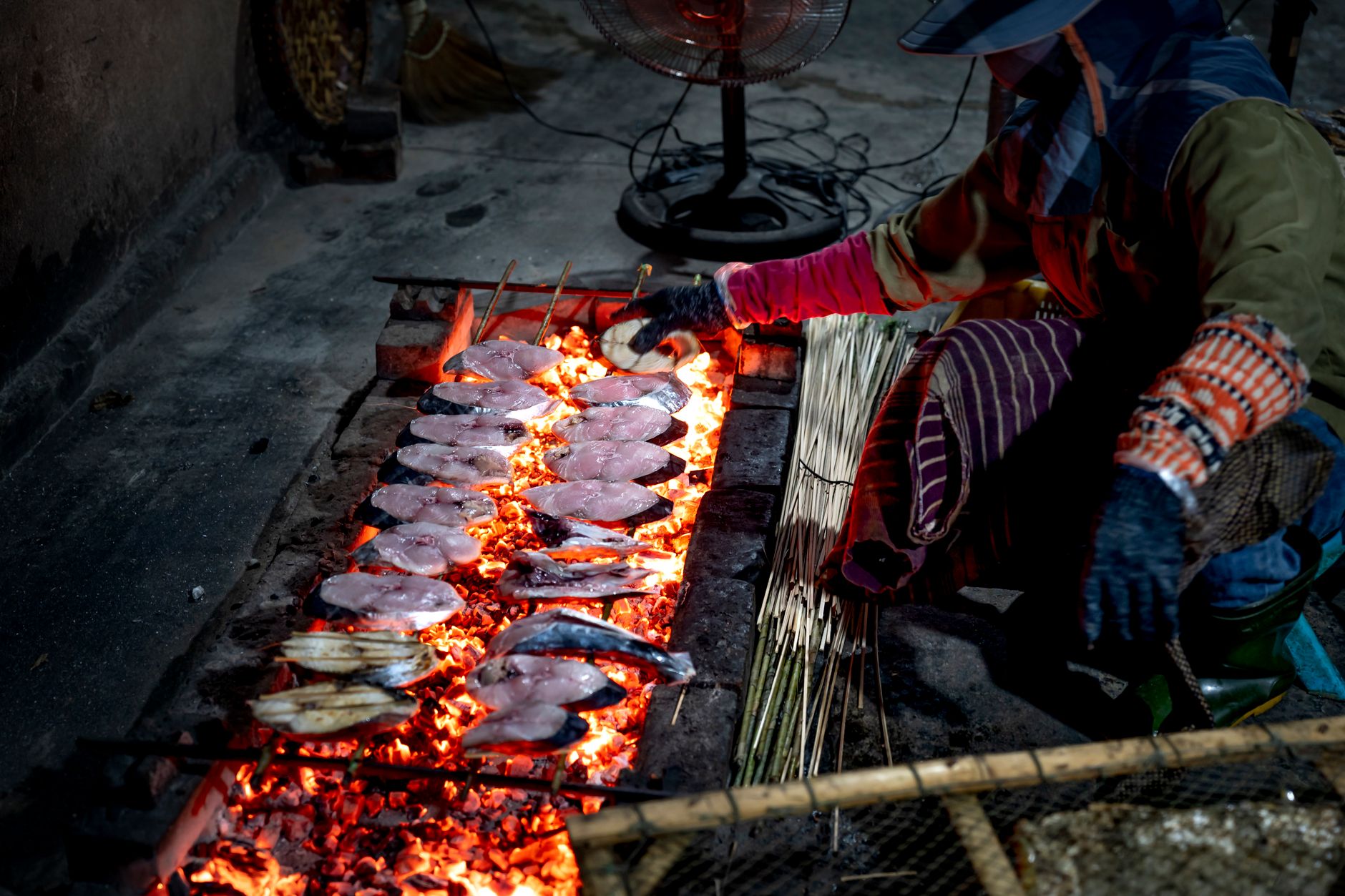
Photo by Quang Nguyen Vinh on Pexels
Where to Learn the Cooking
Can Tho has a small but functional cooking school scene. Hoa Su Cooking Class, operating out of a family home near the Phong Dien floating market, includes ca loc nuong trui in its full-day Mekong program. The class takes you to the morning market to pick the fish, then covers the straw-fire technique hands-on. It runs around 650,000 VND per person including the market visit and lunch.
Several homestays along the river between Can Tho and An Giang also offer informal cooking sessions — less structured, but you're more likely to learn from someone who grew up making it. Ask at your guesthouse in Chau Doc; most can connect you with a family that does this for small groups.
If you're already planning a broader delta trip, pairing ca loc nuong trui with a morning at the floating markets and a bowl of "hu tieu" for breakfast makes for a full day of Mekong eating with almost no overlap in flavor or technique.
Practical Notes
Ca loc is a seasonal fish — the best specimens come from the flood season (roughly August to November), when wild-caught fish are available and the flesh is denser. Outside that window, most restaurants use farmed ca loc, which is acceptable but milder. The dish appears on menus year-round in Can Tho and An Giang; just know what you're getting in the dry months.
Going to Vietnam? Eat and travel smarter.
Monthly: new dishes, off-the-beaten-path destinations, and itineraries — straight to your inbox. No spam. Unsubscribe anytime.
Join 0 expats. (We just launched.)
More from can-tho
Other articles covering this city.

Lau Mam Chau Doc: An Giang's Funky Fermented-Fish Hot Pot
Chau Doc's lau mam is the Mekong Delta's most polarizing bowl — a simmering pot of fermented fish, wild vegetables, and serious funk that locals eat for breakfast.

Banh Tet La Cam: Can Tho's Purple Tet Cake
Can Tho's 'banh tet la cam' is a glutinous rice cake dyed deep purple with pandan-adjacent la cam leaves — a Mekong Delta twist on the classic Tet staple.

7 Days in Vietnam: A Yoga and Meditation Itinerary
A week-long route through Vietnam's quietest corners: Sapa's mountain silence, a meditation center in the Mekong, and coastal stillness in Da Lat. Real costs, transport, and retreat recommendations.
More from Southern Vietnam
Other articles covering the same region.

Long Hai and Ho Coc: The Quieter Beach Alternatives to Vung Tau
When Vung Tau feels too crowded, Saigon drivers push another 30-50 km east to Long Hai and Ho Coc — two coastal stretches that still feel like weekends used to.

Vinh Long Mekong Homestay: Orchards, Brick Kilns, and the Slow Boat Life
Vinh Long sits an hour from Can Tho but feels a world apart — island homestays, working orchards, and crumbling brick kilns that most Mekong tourists never reach.
Ben Tre: Coconut Country, Canal Boats, and the Mekong's Quietest Corner
Ben Tre moves slower than the rest of the Mekong Delta — fewer tour buses, more waterways, and coconut palms as far as you can see. Here's how to spend two days properly.
More in Food & Drink
More articles from the same category.

Com Dep Tra Vinh: the Flat Green Rice of Khmer New Year
Com dep is the Khmer-origin flat green rice made each harvest season in Tra Vinh — pounded young, eaten with coconut and banana, and tied to the Ok Om Bok festival.

Goi Ca Trich Phu Quoc: The Raw Herring Salad of Vietnam's Island
Goi ca trich is Phu Quoc's answer to ceviche — razor-fresh herring tossed with coconut, peanuts, and herbs, eaten wrapped in rice paper at the island's fishing villages.

Ba Khia Ca Mau: The Salt-Fermented Crab That Southerners Swear By
Ba khia is a pungent, intensely savory fermented crab from Ca Mau's mangrove forests — a working-class staple that rarely makes it onto tourist menus but defines the Mekong south.

Banh Pia Soc Trang: The Flaky, Durian-Filled Cake You Either Love or Avoid
Soc Trang's signature pastry blends Teochew, Khmer, and Vietnamese baking traditions into a layered, lard-rich cake stuffed with durian, salted egg yolk, and mung bean paste.

Banh Trang Phoi Suong Tay Ninh: The Dew-Dried Rice Paper Behind Vietnam's Best Pork Rolls
The rice paper from Trang Bang district in Tay Ninh is air-dried overnight in open fields, giving it a soft, pliable texture that needs no soaking — and it's the only wrapper worth using for banh trang cuon thit heo.

Ca Phe Buon Ma Thuot: Where Vietnamese Robusta Comes From
Buon Ma Thuot in Dak Lak province grows roughly 30% of the world's robusta coffee. Here's what that means for your cup and how to explore it on the ground.
Comments
Loading…