Sam Mountain, Chau Doc: Pilgrimage Sites and the View into Cambodia
Sam Mountain rises sharply from the Mekong Delta flatlands near Chau Doc, packing in active pilgrimage temples, a cable car, and a hilltop view that reaches across the Cambodian border.

Sam Mountain rises only 284 metres above sea level, but out here in the dead-flat Mekong Delta (메콩 델타 / 湄公河三角洲 / メコンデルタ) it looks enormous. The mountain — Nui Sam in Vietnamese — sits about 5 km southwest of Chau Doc town and draws both devout Vietnamese pilgrims and curious travellers who want to see where the delta runs out and Cambodia begins.
Ba Chua Xu Temple — the Reason Most People Come
At the base of the mountain's southwestern slope sits the Ba Chua Xu Temple, dedicated to the Holy Mother of the Realm, one of the most visited religious sites in southern Vietnam (베트남 / 越南 / ベトナム). The main structure was rebuilt in the 1970s and expanded since, and it functions more like a small religious campus than a single pagoda — incense coils hang from the ceiling in thick clouds, offerings of roast pig and fresh fruit pile up on tiered altars, and worshippers move through in a constant stream.
The biggest draw is the Ba Chua Xu Festival, which runs from the 23rd to the 27th day of the fourth lunar month (usually falling in May on the Gregorian calendar). During those five days the site fills with tens of thousands of pilgrims from across the south — An Giang, Can Tho, Saigon, the whole delta. The ceremonial bathing and re-robing of the statue on the night of the 23rd is the emotional peak of the festival. If you're visiting outside the festival period, the temple is still busy but calm enough to walk around slowly.
Tay An Pagoda
About 100 metres from the Ba Chua Xu entrance, Tay An Pagoda is worth 20 minutes of your time. The facade is a dense layering of coloured figures — elephants flank the entrance, the roof tiers are crowded with carved animals and deities. Inside, over 200 statues line the halls in varying sizes. It's a hybrid of Buddhist, Taoist, and folk-religion iconography that's very typical of southern Vietnamese religious architecture, and it's a good visual contrast to the more solemn Ba Chua Xu compound next door.
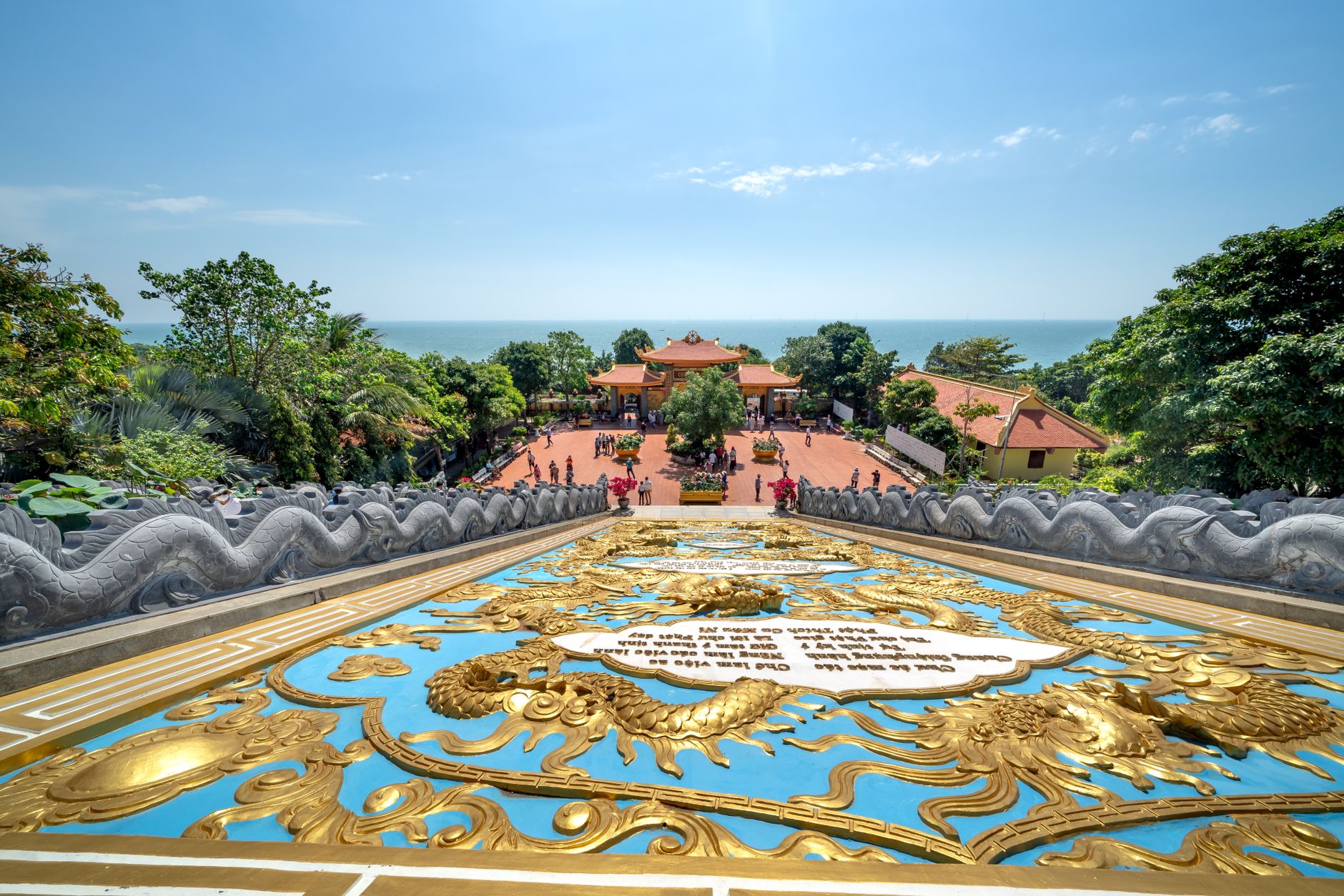
Photo by Quang Nguyen Vinh on Pexels
Getting Up the Mountain
You have two options: the cable car or your legs.
The cable car (roughly 120,000 VND return) runs from a station near the temple cluster up to a point near the summit pagoda. The ride takes about eight minutes each way and gives you an early sense of the scale — the delta stretches out in every direction, rice paddies and fish ponds and the grey-green ribbon of the Vinh Te Canal running toward the border.
The hiking route winds up through a series of smaller shrines and rest stops, taking around 45 minutes at a relaxed pace. Local vendors sell fresh coconut and sugar cane juice at intervals. Most Vietnamese pilgrims do this route on foot, stopping to pray at the shrines along the way. The path is paved but steep in sections — decent shoes help.
The Summit View
At the top, past the Nguyet Quang Pagoda and a statue of Phat Thay Tay An, the viewing area opens west. On a clear morning — before the delta haze builds — you can see across the Vinh Te Canal and into Cambodian territory: flat agricultural land, a different shade of green, the road that runs toward Takeo. There's no dramatic landmark on the other side, just the strange quiet satisfaction of standing at an edge. The border here is about 3 km from the summit as the crow flies.
Sunrise visits are popular for a reason. Get up before 6 a.m., ride a xe om from Chau Doc town to the base, and you'll have the upper paths nearly to yourself before the tour buses from Can Tho (껀터 / 芹苴 / カントー) arrive around 8:30 a.m.

Photo by maxed. RAW on Pexels
Combining Sam Mountain with Tra Su Cajuput Forest
Tra Su, a flooded cajuput forest about 25 km north of Chau Doc, pairs well with a Sam Mountain morning. The usual approach: arrive at Sam Mountain by 6 a.m., spend two to three hours between the temples and the summit, then have a bowl of "bun ca" (fish noodle soup) at one of the stalls near the pagoda base — it's the local breakfast of choice around here — and drive up to Tra Su for an afternoon boat trip through the cajuput trees. You'll be back in Chau Doc by early evening.
Hire a motorbike in Chau Doc town (around 120,000–150,000 VND per day) and both sites are manageable in a single day without booking a tour.
Practical Notes
Chau Doc is a 30-minute speedboat ride or about four hours by road from Can Tho, making it a natural extension of a Mekong Delta circuit that might also include a night in Can Tho. Accommodation near the mountain is cheaper than in town — several guesthouses cluster along the road to Ba Chua Xu for under 300,000 VND a night. Dress modestly for the temple complex: shoulders and knees covered is the expected standard.
Going to Vietnam? Eat and travel smarter.
Monthly: new dishes, off-the-beaten-path destinations, and itineraries — straight to your inbox. No spam. Unsubscribe anytime.
Join 0 expats. (We just launched.)
More from an-giang
Other articles covering this city.

Lau Mam Chau Doc: An Giang's Funky Fermented-Fish Hot Pot
Chau Doc's lau mam is the Mekong Delta's most polarizing bowl — a simmering pot of fermented fish, wild vegetables, and serious funk that locals eat for breakfast.
More from Southern Vietnam
Other articles covering the same region.

Long Hai and Ho Coc: The Quieter Beach Alternatives to Vung Tau
When Vung Tau feels too crowded, Saigon drivers push another 30-50 km east to Long Hai and Ho Coc — two coastal stretches that still feel like weekends used to.

Vinh Long Mekong Homestay: Orchards, Brick Kilns, and the Slow Boat Life
Vinh Long sits an hour from Can Tho but feels a world apart — island homestays, working orchards, and crumbling brick kilns that most Mekong tourists never reach.
Ben Tre: Coconut Country, Canal Boats, and the Mekong's Quietest Corner
Ben Tre moves slower than the rest of the Mekong Delta — fewer tour buses, more waterways, and coconut palms as far as you can see. Here's how to spend two days properly.
More in Destinations
More articles from the same category.

Bat Trang vs Phu Lang vs Chu Dau: Vietnam's Three Ceramic Villages Compared
Three villages, three completely different traditions in clay. Here's how Bat Trang, Phu Lang, and Chu Dau compare — and how to visit each from Hanoi.

Tet Nguyen Dan: What Really Happens During Vietnam's Lunar New Year Week
Tet shuts Vietnam down and lights it back up simultaneously. Here's what actually unfolds day by day — and how to navigate it as a visitor.

Hat Xam: The Blind Beggar Music of Vietnam Making a Comeback
Hat xam was sung by blind street performers for centuries — then nearly vanished. Here's where to hear it live in Hanoi today.

Vietnamese Calligraphy: The Ong Do Tradition and Where to Commission a Piece
Vietnam's 'ong do' calligraphy tradition peaks at Tet but survives year-round. Here's the history, where to find calligraphers in Hanoi and Saigon, and how to commission a piece.

Van Phuc Silk Village: The 1000-Year Loom Town Just Outside Hanoi
Twelve kilometers southwest of Hanoi's Old Quarter, Van Phuc has been weaving silk for over a millennium — and it's still the best place in the north to buy the real thing.

Son Mai: Vietnam's Lacquer Art, From Temple Walls to Hanoi Galleries
Son mai lacquerware is one of Vietnam's most technically demanding crafts. Here's how it's made, who the key artists are, and where to find the real thing in Hanoi.
Comments
Loading…