Banh Phu The Bac Ninh: The Wedding Cake of Northern Vietnam
Bac Ninh's 'banh phu the' is a translucent, mung-bean-filled steamed cake tied to a thousand-year-old legend of marital devotion — and still central to northern wedding tables today.

Few Vietnamese sweets carry as much symbolic weight as "banh phu the" — literally "husband and wife cake" — the jewel-like steamed confection that has been placed on wedding trays in Bac Ninh for over a thousand years. If you've attended a northern Vietnamese wedding and wondered about those small, amber-colored parcels wrapped in dried banana leaf, this is what you were eating.
The Legend Behind the Name
The origin story attached to banh phu the is one of those tales that gets retold at every Bac Ninh grandmother's kitchen table. A king, about to leave for war, asked his wife to make a cake that would remind him of her faithfulness while he was away. She crafted a small, translucent square — soft on the outside, sweet at the center — and the king supposedly declared that eating it kept her memory close. The cake's two halves, pressed together inside a single leaf parcel, represent the inseparability of husband and wife.
Whether or not the story is historically traceable, it stuck. Banh phu the became embedded in the ritual logic of northern weddings: you don't just give guests food, you give them a symbol.
What's Inside
The outer shell is made from a mixture of glutinous rice flour and tapioca starch, which gives it that characteristic semi-transparency once steamed — you can faintly see the filling through the skin. Some versions add a small amount of pandan juice for a pale green tint, though the traditional Bac Ninh style tends toward a natural amber-yellow from the dried leaf mold it's pressed into.
The filling is straightforward but precise: split mung beans, soaked and steamed until soft, then mashed with sugar and dried coconut shreds. A few versions add a small piece of candied winter melon (bi dao) for extra chew. The ratio matters — too much sugar and the filling turns cloying; too little and the whole thing tastes flat against the neutral dough. A good banh phu the holds a clean sweetness, slightly grainy from the coconut, with the mung bean giving it just enough density to feel substantial without being heavy.
The cakes are formed in small rectangular wooden or plastic molds, then wrapped tightly in pairs inside a dried banana leaf or dong leaf casing, tied with a length of straw or twine. That pairing — two cakes per parcel — reinforces the wedding symbolism.
Photo by Studio Dreamview on Pexels
Why Weddings
In the logic of northern Vietnamese ceremonies, food gifts carry meaning beyond nutrition. A wedding tray (mam qua) traditionally includes areca nuts, betel leaves, rice wine, and banh phu the among the offerings exchanged between the two families. The cake's name alone makes the messaging obvious, but the durability matters too: banh phu the keeps for two to three days without refrigeration, which made it practical for multi-day wedding ceremonies when refrigeration wasn't an option.
Bac Ninh weddings, in particular, have historically been elaborate affairs tied to the province's Quan Ho folk singing tradition — a UNESCO-recognized form of call-and-response courtship singing. "Quan Ho" and banh phu the exist in the same cultural orbit: both are about courtship, devotion, and community. You'll find the cakes at engagement ceremonies, the formal wedding day, and sometimes at the one-month anniversary celebration.
Where to Buy: Dinh Bang Village
If you want the real thing, go to Dinh Bang, a village in Tu Son district roughly 20 km north of Hanoi and about 12 km southwest of Bac Ninh city. Dinh Bang is the production heartland — a handful of households here have been making banh phu the for generations, and the craft is genuinely artisanal rather than industrial.
The main cluster of sellers operates out of home workshops along the village's central lane. Prices run around 5,000–8,000 VND per pair (one parcel of two cakes) for standard size. For wedding orders — which come in trays of 50 to 200 pairs — families typically commission directly and collect a day or two before the ceremony. If you're visiting without a commission, most households will sell retail to walk-in customers, and a morning visit (before 10 a.m.) catches them freshly made.
Dinh Bang is also worth a visit in its own right: the 18th-century communal house (dinh Dinh Bang) is considered one of the finest surviving examples of traditional northern Vietnamese wooden architecture, and the village sits along a route that pairs naturally with a day trip from Hanoi (하노이 / 河内 / ハノイ) through the Bac Ninh countryside.
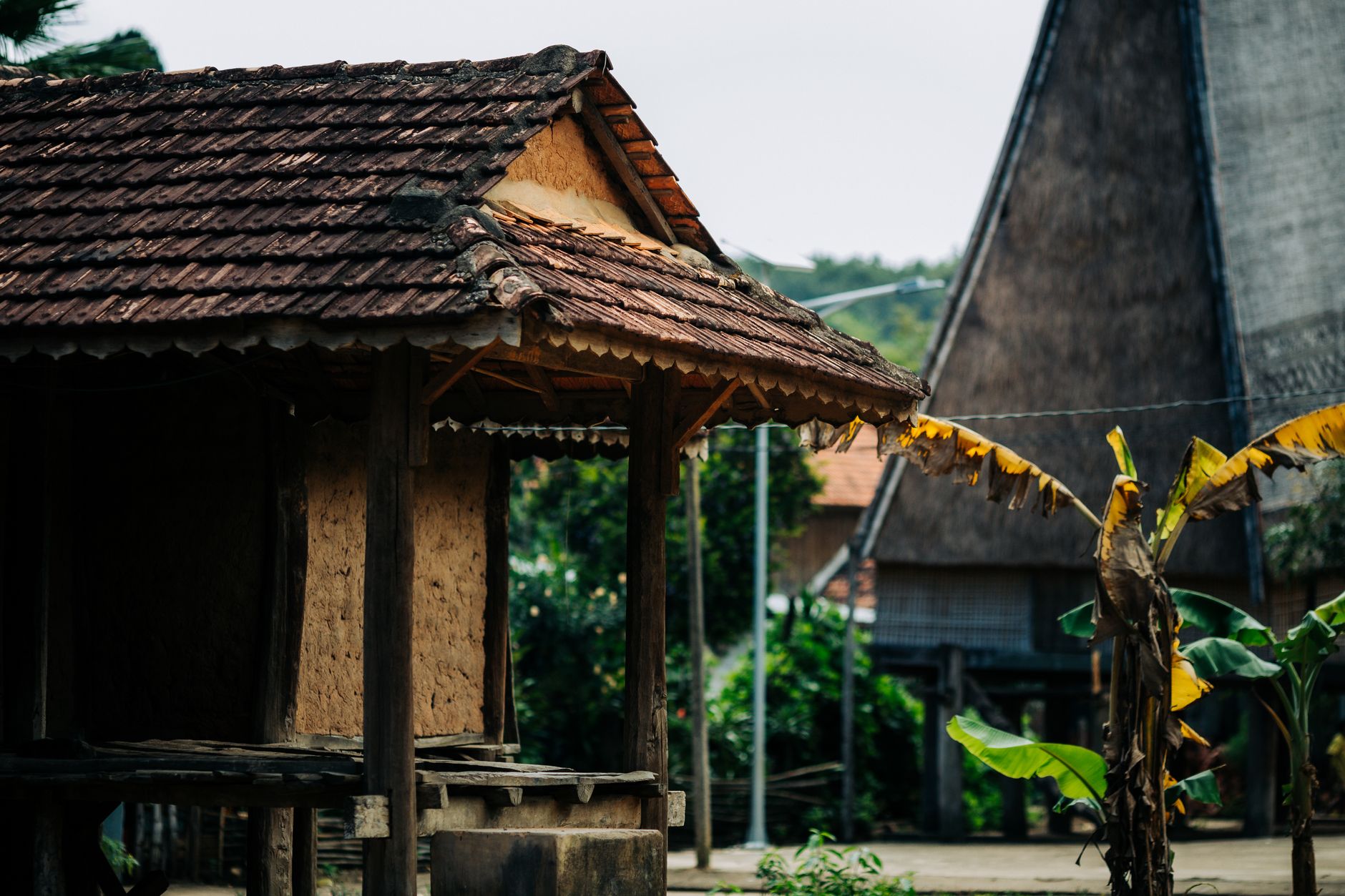
Photo by Thái Trường Giang on Pexels
Traditional vs. Modern Versions
The traditional version — mung bean, dried coconut, no food coloring, wrapped in dried leaf — is still what you get at Dinh Bang. In Bac Ninh city's market stalls and in Hanoi specialty cake shops, you'll encounter modernized variants: fillings that include durian, taro, or lotus seed paste; brightly colored outer skins tinted pink, green, or purple; and vacuum-sealed plastic packaging that extends shelf life to a week or more.
These aren't necessarily inferior — the lotus seed version in particular is worth trying — but they've drifted from the original. If you want to taste what's been placed on wedding trays here for a thousand years, the Dinh Bang version is the reference point.
Practical Notes
Dinh Bang is a straightforward 35–40 minute drive from Hanoi via National Highway 1A; Grab taxis or a hired motorbike are the most practical options. Bac Ninh city itself is reachable by local bus from Hanoi's My Dinh station (around 15,000 VND, 45 minutes). Banh phu the does not travel well in heat — if you're bringing some back to Hanoi, keep them out of direct sun and eat within two days.
Going to Vietnam? Eat and travel smarter.
Monthly: new dishes, off-the-beaten-path destinations, and itineraries — straight to your inbox. No spam. Unsubscribe anytime.
Join 0 expats. (We just launched.)
More from bac-ninh
Other articles covering this city.

Where to Stay in Bac Ninh: Neighborhoods & Hotels by Budget
Bac Ninh is a compact province north of Hanoi known for ceramic villages and temples. Here's how to pick a neighborhood and hotel that matches your budget and pace.

Bac Ninh: What to Do — A Traveler's Guide
Bac Ninh is Vietnam's pottery and silk capital, an hour north of Hanoi. Skip the generic tour stops; instead, spend time in village workshops, catch a water puppet show, and eat com tam at a family stall.

Bac Ninh Best Time to Visit: A Traveler's Guide
Bac Ninh's industrial charm peaks in spring and autumn. Skip the summer heat and winter crowds around Tet to plan a smarter trip to this underrated northern province.
More from Northern Vietnam
Other articles covering the same region.

Hat Xam: The Blind Beggar Music of Vietnam Making a Comeback
Hat xam was sung by blind street performers for centuries — then nearly vanished. Here's where to hear it live in Hanoi today.

Van Phuc Silk Village: The 1000-Year Loom Town Just Outside Hanoi
Twelve kilometers southwest of Hanoi's Old Quarter, Van Phuc has been weaving silk for over a millennium — and it's still the best place in the north to buy the real thing.

Banh Gai Ninh Giang: The Black Sticky Rice Cake from Hai Duong
Banh gai from Ninh Giang district is one of northern Vietnam's most distinctive regional sweets — jet-black, leaf-wrapped, and nothing like the sticky rice cakes sold elsewhere.
More in Food & Drink
More articles from the same category.

Com Dep Tra Vinh: the Flat Green Rice of Khmer New Year
Com dep is the Khmer-origin flat green rice made each harvest season in Tra Vinh — pounded young, eaten with coconut and banana, and tied to the Ok Om Bok festival.

Goi Ca Trich Phu Quoc: The Raw Herring Salad of Vietnam's Island
Goi ca trich is Phu Quoc's answer to ceviche — razor-fresh herring tossed with coconut, peanuts, and herbs, eaten wrapped in rice paper at the island's fishing villages.

Ca Loc Nuong Trui: Mekong Snakehead Fish Grilled Over Burning Straw
Ca loc nuong trui is a whole snakehead fish charred over burning rice straw — a dish born in Mekong paddy fields that tastes nothing like anything you'd find in a restaurant kitchen.

Ba Khia Ca Mau: The Salt-Fermented Crab That Southerners Swear By
Ba khia is a pungent, intensely savory fermented crab from Ca Mau's mangrove forests — a working-class staple that rarely makes it onto tourist menus but defines the Mekong south.

Lau Mam Chau Doc: An Giang's Funky Fermented-Fish Hot Pot
Chau Doc's lau mam is the Mekong Delta's most polarizing bowl — a simmering pot of fermented fish, wild vegetables, and serious funk that locals eat for breakfast.

Banh Pia Soc Trang: The Flaky, Durian-Filled Cake You Either Love or Avoid
Soc Trang's signature pastry blends Teochew, Khmer, and Vietnamese baking traditions into a layered, lard-rich cake stuffed with durian, salted egg yolk, and mung bean paste.
Comments
Loading…