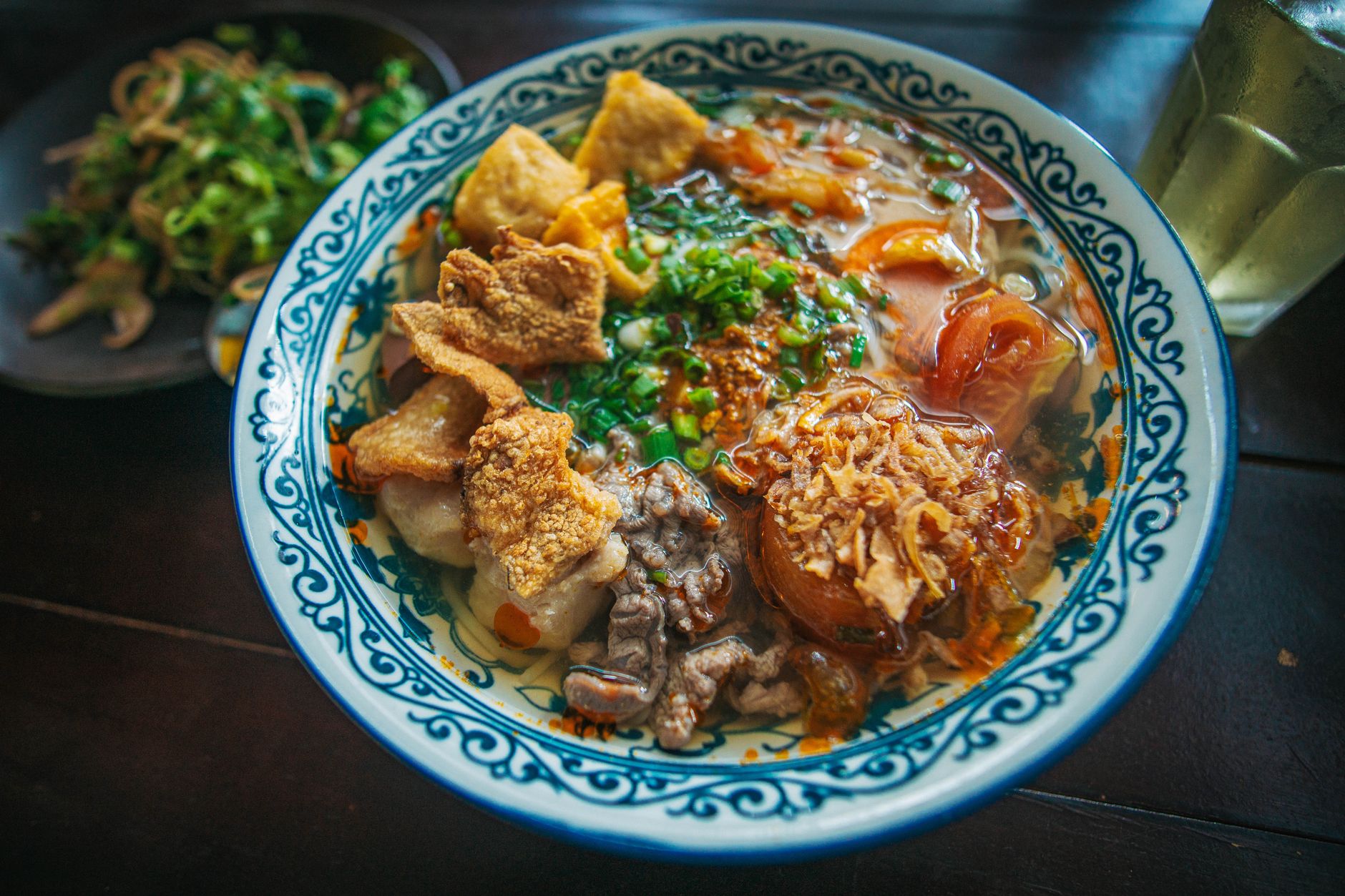
"Bun cha (분짜 / 烤肉米粉 / ブンチャー)" is Hanoi's default lunch. Walk any Old Quarter alley between 11 a.m. and 1 p.m. and you'll hit charcoal smoke, the smell of pork fat dripping onto coals, and plastic stools occupied by office workers and moto drivers eating fast.
The structure never changes: cold vermicelli noodles, a bowl of warm fish-sauce broth with grilled pork swimming in it, a plate of herbs, and pickled green papaya on the side. You dip the noodles and herbs into the broth, fish out the pork, repeat. It's a assembly-line operation, but when the pork is charred right and the broth is balanced, it works.
Barack Obama and Anthony Bourdain ate bun cha at Huong Lien on "Ngo" Thi Nham in 2016, which turned that shop into a mandatory photo-op. But Huong Lien was solid before Obama, and dozens of other places across Hanoi do it just as well — sometimes better.
What Goes Into Bun Cha
Cha (the pork): Two cuts. "Cha vien" are hand-formed patties made from minced pork shoulder — fatty enough to stay juicy over charcoal. "Cha mieng" are thin slices of pork belly, skin removed, grilled until the edges caramelize. Some places wrap the patties in banana leaf before grilling to keep them from drying out. You can order one or both.
Marination is simple: fish sauce (protein content over 35%), sugar, black pepper, minced shallots, and a little lard or vegetable oil. The pork goes onto a charcoal grill — no gas, no oven. Charcoal is non-negotiable. Once cooked, it goes directly into the dipping broth while still hot.
"Nuoc cham" (the broth): Diluted fish sauce base with sugar, lime juice, rice vinegar, minced garlic, minced chili, and sometimes a drop of "tinh dau ca cuong" (essence from a giant water bug, illegal to harvest now but still shows up). The broth should be warm, not scalding. Sour-sweet-salty balance is everything. Too salty and you'll need water; too sweet and it tastes like dessert.
Bun (noodles): Cold vermicelli, served in a separate basket. Traditionally it was "bun con" — small, tightly coiled portions you could pick up in one bite. Now most places use "bun roi", loose vermicelli that you portion yourself.
"Rau song" (herbs): Lettuce, perilla, mint, cilantro, ngo (rice paddy herb), "kinh gioi" (Vietnamese balm). The herb plate should be bigger than the noodle basket. You use the lettuce as a wrap, stuff it with noodles and pork, dip.
"Dua gop" (pickles): Green papaya, shredded and pickled in vinegar-sugar brine. Carrots or kohlrabi work too. The acidity cuts the pork fat.
On the table: extra garlic, chili, vinegar, black pepper, kumquats. Adjust the broth yourself.
How to Eat It
You don't pour the broth over the noodles. The noodles stay cold. You dip.
- Pick up a small bundle of noodles with chopsticks.
- Dunk into the broth, swirl, lift out.
- Add herbs, pickles, a piece of pork.
- Eat in one or two bites.
- Repeat.
Some people wrap everything in lettuce. Some squeeze kumquat into the broth. Some add so much chili the broth turns red. There's no wrong way, but pouring the broth over the noodles and eating it like soup marks you as a first-timer.

Image by Cheong. Original uploader was Cheong Kok Chun at en.wikipedi via Wikimedia Commons (CC BY-SA)
Where to Eat Bun Cha in Hanoi
Every neighborhood has a bun cha spot. The famous ones:
- Bun Cha Dac Kim (Hang Manh, Old Quarter) — been here since the 1960s, opens 10:30 a.m., closes when they run out (usually by 1 p.m.).
- Bun Cha Huong Lien (Ngo Thi Nham, Hai Ba Trung) — the Obama place. Set menu 40,000 VND. Crowded with tourists taking selfies at table #20, but the food is still correct.
- Bun Cha Sinh Tu (multiple locations) — reliable chain, consistent quality, air-conditioned if you can't handle the heat.
- Bun Cha Binh Chung (Bach Mai) — locals' choice, no English menu, no tourists, just pork and noodles.
- Bun Cha Ngoc Xuan (Thuy Khue, Tay Ho) — near West Lake, good for a post-walk lunch.
Price range: 30,000–50,000 VND per serving. Add 10,000 VND for "nem cua be" (fried crab spring rolls), the standard side order.
Most places open 10 a.m., close by 2 p.m. Bun cha is a lunch food. Eating it at 7 p.m. is possible but feels wrong.

Image by CEphoto, Uwe Aranas via Wikimedia Commons (CC BY-SA)
Variations
Some shops experiment:
- Bun cha cuon la chuoi — pork wrapped in banana leaf before grilling.
- Bun cha cuon mo chai — pork wrapped in caul fat, richer.
- Bun cha nuong que tre — pork grilled on bamboo skewers.
- Bun cha nuoc leo — served with a pork-bone broth instead of fish-sauce dipping sauce. Different dish, same name.
None of these are better than the original. They're just different.
Bun Cha in Vietnamese Writing
Thach Lam, in Hanoi Bam Sau Pho Phuong (1943), wrote about a countryside scholar who came to Hanoi, smelled the charcoal smoke, and spontaneously composed poetry:
A thousand-year treasure of Thang Long land.
Is this bun cha, I wonder?
Thach Lam continues: "When sitting in the late afternoon breeze, hungry, and catching the fragrant smoke of grilled pork, one can easily become a poet. The blue smoke curls like mist on a mountainside, the drops of pork fat sizzle on the red charcoal like a sigh."
Vu Ngoc Phan, in Nhung Nam Thang Ay, describes street-vendor bun cha in pre-war Hanoi: "Three or five xu for a small tray. The vendor fanned the pork over red charcoal in a tin box, the pork sizzling, smoke billowing. For three or five xu, one could enjoy delicious bun cha; making it at home was more expensive and cumbersome."
Bun cha hasn't changed much. Same pork, same noodles, same charcoal. The price went up.
Last updated · May 26, 2026 · independently researched, never sponsored.