Haiphong: Gateway Port City in Northern Vietnam
Haiphong is Vietnam's third-largest city and the north's main port. A humid subtropical coastal gateway at the mouth of the Cam River, it's an industrial and trade hub—but also a realistic stop for travelers interested in Vietnamese shipping culture and seafood.

What Haiphong Is
Haiphong (Hai Phong) is a working port city of roughly 2 million people in the Red River Delta, about 120 kilometers east of Hanoi. It's not Hoi An or Da Nang—it's a functional industrial center with real docks, shipyards, and freight. That's the point. If you want to see how Vietnam actually moves goods, or you're visiting for family or business, Haiphong rewards an honest look.
The city sits at the mouth of the Cam River and extends into the Gulf of Tonkin, with islands like Cat Ba and Bach Long Vi administratively part of the municipality. The urban core is compact; the broader administrative area covers 3,194 square kilometers.
Geography and Climate
Haiphong's location is strategic: it borders Quang Ninh Province to the north, Bac Ninh to the northwest, Hung Yen to the southwest, and the Gulf of Tonkin to the east. The Binh Bridge spans the Cam River and connects the central districts with outlying areas.
Expect a humid subtropical climate. May through October is the wet season—about 90% of the 1,700 mm annual rainfall falls then. Summers are hot and sticky: June and July average 33 °C (91 °F) highs. Winters are cooler and drier; January and February hover around 20 °C (68 °F) highs. Sea temperature ranges from 21 °C in February to 30 °C in summer, making summer swimming feasible if you're willing to brave the humidity.
Why Haiphong Matters Economically
During the French colonial era, Haiphong was ranked alongside Saigon and Hanoi (하노이 / 河内 / ハノイ) as a first-tier city. The colonial government even considered making it Indochina's economic capital. That infrastructure—docks, railways, industrial zones—still underpins the city today.
Haiphong's state budget revenue grew from 34 trillion VND in 2009 to 56.3 trillion VND by 2015, driven by three sectors: industry, agriculture, and fishery. In Vietnam's Provincial Competitiveness Index 2023, Haiphong scored 70.34, a solid middle position. The city has improved in labor policy and regulatory speed, though transparency and policy consistency remain areas for development.
The port handles cargo for over 40 countries and territories. If you're watching containers move or curious about logistics, the harbor is genuinely impressive.

Photo by Theodore Nguyen on Pexels
Industry and Manufacturing
Haiphong manufactures everything: "fish sauce", beer, textiles, paper, motorcycles, ships, steel pipes, and pharmaceuticals. Between 2000 and 2007, shipbuilding, textiles, and plastics manufacturing exploded. PetroVietnam operates a polyester fiber plant here in joint venture with Vinatex, using oil-refining byproducts to reduce Vietnam's fiber imports.
Industry employed roughly 270,000 people as of 2007, with 112,600 new factory jobs created in the preceding seven years. Today, industrial parks are scattered around the city; a walk or drive through them gives a real sense of Vietnam's manufacturing backbone.
Agriculture and Fishing
About one-third of Haiphong's land is agricultural: mostly rice (80% of farm area, yielding 463,100 tons in 2007), plus maize, sugar, and peanuts. The fishing sector is equally vital. Total fish catch was 79,705 tons in 2007; aquaculture now accounts for 60% of that output, with sea fishing making up roughly one-fourth.
Agriculture and fishery employed about 315,500 people in 2007. These sectors remain central to Haiphong's identity, not just its economy.
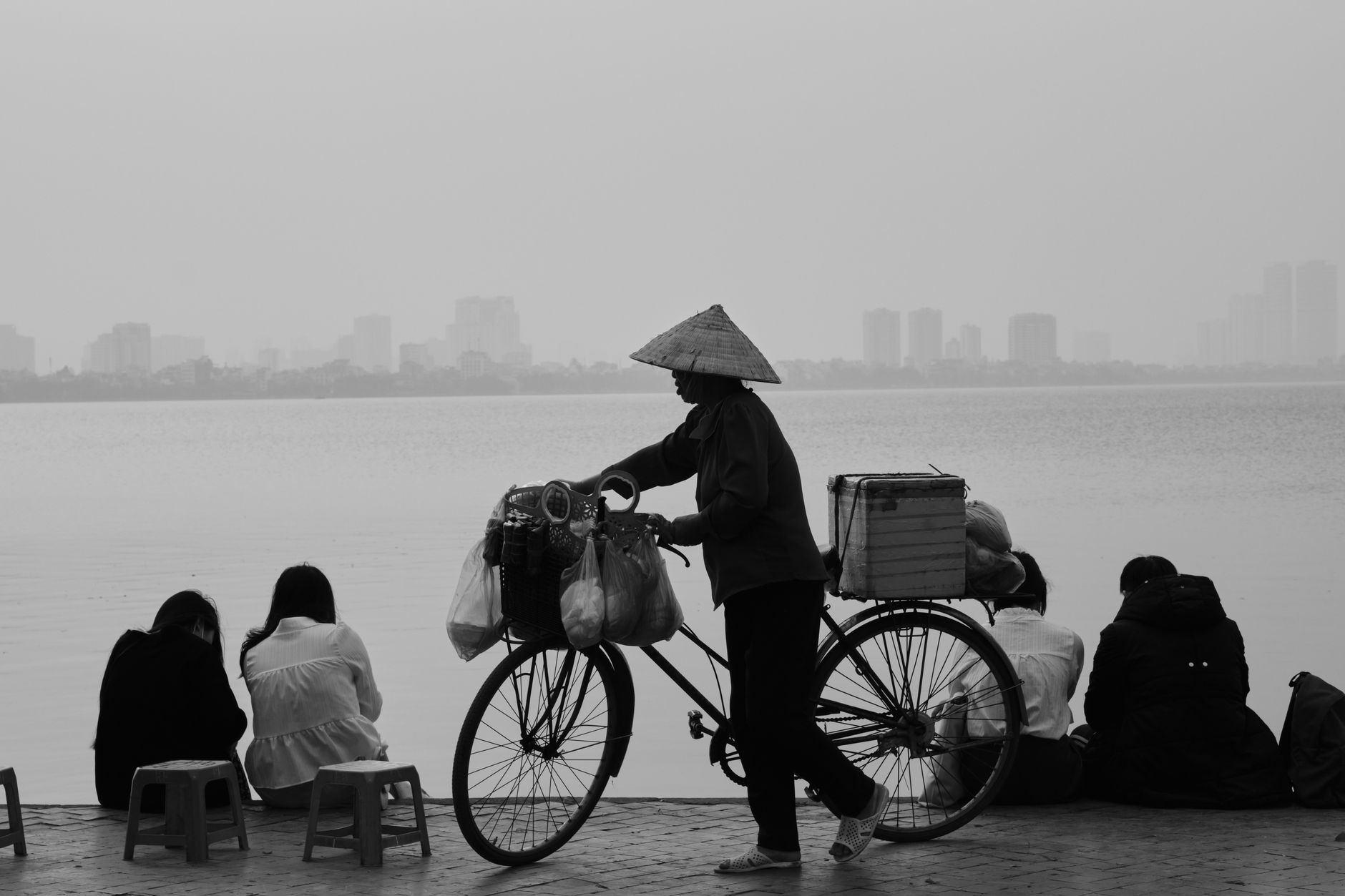
Photo by Thuan Pham on Pexels
Who Lives Here
Haiphong is Vietnam's third-most-populous city. Its metropolitan population is roughly 2.1 million (as of 2015), with nearly even gender distribution. The 2009 census recorded an average annual growth rate of 4%, a crude birth rate of 18.1 per 1,000, and a crude death rate of 7.6 per 1,000. Average life expectancy was 74.5 years (77.1 for women, 72.0 for men)—decent figures for a hardworking industrial city.
Visiting Haiphong
Most visitors pass through on the way to Ha Long Bay or Cat Ba Island. But if you have a day or overnight, Haiphong itself is worth a brief stop. Walk the harbor. Eat fresh "banh hoai" (a local rice-flour crêpe) or catch "ca phe sua da (연유커피 / 越南冰咖啡 / ベトナムアイスコーヒー)" (Vietnamese iced coffee) at a street stall. The city's old French colonial quarter, around Le Chan District, has faded elegance and real character—not tourist-polished, but honest.
The Binh Bridge offers views of the Cam River at sunset. Cat Ba Island, administratively part of Haiphong, is a short ferry ride away and worth its own trip: caves, hiking, swimming, and seafood.
Haiphong won't feel glamorous or exotic. It feels like what it is: a working city that makes things, moves cargo, and feeds itself. That's exactly why some travelers find it more authentic and memorable than the resort towns.
Going to Vietnam? Eat and travel smarter.
Monthly: new dishes, off-the-beaten-path destinations, and itineraries — straight to your inbox. No spam. Unsubscribe anytime.
Join 0 expats. (We just launched.)
More from Northern Vietnam
Other articles covering the same region.

Hoa Lu Ancient Capital: Vietnam's First Kingdom and How to Visit from Ninh Binh
Hoa Lu was Vietnam's first royal capital, and the two temple complexes that survive are among the most atmospheric historical sites in the north.

Hoan Kiem Lake: The Sword Legend, Ngoc Son Temple, and When to Visit
Hoan Kiem Lake sits at the center of Hanoi's Old Quarter — here's the legend behind it, how to walk it properly, and when the streets actually belong to you.

Lung Cu Flag Tower: Vietnam's Northernmost Point
The drive to Lung Cu Flag Tower takes you to Vietnam's northernmost point at 1,500 metres. It's a half-day trip from Dong Van with a steep climb, mountain views, and nearby Hmong villages.
More in Destinations
More articles from the same category.

Landmark 81 Saigon: Observation Deck, Ice Rink, and Getting There from District 1
Landmark 81 is Vietnam's tallest building and Saigon's most visible skyline anchor. Here's what's actually inside and whether it's worth the trip.

Bitexco Financial Tower: Skydeck, Helipad Bar, and Whether the Ticket Is Worth It
Saigon's most recognizable skyscraper charges 250,000 VND to ride up to the 49th floor — here's what you actually see, and whether you should bother.

Notre Dame Cathedral Saigon: French Colonial Centerpiece in the Heart of HCMC
Saigon's Notre Dame Cathedral has been wrapped in scaffolding for years, but the square in front of it remains one of the best starting points for a colonial-era walking tour of District 1.

Paradise Cave, Quang Binh: The 31km Marble Cave That Beats Phong Nha for Photographers
Paradise Cave runs 31km through Quang Binh's karst and delivers the kind of cathedral-scale formations that Phong Nha's boat tour simply can't match. Here's how to see it properly.

Son Doong Cave: What the $3,000 Oxalis Expedition Actually Includes
Son Doong is the world's largest cave and only one operator is legally allowed to take you inside. Here is what the permit-only expedition covers and whether it is worth it.

Phong Nha Cave: Wet Cave, Dry Cave, and How to Choose
Phong Nha has two main caves worth your time — one you reach by river boat, one on foot. Here's how to pick, what each costs, and when to go.
Comments
Loading…