Best Cao Lau in Hoi An: Why the Well Water Actually Matters
Cao lau tastes different in Hoi An because of the water. Here's where to eat it, and why the geography isn't just marketing.

The geography of a single dish
"Cao lau" — the chewy noodle soup that tastes almost nowhere else — exists because of Hoi An's well water. Not marketing. Actual chemistry. If you've had it elsewhere and found it thin or off, that's why.
The dish uses two non-negotiable things: water from Hoi An (호이안 / 会安 / ホイアン)'s ancient wells (which run high in minerals and iron oxide), and lye made by burning wood from local cay tram trees. Together, they create a noodle with a dense, slightly gelatinous chew that you can't replicate outside the town. Restaurants in Hanoi, Saigon, or elsewhere can approximate it — good cooks manage decent versions — but the original sits squarely in Hoi An, and restaurants here know it.
Where the best ones are
Quan Cao Lau Thanh
On Nguyen Hue Street, this place is small and unlabeled from the outside, which is a good sign. You'll recognize it by the metal pot of broth simmering constantly near the entrance. A bowl costs 40,000 VND. The noodles have proper weight; the broth is pork-and-beef based, clear and not oversalted. They don't add much — some pickled greens, a handful of herbs, maybe half a quail egg — which lets the noodle and broth do the work. Eat this standing at a plastic table or take it to go. Open from around 7 a.m. until early afternoon.
Quan Trung Bac
On Tran Phu Street (the main pedestrian drag), Trung Bac is the noisier, more visible option. Tourists find it easily; locals still eat here. Bowl is 40,000–50,000 VND depending on size. The noodles are excellent — chewy and slightly slick in the broth — and they're generous with the "thit heo quay" (roasted pork) and "thit bo" (braised beef). The broth is richer here, more heavily pork-based. It's busier, less atmospheric, but the food is solid. Hours: 6 a.m.–noon, roughly.
Lien Hoa
Walking toward the market from the Old Quarter, Lien Hoa operates from a corner stall. Bowl is 35,000–40,000 VND. The proprietor is precise with the noodles — thin strands, properly cooked — and doesn't oversell the add-ons. Simple herbs, some cracklings if you ask. The broth is lighter and more mineral-forward than the others, which tells you she's leaning into the well-water story. Hours: early morning until mid-afternoon, closed some days.

Photo by Vika Glitter on Pexels
Why cao lau can't be made elsewhere
The well water is the literal foundation. Hoi An sits above aquifers with high iron and mineral content; the water runs faintly orange if you hold it to the light. That's not decoration — it affects gluten development and how the noodle absorbs broth. The lye ("nuoc vo cam" or water from burnt cay tram bark) raises the pH and gives the noodle its characteristic yellow tint and firm snap.
You can buy "cao lau (까오러우 / 高楼面 / カオラウ)" flour and lye packets online now, but the water can't travel. This is why the dish has never gone national, the way "pho" or "banh mi" have. Cao lau is intentionally local.
Some restaurants in other cities will tell you they source the lye and use filtered mineral water to approximate it. That's effort. But it's still an approximation. The original noodle shops in Hoi An aren't being precious — the ingredients really do differ.
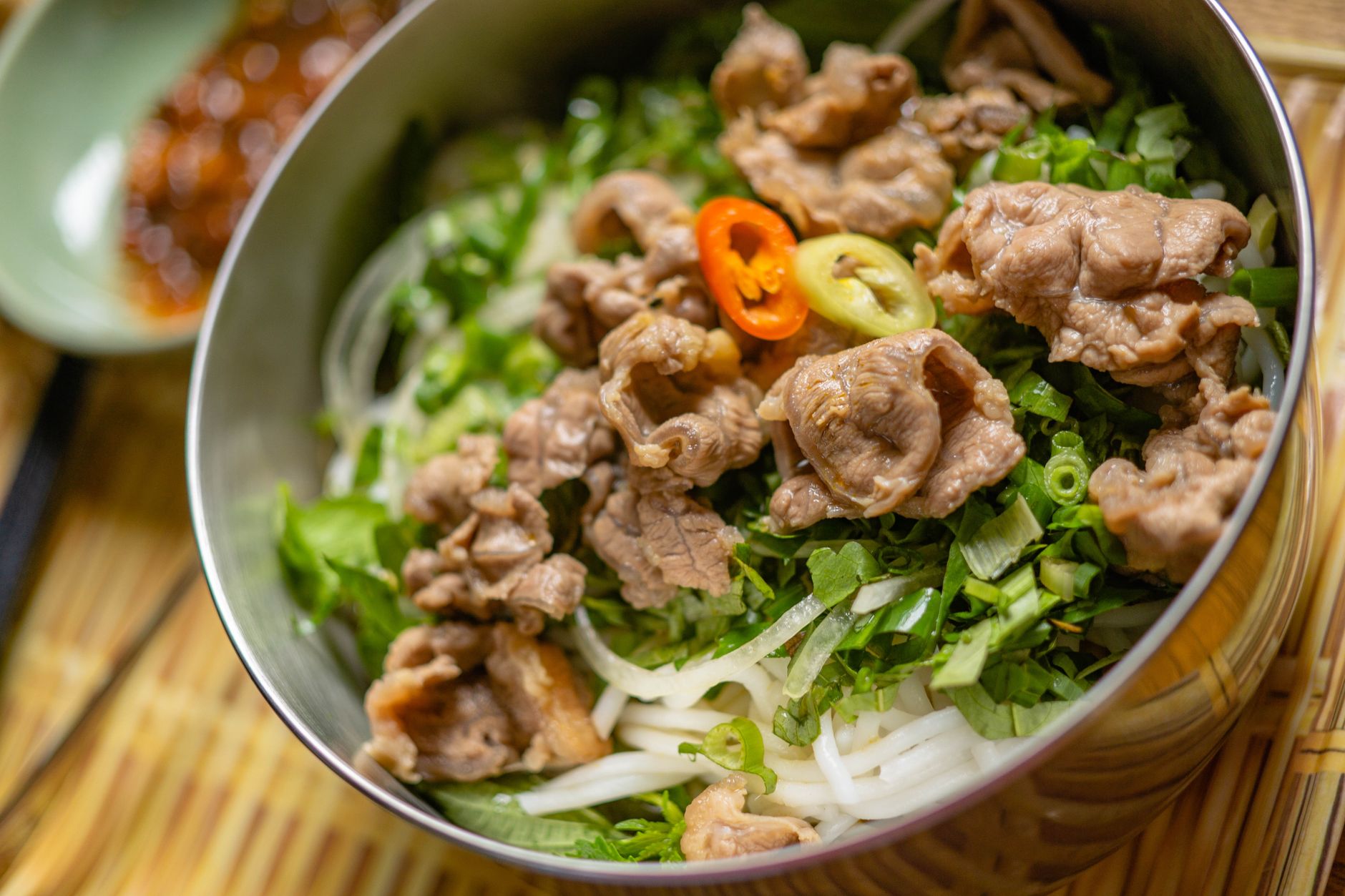
Photo by FOX ^.ᆽ.^= ∫ on Pexels
Texture, not flavor
Don't come expecting a rich or complicated broth. Cao lau's charm is textural. The noodle should be dense and slightly gelatinous, with a faint chew that holds its shape in the broth. Other Vietnamese noodles — "hu tieu", "bun rieu", "banh canh (반깐 / 粗米粉汤 / バインカイン)" — are silkier, or brothier, or fluffier. Cao lau is heavy. It sits in your stomach.
The broth is supporting actor: pork and beef, sometimes a touch of star anise or cinnamon, but not overdone. The pickled greens and pork cracklings add sharpness and texture contrast. The whole thing tastes more like a working lunch — fuel — than a restaurant dish. Which is what it originally was.
Practical notes
Eat cao lau in the morning or early afternoon. Most stalls close by 2 p.m. Avoid the tourist restaurants on the main square; they charge 80,000–100,000 VND and the noodles taste rushed. The best bowls are in unpretentious spots on side streets or inside the covered market. Bring small bills; not all stalls have change for large notes. Water is free; bring your own bottle or ask at the stall.
Going to Vietnam? Eat and travel smarter.
Monthly: new dishes, off-the-beaten-path destinations, and itineraries — straight to your inbox. No spam. Unsubscribe anytime.
Join 0 expats. (We just launched.)
More from Hoi An
Other articles covering this city.

Hoi An Old Town Walking Guide: Yellow Walls, Lantern Alleys, and the Japanese Bridge
A street-level route through Hoi An's UNESCO core — old merchant houses, assembly halls, the famous Japanese Bridge, and when to walk each stretch for the best light.
Best Tau Hu in Hoi An: Where Locals Send You
Tau hu—silky tofu soup—tastes different in Hoi An. Here's where locals actually eat it, and why.

5 Days in Vietnam During Monsoon Season: What Actually Works
A tested itinerary for traveling Vietnam in the wet season. Choose destinations that stay dry, time activities around rain patterns, and eat your way through slack-season food.
More from Central Vietnam
Other articles covering the same region.

Paradise Cave, Quang Binh: The 31km Marble Cave That Beats Phong Nha for Photographers
Paradise Cave runs 31km through Quang Binh's karst and delivers the kind of cathedral-scale formations that Phong Nha's boat tour simply can't match. Here's how to see it properly.

Son Doong Cave: What the $3,000 Oxalis Expedition Actually Includes
Son Doong is the world's largest cave and only one operator is legally allowed to take you inside. Here is what the permit-only expedition covers and whether it is worth it.

Phong Nha Cave: Wet Cave, Dry Cave, and How to Choose
Phong Nha has two main caves worth your time — one you reach by river boat, one on foot. Here's how to pick, what each costs, and when to go.
More in Food & Drink
More articles from the same category.

Best Pho Chua in Ha Giang: Where Locals Send You
Ha Giang's take on sour pho is sharper, tangier, and less known than the southern version. Here's where locals actually eat it.

Best Pho Saigon in Ho Chi Minh City: Where Locals Send You
Pho Saigon is thinner, sweeter, and faster than its northern cousin. Here's where to find the real thing in HCMC, plus what makes it different and how to order.

Best Banh Xeo in Nha Trang: Where Locals Send You
Nha Trang's banh xeo scene is rowdier and greasier than the south. Here's where locals actually eat, what to order, and why the crispy rice pancakes here taste different.

Best Banh Nam in Hue: Where Locals Send You
Hue's version of "banh nam" is a steamed rice cake pocket stuffed with shrimp and pork—nothing like its northern cousin. Here's where locals actually eat it.

Best Banh Uot Thit Nuong in Buon Ma Thuot: Where Locals Send You
Banh uot thit nuong — steamed rice rolls with grilled pork — is a breakfast staple in Buon Ma Thuot's Central Highlands. Here are the spots locals actually eat.

Best Banh Canh Ca in Da Nang: Where Locals Send You
Da Nang's version of "banh canh ca" — thick tapioca noodles in crab broth — tastes different from Hanoi or Saigon. Here's where locals actually eat it, what to order, and why timing matters.
Comments
Loading…