Best Hu Tieu Nam Vang in Saigon: Three Bowls That Define the Dish
Hu Tieu Nam Vang—a Cambodian-Chinese-Vietnamese hybrid—thrives in Saigon's Cholon. We tracked down the three best bowls, each with decades of loyal customers.

What makes "hu tieu Nam Vang" different
"Hu tieu" is a noodle soup that exists across Southeast Asia, but the Nam Vang version—named after the Cambodian capital Phnom Penh—is distinctly Saigon. The noodles are the same thin, pale wheat-tapioca strands you'll find in regular "hu tieu," but the broth is what separates it.
Nam Vang broth is darker, richer, built on pork bones and dried squid or shrimp, and finished with a splash of dark soy sauce that gives it an almost caramel-brown color. The flavor sits somewhere between Chinese and Cambodian: umami-forward, a little sweet, less assertively aromatic than "pho." You get pork offal (liver, kidney, heart), sometimes a quail egg, shrimp, and a scatter of fried shallots. It's a bowl designed to be customized at the table—lime, bird's eye chili, and fish sauce sit in bottles next to your seat.
The dish arrived in Saigon (사이공 / 西贡 / サイゴン) with Cambodian migrants, particularly in Cholon (District 5), where Chinese-Vietnamese merchants had already built a commercial network. Over decades, what might have been a temporary refugee food became permanent, woven into the neighborhood's identity.
Hu Tieu Nam Vang Hung Ky — The institutional anchor
Hung Ky sits on Nguyen Hue, a street in Cholon that slopes downward between shop-houses and wet markets. The storefront is narrow, unpretentious—no English signage, no photos of food on the wall. You walk in and you're either a regular or you're figuring it out.
The bowl here is conservative: a clear, deep pork broth with a faint soy tint, topped with a small quail egg, lean pork slices, liver, a single shrimp, and a handful of fried shallots. The noodles are softer than you might expect—cooked well past the point where most noodle joints would serve them—which works because the broth is concentrated enough to carry the flavor without resistance.
Hung Ky has been running since the 1980s, and the kitchen still moves with the efficiency of a place that has never stopped. A bowl costs around 40,000 VND (USD 1.65). Arrive before 9:30 a.m. or after 4 p.m.; lunch is chaos.
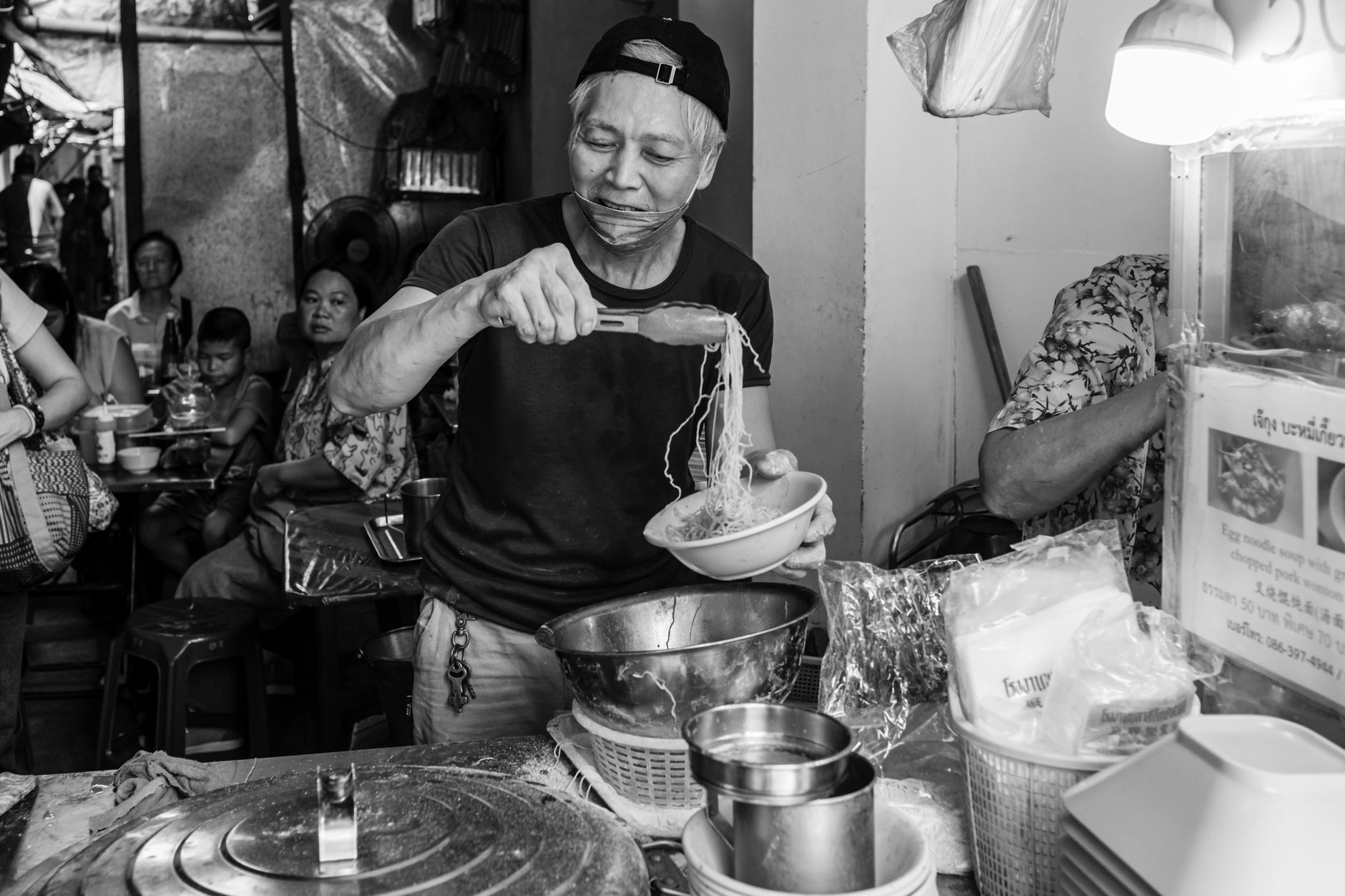
Photo by Kirandeep Singh Walia on Pexels
Hu Tieu Ty — The neighborhood fixture
Ty is easier to miss. It's a mobile cart that parks on Tan Duc Thang Street, a few blocks from the Saigon River, near the old Ben Thanh Market area. The owner, a woman in her sixties, has been wheeling this cart to the same corner for over thirty years. Regulars know to come here at 6:30 a.m. for breakfast or around 10 p.m. for late dinner.
The broth is less dark than Hung Ky—closer to amber—and the ingredients lean toward the generous side. Two quail eggs, a handful of pork offal (she includes kidneys without being asked), three or four shrimp, and enough fried shallots to coat the bottom of the bowl. The noodles have more bite. A bowl is 35,000 VND.
Ty doesn't have a fixed storefront, which means it's packed tight on some nights and nearly empty on others. But the regulars—taxi drivers, night-shift nurses, students—time their arrivals around her schedule. If you're staying in District 1 and craving 11 p.m. hu tieu (후띠우 / 粿条 / フーティウ), this is where you go.
Hu Tieu Nam Vang Phuc Ky — The perfectionist version
Phuc Ky opened in 2008 on Vo Van Tan Street in District 3, a neighborhood that has gentrified steadily over the past decade. The shop is clean, brightly lit, with laminated menus and a line out the door most mornings. It's the most "polished" of the three, which some will see as an advantage, others as dilution.
The broth here is the darkest of the bunch—nearly caramel-colored—and tastes like it's been simmered for hours. The owners source pork bones and dried seafood from traditional suppliers in Cholon, so there's a consistency that the other bowls, for all their charm, can't quite match. The egg is always perfectly soft-boiled. The offal is tender. A bowl costs 50,000 VND (USD 2.05).
Phuc Ky's advantage is reliability and accessibility. It's easier to find, easier to navigate, and the quality dips less on bad days. The disadvantage, for purists, is that it feels designed—optimized for the Instagram-era tourist. But that's not entirely fair; the kitchen is serious about the broth, and serious broth is what this dish is really about.

Photo by Trần Phan Phạm Lê on Pexels
Where to sit, what to order, how to eat
All three places serve hu tieu Nam Vang as their primary dish. You order by pointing or saying "mot tiem hu tieu"—one bowl of hu tieu. Size is usually fixed. No variations, no substitutions.
When the bowl arrives, don't eat immediately. Squeeze lime juice over the top—about a quarter of one lime per bowl. Add fish sauce and chili to taste. Some people add a touch of hoisin or soy sauce, though the broth usually has enough sodium already. Stir once, taste, then adjust.
The noodles should be eaten quickly, before they absorb too much broth and lose their texture. The offal—the liver especially—is best eaten immediately; it softens further as it sits. The egg can wait until the end, after the noodles are gone, when you can break the yolk into the remaining broth and drink it.
Practical notes
Hu tieu Nam Vang is eaten as a full meal, not a snack. Budget 40,000–50,000 VND per person and expect to spend 20–30 minutes, including time at the table after eating. Hung Ky and Phuc Ky are easiest for visitors to locate; Ty requires either local knowledge or luck. All three are best before 10 a.m. or after 4 p.m., when the neighborhood isn't rushing.
Going to Vietnam? Eat and travel smarter.
Monthly: new dishes, off-the-beaten-path destinations, and itineraries — straight to your inbox. No spam. Unsubscribe anytime.
Join 0 expats. (We just launched.)
More from Ho Chi Minh City
Other articles covering this city.

Notre Dame Cathedral Saigon: French Colonial Centerpiece in the Heart of HCMC
Saigon's Notre Dame Cathedral has been wrapped in scaffolding for years, but the square in front of it remains one of the best starting points for a colonial-era walking tour of District 1.

Best Pho Saigon in Ho Chi Minh City: Where Locals Send You
Pho Saigon is thinner, sweeter, and faster than its northern cousin. Here's where to find the real thing in HCMC, plus what makes it different and how to order.

Best Com Tam in Ho Chi Minh City: Where Locals Send You
Authentic "com tam" in Saigon isn't trendy—it's breakfast, lunch, and dinner staple. Here's where locals actually eat it, what to order, and why the rice is better here than anywhere else.
More from Southern Vietnam
Other articles covering the same region.

3 Days Escaping Saigon: Da Lat and Surrounding Highlands
Leave Saigon behind for Da Lat's cool mountain air, pine forests, and French colonial architecture. This tested itinerary covers transport, where to stay, what to eat, and realistic costs for a long weekend.

5 Days in the Mekong Delta: Beyond Can Tho
Skip the tourist boat tours. This itinerary takes you into smaller canals, family orchards, and riverside towns where most visitors don't go—five days based on routes locals actually use.

Best Muc 1 Nang in Mui Ne: Where Locals Send You
Muc 1 nang—grilled squid stuffed with herbs and meat—reaches its peak in Mui Ne. Here's where locals actually eat it, what to order, and why this coastal town makes it better than anywhere else.
More in Food & Drink
More articles from the same category.

Best Tau Hu in Hoi An: Where Locals Send You
Tau hu—silky tofu soup—tastes different in Hoi An. Here's where locals actually eat it, and why.

Best Pho Chua in Ha Giang: Where Locals Send You
Ha Giang's take on sour pho is sharper, tangier, and less known than the southern version. Here's where locals actually eat it.

Best Banh Xeo in Nha Trang: Where Locals Send You
Nha Trang's banh xeo scene is rowdier and greasier than the south. Here's where locals actually eat, what to order, and why the crispy rice pancakes here taste different.

Best Banh Nam in Hue: Where Locals Send You
Hue's version of "banh nam" is a steamed rice cake pocket stuffed with shrimp and pork—nothing like its northern cousin. Here's where locals actually eat it.

Best Banh Uot Thit Nuong in Buon Ma Thuot: Where Locals Send You
Banh uot thit nuong — steamed rice rolls with grilled pork — is a breakfast staple in Buon Ma Thuot's Central Highlands. Here are the spots locals actually eat.

Best Banh Canh Ca in Da Nang: Where Locals Send You
Da Nang's version of "banh canh ca" — thick tapioca noodles in crab broth — tastes different from Hanoi or Saigon. Here's where locals actually eat it, what to order, and why timing matters.
Comments
Loading…