Where to Stay in Tam Coc: Homestays vs. the Hotel Strip
Tam Coc offers two distinct accommodation styles: family-run village homestays for immersion and budget-friendly stays, or waterfront hotels near the boat pier for comfort and convenience.

Tam Coc splits neatly into two worlds when it comes to where you lay your head. You can stay embedded in the village itself—waking up to roosters, eating breakfast with your host family, watching limestone peaks from the porch at dawn. Or you can stay near the boat pier on what locals call the "hotel strip," where you trade intimacy for air-conditioning, hot water, and a restaurant downstairs.
Neither choice is wrong. It depends on what you came for.
Village Homestays: The Immersion Play
These are scattered through Tam Coc's lanes and surrounding hamlets—basic guesthouses run by families who sometimes cook, sometimes just unlock the door and leave you to it.
What you get: A double room with a fan, maybe an ensuite bathroom (cold water likely), and breakfast—usually sticky rice with pickled vegetables, eggs, and instant coffee. Prices run 250,000–800,000 VND ($10–32 USD) per night depending on whether you want a private room or shared dorm, and whether the host throws in dinner. A handful of nicer homestays with actual air-con and hot water creep toward 1–1.5 million VND ($40–60 USD).
The feel: You're not in a resort. You're in someone's house extension. You'll hear neighbors' motorbikes, roosters at 5 a.m., and sometimes a karaoke bar three streets over at night. Hosts are often grandmothers or young couples renting out an extra wing. Conversation happens over breakfast. You'll get lost finding your place the first time. WiFi is spotty.
Best for: Solo travelers, backpackers, people who want to eat lunch at a family-run "[pho](/posts/pho-vietnam (베트남 / 越南 / ベトナム)-noodle-soup-guide)" stall and know the owner's name by day two. If you're here to hike and explore, not lounge poolside, a homestay anchors you in the place instead of floating above it.
The catch: No frills. No late-night room service. If the water runs out (it occasionally does in dry season), you're waiting. Bathrooms are functional but often squat toilets in cheaper places. Noise from the street and other guests. And if you book through a third-party site, communication can be choppy—WhatsApp messages that take hours to answer.
The Hotel Strip: Convenience & Predictability
Head toward Tam Coc's pier and you'll find a cluster of mid-range hotels and resorts lining the main road and waterfront. This is where tour groups stay, where you can get a cold beer at 11 p.m., and where the beds are firm.
What you get: Air-conditioning, private hot-water bathroom, TV, maybe a small balcony overlooking rice paddies or the Ngo Dong River. Breakfast is a buffet or à la carte. Prices range from 500,000 VND ($20 USD) for a basic double at a smaller hotel, to 2–2.5 million VND ($80–100 USD) for a mid-range resort with a restaurant, garden, and boat tours booked in-house.
The feel: Professional. Quiet enough. You're one of many guests. Staff wear uniforms. There's a reception desk 24/7. Checkout is 11 a.m., and if you're running late, they'll hold your bags. You can order dinner without leaving the property. WiFi is reliable.
Best for: Couples, families with kids, anyone who prioritizes comfort and wants accommodation sorted so they can focus on activities. If you're arriving late or leaving early, the hotel strip is forgiving—you don't have to negotiate with a homestay host.
The catch: Less character. You're not really "in" Tam Coc; you're adjacent to it. The pier area is touristy. You'll see tour groups in matching hats everywhere. Room noise from other guests. The "local experience" evaporates when your breakfast table has eight other tables around you.

Photo by Hòa Lê Đình on Pexels
Mid-Ground: Tam Coc Garden Resort
If you want a third option, Tam Coc Garden Resort sits between the two extremes—roughly 1.6–2 million VND ($65–80 USD) per night for a bungalow or room in a garden setting. It has actual design (not just a concrete box), a restaurant, and feels less corporate than the hotel strip but more comfortable than a homestay. Staff speak English, and the place is close enough to walk into the village but quiet enough to feel separate. It's popular with couples and small groups who don't want to rough it but don't want sterile either.
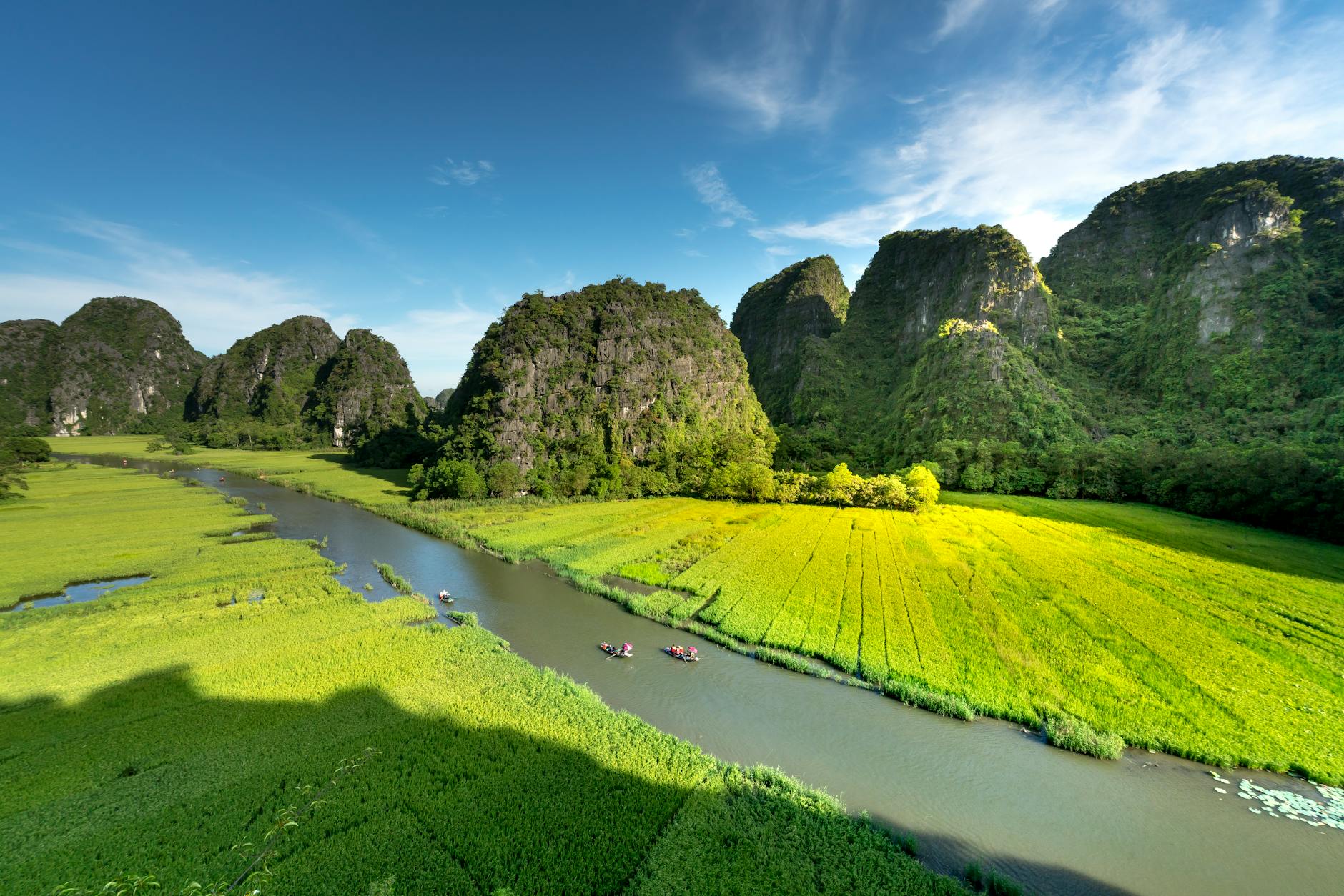
Photo by Quang Nguyen Vinh on Pexels
How to Decide
Pick a homestay if: You're flexible on creature comforts, you want to eat where locals eat, you don't mind asking for directions, you're staying 3+ nights (you'll settle in faster), and your trip hinges on atmosphere over logistics.
Pick a hotel if: You value a working WiFi connection, you want predictable meals and hours, you're traveling with young children, you have mobility issues, you're jet-lagged and need a quiet sleep, or you're only passing through for 1–2 nights.
Pick the garden resort if: You want a foot in both camps—comfort with character, and the ability to walk into the village when you feel like it without slamming into the tourist machine.
Practical Notes
Book homestays through direct contact (call or message the owners) or Airbnb/Booking—response times vary wildly, so book 2–3 weeks ahead if you're coming in peak season (October–November, March–April). Hotels can absorb walk-ins better. Ninh Binh (닌빈 / 宁平 / ニンビン) town, 30 km away, has more chains if you arrive without plans, but you'll lose the Tam Coc immersion. Most homestays and hotels can arrange your boat tour (usually 900,000–1.2 million VND per person for a 2–3 hour trip on the "Ngo Dong River"), so location isn't a deal-breaker for logistics.
Going to Vietnam? Eat and travel smarter.
Monthly: new dishes, off-the-beaten-path destinations, and itineraries — straight to your inbox. No spam. Unsubscribe anytime.
Join 0 expats. (We just launched.)
More from Northern Vietnam
Other articles covering the same region.

Hoa Lu Ancient Capital: Vietnam's First Kingdom and How to Visit from Ninh Binh
Hoa Lu was Vietnam's first royal capital, and the two temple complexes that survive are among the most atmospheric historical sites in the north.

Hoan Kiem Lake: The Sword Legend, Ngoc Son Temple, and When to Visit
Hoan Kiem Lake sits at the center of Hanoi's Old Quarter — here's the legend behind it, how to walk it properly, and when the streets actually belong to you.

Lung Cu Flag Tower: Vietnam's Northernmost Point
The drive to Lung Cu Flag Tower takes you to Vietnam's northernmost point at 1,500 metres. It's a half-day trip from Dong Van with a steep climb, mountain views, and nearby Hmong villages.
More in Travel Tips
More articles from the same category.

Bargaining in Vietnam: When to haggle, when to pay the asking price
Haggling is normal at markets and with cyclos, but not everywhere. Learn which settings expect negotiation, how much to push back, and where to just hand over your money.
Best Vietnam eSIM Providers 2026: Costs, Setup, and Real-World Tips
A practical breakdown of Vietnam's top eSIM options, real prices, and how to avoid common pitfalls when arriving with no local SIM.

Where to Stay in Saigon: District 1 vs District 3 vs District 7
Three neighborhoods, three vibes. Pick District 1 for backpackers and chaos, District 3 for quiet and value, or District 7 for modern expat comfort. Here's how each stacks up.

Where to Stay in Sapa: Town Center vs Cat Cat vs Ta Van
Sapa has three distinct bases: the foggy town center for convenience, Cat Cat village for quiet hilltop views, or Ta Van for homestay immersion. Pick based on whether you're chasing comfort or trekking.

Where to Stay in Can Tho: Ninh Kieu, Cai Rang, or Orchards
Can Tho's three main neighborhoods offer different angles on Mekong Delta life. Here's how to pick based on your priorities and budget.

Where to Stay in Hue: Citadel vs South Bank vs Beach
Hue splits into three distinct neighborhoods for travelers. Each offers different trade-offs between history access, dining, and atmosphere—here's how to choose.
Comments
Loading…