Cha lua and gio lua: Vietnamese pork sausages explained
Steamed pork paste in banana leaf—cha lua and gio lua are the backbone of Vietnamese breakfasts and sandwiches. Here's what they are, how they differ, and where to find the real thing.

What are cha lua and gio lua?
"Cha lua" and "gio lua" are steamed pork forcemeats bound with tapioca starch, salt, sugar, and spice, then wrapped in banana leaf and cooked until firm. The result is a pale pink, lightly textured sausage that's part charcuterie, part custard—moist enough to slice, dense enough to hold together.
The two are technically the same product; "cha lua" is the northern Vietnamese term (Hanoi, Ha Giang, the Red River Delta), while "gio lua" dominates in the south (Saigon, the Mekong Delta (메콩 델타 / 湄公河三角洲 / メコンデルタ)). Menus, street vendors, and recipes use both interchangeably. For clarity: they're the same thing, just regional naming.
Unlike Western sausage, cha lua has no casing. Instead, banana leaf serves as both wrapper and steaming vessel, imparting a subtle sweetness to the paste. The texture is uniform, never grainy—more like terrine than traditional sausage.
How it tastes and how to use it
Cha lua is mild, salty-sweet, and subtly herbaceous. On its own, it's pleasant but not exciting. Its real power emerges in breakfast sandwiches and rice dishes, where it acts as a protein anchor and fat carrier.
The classic pairing is "banh mi"—a split baguette dressed with mayo, pickled daikon and carrot, cilantro, and chilies, stuffed with sliced cha lua, pâté (often from the same pork), and cold cuts. A good banh mi from a Hanoi street stall (30,000–40,000 VND) should have at least 3–4 thick slices of cha lua per sandwich. In Saigon, the same sandwich costs 25,000–35,000 VND due to regional pricing.
"Banh cuon"—delicate rice-flour crepes filled with minced pork and shrimp—often includes a slice or two of cha lua as garnish. "[Com tam](/posts/com-tam-saigon (사이공 / 西贡 / サイゴン)-broken-rice)"—broken-rice dishes—frequently top the rice with a small piece, fried until the edges curl slightly. Both formats highlight cha lua's texture: slightly bouncy, never dry.
At home or in a pho restaurant, cha lua can be sliced cold and eaten alongside breakfast congee or served as a side with plain rice and a fried egg.
Regional and specialty variations
While the base recipe is consistent, regional producers add their own twists.
Cha que (cinnamon sausage) is made with visible ground black pepper and sometimes star anise or cinnamon powder worked into the paste. The spicing is warm, slightly sweet, and distinctive—popular in the Red River Delta and northern provinces like Thai Nguyen. Markets in Hanoi (하노이 / 河内 / ハノイ) Old Quarter sell cha que from specialty producers for 80,000–120,000 VND per kilogram, a premium over plain cha lua.
Gio thu (head cheese or "mortadella") is a coarser pâté made from pork head meat, tongue, and skin, bound with gelatin and spices. It's denser and less uniform than cha lua, with visible flecks of meat and fat. Gio thu is eaten in the same contexts (banh mi (반미 / 越式法包 / バインミー), breakfast) but is more savory and less sweet. Many northern vendors stock both; southern markets see it less often.
Cha bong (pork floss) is shredded, dried pork that's sometimes confused with cha lua but is a different product entirely—drier, fluffier, and used as a topping or filling ingredient rather than sliced and served as a main protein.
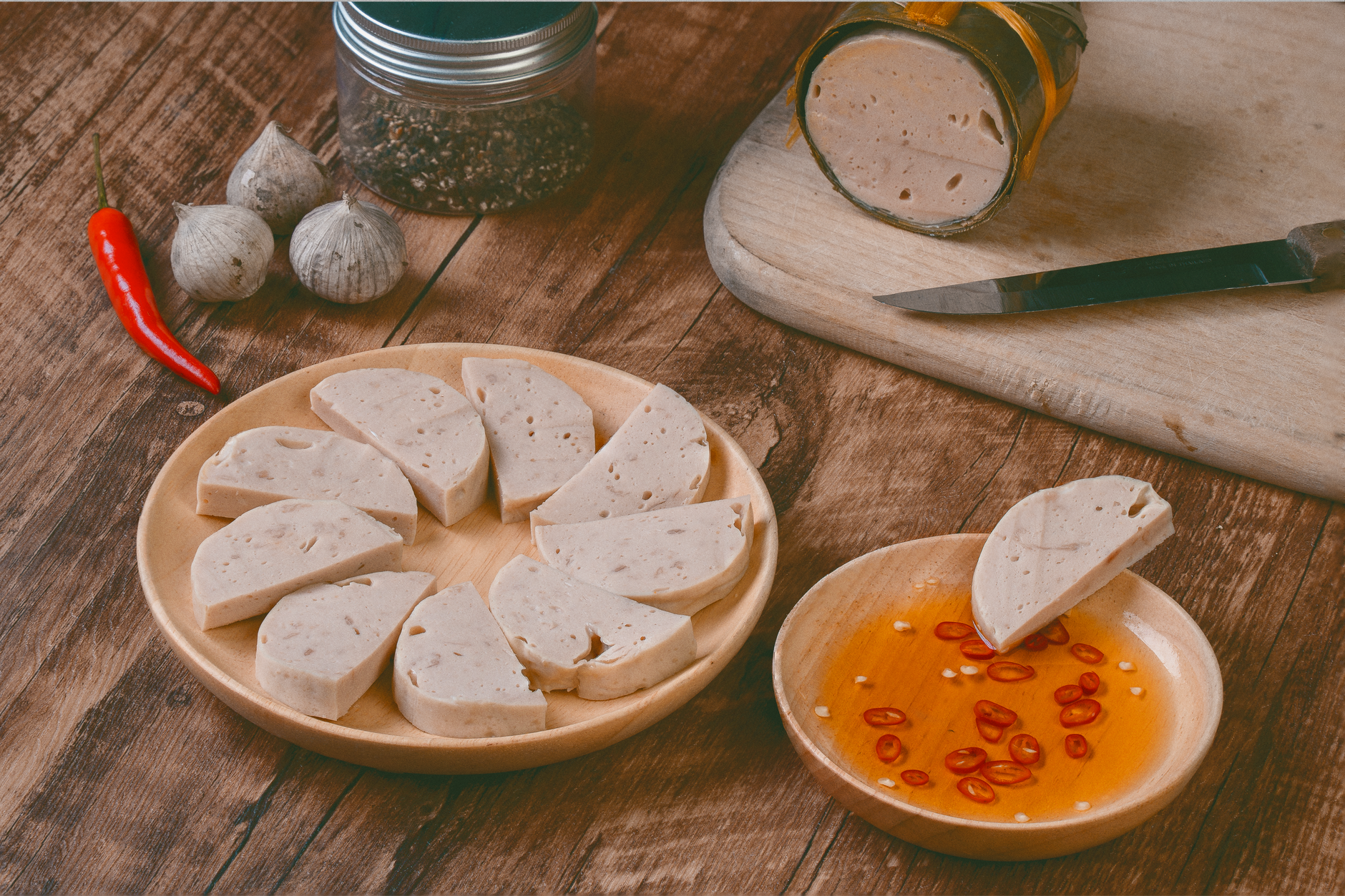
Photo by Hải Nguyễn on Pexels
Where to buy and how to judge quality
In Hanoi, wet markets like Dong Xuan Market (near the Old Quarter) and smaller neighborhood vendors sell fresh cha lua daily, often made on-site or sourced from local producers. Prices range from 60,000–100,000 VND per kilogram for standard cha lua; specialty varieties like cha que cost more.
In Saigon, Ben Thanh Market remains the central hub, with 20–30 cha lua vendors lining the ground floor. Quality varies widely; the best stalls have a visible line of customers buying for breakfast.
Look for these markers of freshness and quality:
- Color: Pale pink, not gray or brown. A brownish tint suggests age or oxidation.
- Surface: Smooth, with no visible cracks or weeping liquid. The banana leaf should be intact and slightly moist, never dried or brittle.
- Smell: Clean, lightly sweet, herbaceous from the banana leaf. Any sour or ammonia-like odor is a red flag.
- Texture: Firm but yielding when pressed gently. It should not feel spongy or mushy.
- Slice test: When sliced, it should cut cleanly without crumbling or releasing excess liquid. The interior should be uniform pale pink.
If buying pre-packaged cha lua at a supermarket (Saigon Co.op, BigC, Aeon), check the date closely. Cha lua is perishable; buy only if consumed within 2–3 days or freeze immediately.
How it's made (simplified)
Producers source ground pork (often shoulder or belly trim), mix it with tapioca starch (the binding agent), salt, sugar, and spices, then blend until the paste becomes uniform and sticky. The mix is piped or spooned onto banana leaves, wrapped tightly, and either steamed in large trays or boiled in water for 45–60 minutes. Once cooled, the wraps are unwrapped, sliced, and sold fresh or chilled.
Home cooks can make a simplified version, though commercial producers use specialized equipment and source control that's hard to replicate in a home kitchen.
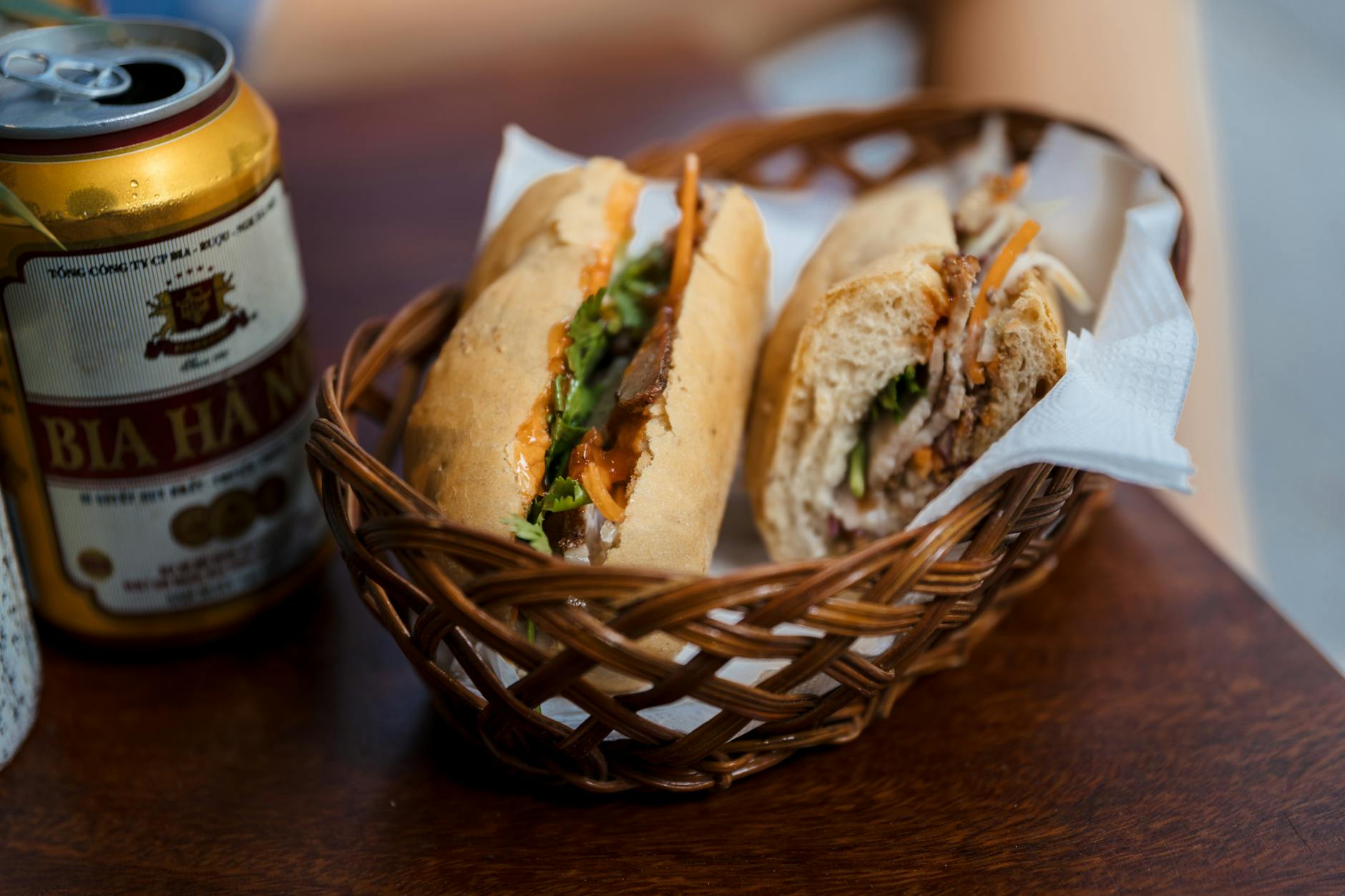
Photo by Flo Dahm on Pexels
Storage and serving
Fresh cha lua keeps in the refrigerator for 3–4 days in an airtight container or wrapped in plastic. For longer storage, freeze for up to one month. Thaw in the fridge before eating; do not refreeze after thawing.
When serving cold (as in banh mi or with rice), slice cleanly with a sharp knife. For banh mi, slices should be thin and uniform—about 3mm thick. If frying as a side dish, cut into 1cm-thick rounds and pan-fry over medium-high heat until the edges brown, about 2 minutes per side.
Practical notes
Cha lua is one of the quietest heroes of Vietnamese breakfast culture—so embedded in daily eating that it's easy to overlook. Quality varies by vendor and region; buying from a busy morning market stall is almost always safer than supermarket shelf stock. If you find a vendor whose cha lua you like (Hanoi Old Quarter, Saigon Ben Thanh), return to the same spot. Consistency matters in charcuterie.
Going to Vietnam? Eat and travel smarter.
Monthly: new dishes, off-the-beaten-path destinations, and itineraries — straight to your inbox. No spam. Unsubscribe anytime.
Join 0 expats. (We just launched.)
More from Hanoi
Other articles covering this city.

Hoan Kiem Lake: History, Temples, and the Best Time to Walk
The turtle legend, Ngoc Son Temple, and a 2-km loop around Hanoi's most visited lake. Best visited early morning or when Old Quarter streets close to cars.

7 Days in Vietnam: A Yoga and Meditation Itinerary
A week-long route through Vietnam's quietest corners: Sapa's mountain silence, a meditation center in the Mekong, and coastal stillness in Da Lat. Real costs, transport, and retreat recommendations.

7 Days in Vietnam: A Solo Backpacker Itinerary
A tested week-long route through Hanoi, Ha Long Bay, and Saigon with budget lodging, street food, and overland transport. Real costs and booking tips included.
More from All of Vietnam
Other articles covering the same region.

Best Banh Xeo in Nha Trang: Where Locals Send You
Nha Trang's banh xeo scene is rowdier and greasier than the south. Here's where locals actually eat, what to order, and why the crispy rice pancakes here taste different.

7 Days in Vietnam for Vegetarian and Vegan Travelers
A tested week-long route from Hanoi to Saigon hitting street food, temples, and markets where plant-based eating is embedded in local culture, not a special request.

Bargaining in Vietnam: When to haggle, when to pay the asking price
Haggling is normal at markets and with cyclos, but not everywhere. Learn which settings expect negotiation, how much to push back, and where to just hand over your money.
More in Food & Drink
More articles from the same category.

Best Pho Chua in Ha Giang: Where Locals Send You
Ha Giang's take on sour pho is sharper, tangier, and less known than the southern version. Here's where locals actually eat it.

Best Pho Saigon in Ho Chi Minh City: Where Locals Send You
Pho Saigon is thinner, sweeter, and faster than its northern cousin. Here's where to find the real thing in HCMC, plus what makes it different and how to order.

Best Banh Nam in Hue: Where Locals Send You
Hue's version of "banh nam" is a steamed rice cake pocket stuffed with shrimp and pork—nothing like its northern cousin. Here's where locals actually eat it.

Best Banh Uot Thit Nuong in Buon Ma Thuot: Where Locals Send You
Banh uot thit nuong — steamed rice rolls with grilled pork — is a breakfast staple in Buon Ma Thuot's Central Highlands. Here are the spots locals actually eat.

Best Banh Canh Ca in Da Nang: Where Locals Send You
Da Nang's version of "banh canh ca" — thick tapioca noodles in crab broth — tastes different from Hanoi or Saigon. Here's where locals actually eat it, what to order, and why timing matters.

Best Muc 1 Nang in Mui Ne: Where Locals Send You
Muc 1 nang—grilled squid stuffed with herbs and meat—reaches its peak in Mui Ne. Here's where locals actually eat it, what to order, and why this coastal town makes it better than anywhere else.
Comments
Loading…