Vu Quang National Park: Where Scientists Keep Finding New Species
In the remote forests of Ha Tinh Province, Vu Quang National Park is one of the world's most active sites for animal discovery. Since the 1990s, scientists have identified species like the "Asian unicorn" saola and the world's largest muntjac—creatures unknown to science just decades ago.

The Park That Rewrites Textbooks
Vu Quang National Park sits in Ha Tinh Province along Vietnam (베트남 / 越南 / ベトナム)'s North Central Coast—550 square kilometers of dense, mountainous forest that has become synonymous with zoological surprise. Established as a forest reserve in 1986 and upgraded to national park status in 2002, it's remote enough that new species are still being identified within its boundaries.
The remoteness is the point. Thick forest, rugged terrain, and minimal infrastructure have allowed creatures to survive—and hide from science—for centuries. This is not a park optimized for visitor comfort. It's a working research station where conservation and discovery come first.
The "Asian Unicorn" and Other Flagship Species
The park's most famous resident is the "saola" (Pseudoryx nghetinhensis), often called the "Asian unicorn." First formally described in 1992, it's a bovid so rare and elusive that sightings remain newsworthy decades later. Saola look like a cross between a deer and an antelope, with parallel horns and a stocky build. They're critically endangered, and Vu Quang remains one of the few places they might still exist.
Equally remarkable is the "giant muntjac" (Megamuntiacus vuquangensis), discovered in the early 1990s and recognized as the world's largest muntjac—a family of small, spike-antlered deer. The park is also home to the "Quang Khem" (slow deer), another endemic species, and the Northern White-Cheeked Gibbon, a critically endangered primate whose calls echo through the forest canopy.
Beyond mammals, the park harbors five fish species new to science: Parazacco vuquangensis, Crossocheilus vuha, Pararhoedus philanthropus, Pararhoedus equalitus, and Oreoglanis libertus. Each discovery hints at how little we still know about Southeast Asian ecosystems.

Photo by Loifotos on Pexels
Ongoing Mysteries
Vu Quang still teases scientists with unconfirmed sightings and tantalizing hints. In 1994, a cream-colored slow loris—possibly from Vu Quang—was spotted at Hanoi Zoo. That same year, wildlife experts documented a black muntjac in nearby Laos, raising the question of whether it also roams Vu Quang's forests. A Vietnamese warty pig (Sus bucculensis)—a species supposedly extinct in the wild—showed up as a skull and meat sample, suggesting remote populations might still survive.
These unresolved cases exemplify why Vu Quang matters: it's a living laboratory where the boundaries of what we know about wildlife are constantly being redrawn.
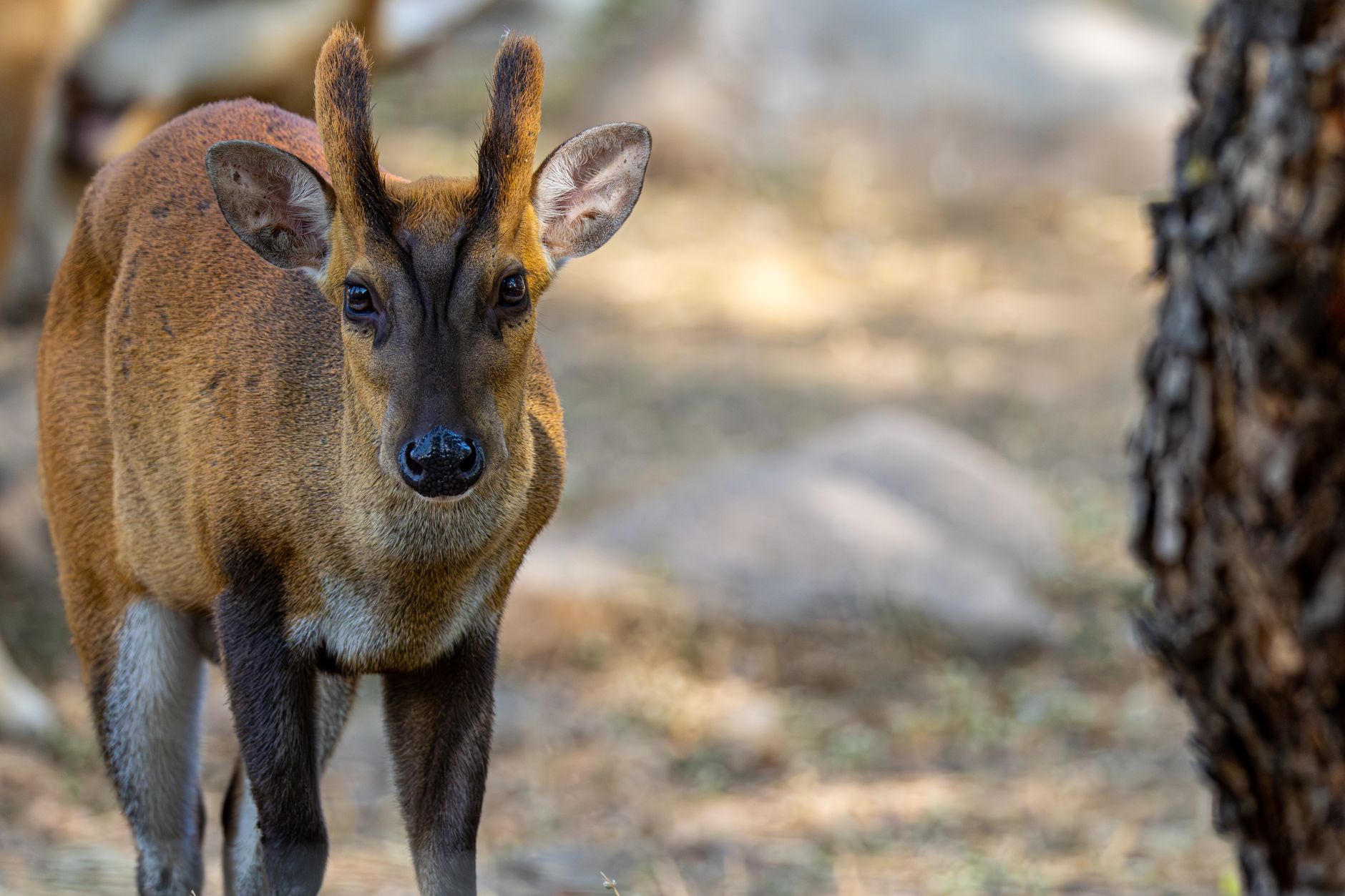
Photo by Regan Dsouza on Pexels
Visiting: What to Expect
Access is through Ha Tinh Province's administration and local guides. Expect a raw, undeveloped experience compared to more tourist-heavy national parks. The park prioritizes research and conservation over visitor amenities, so trails are rugged, facilities are basic, and the focus is ecological, not recreational.
You won't easily spot a saola or giant muntjac—they're nocturnal, elusive, and adapted to avoid detection. But you will walk through pristine forest, possibly hear gibbon calls, and understand viscerally why this corner of Vietnam matters to global biodiversity. Arrange visits through the park administration or tour operators specializing in ecological tourism; they'll advise on seasonal access, terrain, and what wildlife is actively being studied.
Vu Quang is for travelers with a genuine interest in ecology and conservation, not casual sightseeing. Come here to witness a place where science is still being written.
Going to Vietnam? Eat and travel smarter.
Monthly: new dishes, off-the-beaten-path destinations, and itineraries — straight to your inbox. No spam. Unsubscribe anytime.
Join 0 expats. (We just launched.)
More from Central Vietnam
Other articles covering the same region.

Son Doong Cave: Inside the $3,000 Oxalis Expedition
Son Doong is the world's largest cave by volume—and the only way in is a 4-day permit-exclusive tour with Oxalis. Here's what you actually get, who should go, and what cheaper caves offer instead.

Phong Nha Cave: Boat Tours, Dry Caves, and How to Choose
Phong Nha-Ke Bang has two main cave experiences: the iconic river boat through Phong Nha Cave itself, and the dry trek into Tien Son. Here's how to pick, what to expect, and when to go.

Hoi An Lantern Festival: Full Moon Nights and How to Plan Around Them
The Hoi An Lantern Festival happens on the 14th lunar day each month. Electricity shuts off, lanterns float on the Thu Bon River, and crowds triple. Here's how to time your visit and actually enjoy it.
More in Destinations
More articles from the same category.

Japanese Bridge in Hoi An: What to Know Before You Visit
The 400-year-old Japanese Bridge is Hoi An's most iconic landmark. Here's how to see it properly—and avoid the crowds.

Thien Mu Pagoda in Hue: Seven Stories Above the Perfume River
Hue's most recognizable landmark rises 21 metres above the Perfume River. This is the story behind the tower, how to get there, and when to visit without the tour groups.

Lung Cu Flag Tower: Vietnam's Northernmost Point
The drive to Lung Cu Flag Tower takes you to Vietnam's northernmost point at 1,500 metres. It's a half-day trip from Dong Van with a steep climb, mountain views, and nearby Hmong villages.

Hoa Lu Ancient Capital: Vietnam's First Kingdom and How to Visit from Ninh Binh
Hoa Lu was the seat of Vietnam's first independent dynasties in the 10th century. Two surviving temples anchor a quiet bike ride through rice fields just outside Ninh Binh.

Perfume Pagoda Day Trip from Hanoi: Boat, Hike, and Festival Season
A half or full-day pilgrimage from Hanoi to the Perfume Pagoda involves a scenic boat ride through limestone karst, a trek or cable car ascent, and crowds during Tet season. Here's what to expect and how to plan.

Hanoi Old Quarter Walking Guide: 36 Streets, Street Food & Craft Alleys
The 36 streets of Hanoi's Old Quarter were named after the guilds that dominated them—silk, silver, tin, paper. Here's how to walk them, eat on them, and see which craft trades still survive.
Comments
Loading…