Com Lam: Bamboo-Tube Rice and the Campfire Dishes of Vietnam's Highlands
Com lam — rice steamed inside green bamboo over an open fire — is one of northern Vietnam's most distinctive highland dishes, simple in technique but deeply tied to Tay, Muong, and H'Mong cooking traditions.

"Com lam" is rice cooked inside a freshly cut bamboo tube, sealed with a banana leaf plug, and left to char slowly over an open fire. The result is a cylinder of sticky rice faintly perfumed with bamboo smoke, peeled open at the table and eaten with your hands. It is the kind of food that tastes exactly like where it comes from.
How the Cooking Actually Works
The bamboo used is young and green — old, dry bamboo splits and burns through. Highland cooks select a segment about 30–40 cm long with one natural node intact at the base to hold the liquid. Glutinous rice, soaked overnight and sometimes mixed with coconut milk or a pinch of salt, is packed loosely into the tube (tightly packed rice won't cook evenly). A rolled banana leaf goes in at the top, and the tube is propped at a low angle over hardwood coals — not flame — for 45 minutes to an hour.
The bamboo chars and hisses. Inside, the steam trapped by the node and the banana leaf plug cooks the rice from all sides simultaneously. The inner wall of the bamboo transfers a faint woody, slightly grassy flavor that no rice cooker can replicate. Once done, you peel back the charred outer layer like bark from a log and eat the white cylinder inside, still wrapped in a thin bamboo membrane.
Regional Variations
The Tay people of the northeastern highlands — concentrated around Ha Giang and the valleys of Cao Bang — make com lam with plain glutinous rice and serve it alongside "thang co", a slow-cooked horse meat broth that will challenge most first-time visitors. Their version is austere and starchy, meant to anchor a long day working in the fields or on a mountain trail.
The Muong, whose territory runs through Hoa Binh province and into the upland fringes of the Red River Delta, lean toward coconut-laced rice in the bamboo tube, which comes out slightly richer and sweeter. Muong markets near Mai Chau sell com lam by the tube for around 15,000–20,000 VND each, already cooked and still warm from the fire.
In and around Sapa, you find com lam adapted to tourist appetite but still made properly at good homestays: the Black H'Mong and Red Dao communities here often pair it with grilled pork ribs marinated in lemongrass and chili, or thin slices of "thit lon cap nach" — free-range mountain pork raised in the hillside villages above town. The pork is leaner and darker than lowland breeds, closer in flavor to wild boar.
Along the terraced valley floors of Ha Giang (하장 / 河江 / ハーザン), particularly in Dong Van and Meo Vac, com lam appears at Sunday ethnic markets alongside smoked buffalo meat and corn wine. The corn wine — "ruou ngo" — is the standard pairing: potent, slightly sour, poured from a repurposed plastic bottle.
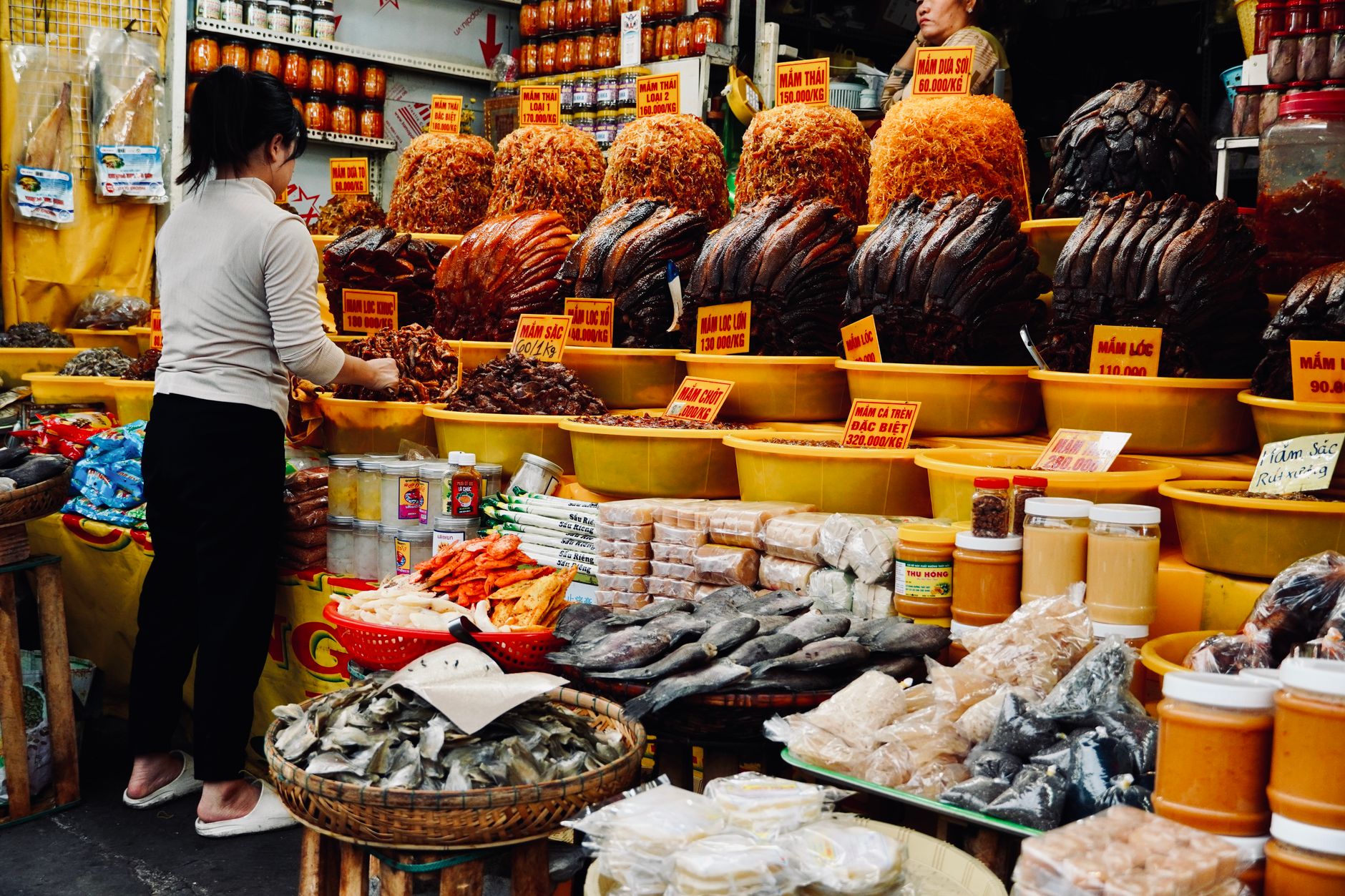
Photo by Tuan Vy on Pexels
Where to Eat It
The most reliable com lam you will eat is at a homestay, not a restaurant. The dish requires an open fire and fresh bamboo, neither of which most town-center restaurants have on hand. In Sapa (사파 / 沙坝 / サパ), homestays in the villages of Cat Cat and Ta Van regularly serve it as part of a set dinner included in the room rate (typically 150,000–250,000 VND per person all-in). Ask ahead — not every homestay prepares it nightly.
In Ha Giang town itself, the market on Tran Hung Dao Street has stalls selling cooked com lam from early morning. For the experience of watching it made over coals, the Sunday market in Dong Van — roughly 150 km from Ha Giang town on the Ha Giang loop road — is your best opportunity. Vendors there cook tubes to order while you wait.
If you are coming through Mai Chau, the valley's morning market near the main road into Lac village has Muong women selling com lam alongside steamed glutinous rice in banana leaves and grilled corn. Budget 40,000–60,000 VND for a small breakfast spread.
Pairings Worth Noting
Com lam is starchy, neutral, and slightly smoky. It needs contrast. Grilled meat is the obvious answer: pork, chicken, or buffalo, all marinated with galangal and fish sauce and cooked over the same coals. "Cha nuong" — grilled pork sausage stuffed with herbs and wrapped in banana leaf — works particularly well. A dipping sauce of chili, salt, and a squeeze of local lime (smaller and more acidic than the lowland variety) cuts through the fat.
Highland meals rarely include soup, unlike the pho-anchored breakfasts of Hanoi. The bamboo rice is the carbohydrate anchor; the grilled meat is the main event. Eat with your hands if you can — the tactile part of peeling the bamboo and breaking off a chunk of rice is half the appeal.

Photo by Vietnam Tri Duong Photographer on Pexels
DIY at Home
You can approximate com lam outside of Vietnam with a few adjustments. You will need glutinous rice (sold at any Southeast Asian grocery), and either fresh bamboo segments from an Asian garden supplier or, as a workaround, a tightly rolled cylinder of banana leaf secured with kitchen twine and baked in a 180°C oven for 40 minutes. The banana-leaf version lacks the bamboo perfume but produces a decent pressed sticky rice. Soak the glutinous rice for at least 6 hours, season with salt and a tablespoon of coconut milk per 100 g of rice, and pack loosely. The result will not be identical, but the texture and the act of unwrapping it at the table carry something of the original.
If you have access to fresh bamboo, the technique translates almost exactly. Use green bamboo only, soak the outside of the tube in water for 30 minutes before putting it over coals, and keep the heat low and steady.
Practical Notes
Com lam is most accessible between April and October when highland markets are active and roads into Ha Giang and Sapa are reliable. Outside of homestays, it is hard to find in urban restaurants — Hanoi (하노이 / 河内 / ハノイ) has a handful of highland-cuisine spots in the Old Quarter, but the quality is inconsistent. Go to the source if you can.
Going to Vietnam? Eat and travel smarter.
Monthly: new dishes, off-the-beaten-path destinations, and itineraries — straight to your inbox. No spam. Unsubscribe anytime.
Join 0 expats. (We just launched.)
More from Sapa
Other articles covering this city.

Best Pho Chua in Ha Giang: Where Locals Send You
Ha Giang's take on sour pho is sharper, tangier, and less known than the southern version. Here's where locals actually eat it.

7 Days in Vietnam: A Yoga and Meditation Itinerary
A week-long route through Vietnam's quietest corners: Sapa's mountain silence, a meditation center in the Mekong, and coastal stillness in Da Lat. Real costs, transport, and retreat recommendations.

10 Days on the Northern Frontier Loop: Hanoi to Ha Giang and Back
A tested itinerary covering Hanoi, Mai Chau, Sapa, Ha Giang, and back—with transport, guesthouses, food costs, and what actually works on the ground.
More from Northern Vietnam
Other articles covering the same region.

Bat Trang vs Phu Lang vs Chu Dau: Vietnam's Three Ceramic Villages Compared
Three villages, three completely different traditions in clay. Here's how Bat Trang, Phu Lang, and Chu Dau compare — and how to visit each from Hanoi.

Hat Xam: The Blind Beggar Music of Vietnam Making a Comeback
Hat xam was sung by blind street performers for centuries — then nearly vanished. Here's where to hear it live in Hanoi today.

Van Phuc Silk Village: The 1000-Year Loom Town Just Outside Hanoi
Twelve kilometers southwest of Hanoi's Old Quarter, Van Phuc has been weaving silk for over a millennium — and it's still the best place in the north to buy the real thing.
More in Food & Drink
More articles from the same category.

Com Dep Tra Vinh: the Flat Green Rice of Khmer New Year
Com dep is the Khmer-origin flat green rice made each harvest season in Tra Vinh — pounded young, eaten with coconut and banana, and tied to the Ok Om Bok festival.

Goi Ca Trich Phu Quoc: The Raw Herring Salad of Vietnam's Island
Goi ca trich is Phu Quoc's answer to ceviche — razor-fresh herring tossed with coconut, peanuts, and herbs, eaten wrapped in rice paper at the island's fishing villages.

Ca Loc Nuong Trui: Mekong Snakehead Fish Grilled Over Burning Straw
Ca loc nuong trui is a whole snakehead fish charred over burning rice straw — a dish born in Mekong paddy fields that tastes nothing like anything you'd find in a restaurant kitchen.

Ba Khia Ca Mau: The Salt-Fermented Crab That Southerners Swear By
Ba khia is a pungent, intensely savory fermented crab from Ca Mau's mangrove forests — a working-class staple that rarely makes it onto tourist menus but defines the Mekong south.

Lau Mam Chau Doc: An Giang's Funky Fermented-Fish Hot Pot
Chau Doc's lau mam is the Mekong Delta's most polarizing bowl — a simmering pot of fermented fish, wild vegetables, and serious funk that locals eat for breakfast.

Banh Pia Soc Trang: The Flaky, Durian-Filled Cake You Either Love or Avoid
Soc Trang's signature pastry blends Teochew, Khmer, and Vietnamese baking traditions into a layered, lard-rich cake stuffed with durian, salted egg yolk, and mung bean paste.
Comments
Loading…