Ha Nam: What to Do — A Traveler's Guide
Ha Nam is a quiet Delta province often skipped by tourists heading to Hanoi or Ha Long. Here's what's actually worth your time, and what to skip.

Ha Nam sits between Hanoi and the Red River Delta, close enough for a day trip but often invisible on Vietnam itineraries. Most travelers don't stop here—they pass through on the way to somewhere else. But there are real reasons to spend a day or two: temples older than Hanoi, ceramic villages with working kilns, and the kind of rural countryside that's vanishing fast elsewhere.
This is not a "destination" in the Instagram sense. You won't find resort pools or white-sand beaches. What you get is access to authentic Delta life, a handful of temples and pagodas with genuine history, and the chance to eat very well on almost no budget. If that appeals to you, read on.
Bai Dinh — the biggest pagoda complex in Vietnam
This is the main draw, and for good reason. Bai Dinh sits on a limestone hill about 30 km southwest of Ha Nam's provincial center (Phu Ly), and comprises three temple complexes: the Lower Temple, the Upper Temple, and a new massive complex built in the 2000s.
The Lower Temple (Chua Ha) is the oldest—parts date to the 11th century—and feels like a real pilgrimage site, not a tourist trap. Incense hangs thick, locals kneel in prayer, and the courtyards are lined with stone carvings. The climb to the Upper Temple (Chua Thuong) is steep and sweaty, but the view over the Delta spreads out below you, and the quieter pagoda at the top has none of the souvenir-seller energy of the base.
The newer complex—built in the 1990s–2000s—is massive and ornate. It holds a 10-meter bronze Buddha and draws crowds on weekends. It's impressive in a "biggest Buddha" way, but less atmospheric than the older temples.
Entry is free. Bring water and go early (before 09:00) if you want to avoid tour groups. Budget 3–4 hours for a proper visit to all three complexes.
Phat Tich Pagoda — where Buddhism arrived
About 15 km northeast of Phu Ly, Phat Tich is a much quieter temple with deeper historical weight. It's one of Vietnam's oldest pagodas—legend claims it was built in 1018 to celebrate the arrival of Buddhism in Vietnam. Whether or not that date holds up, the temple genuinely feels ancient: the stonework is worn smooth, the courtyards are overgrown with moss, and you'll likely have it nearly to yourself.
The main hall houses a 10-meter wooden Buddha carved in the 17th century. Sunlight filters through the wooden lattice roof, hitting the Buddha's face. It's the kind of image that sticks with you.
There's a small market outside where locals sell incense and fruit for temple offerings. A motorbike taxi from Phu Ly costs around 80,000 VND return (about 3.50 USD). The pagoda is less polished than Bai Dinh, and that's the point.
Bat Trang — ceramics village
Technically in Hanoi, but Ha Nam is close enough to combine in a day trip. Bat Trang, about 20 km southeast of Phu Ly, is the country's oldest ceramics cluster—potters have worked there for 500+ years.
Today it's half workshop, half souvenir shop. Wander the narrow lanes and you'll see open-front pottery studios where families throw bowls and vases by hand, fire them in wood kilns, and sell directly. Prices are rock-bottom—a hand-thrown soup bowl costs 30,000–50,000 VND. Many pieces are genuinely beautiful; some are touristy tourist bait. Pick carefully.
The best approach: arrive early in the morning before tour buses, walk without a guide, and talk to potters directly. They're used to tourists but aren't sales-aggressive. Eating is good too—several "nha hang" (restaurants) serve "com tam" and grilled fish at market prices.
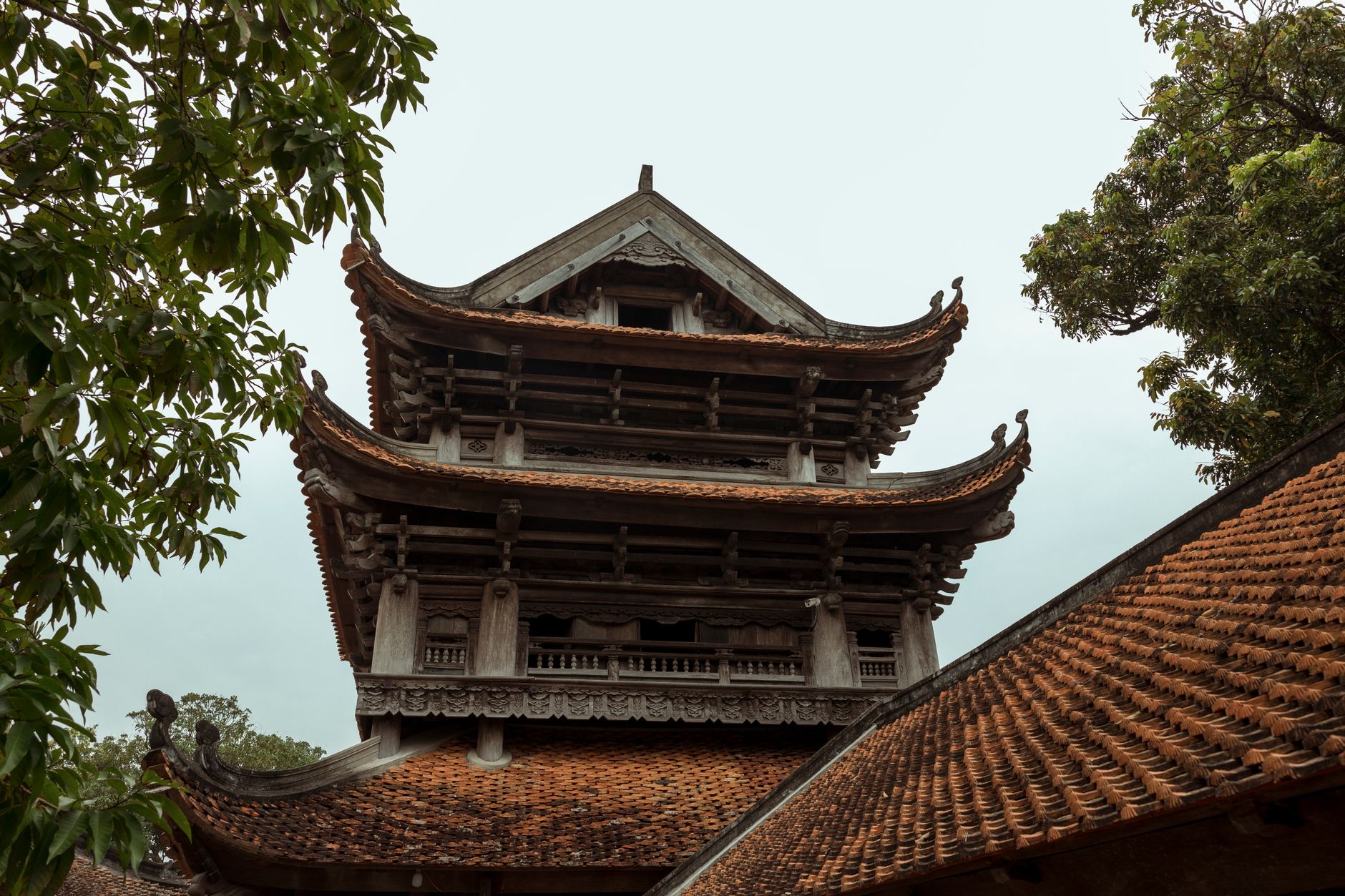
Photo by HONG SON on Pexels
Dong Ho Painting village
Another ceramic/folk-art stop, about 10 km east of Phu Ly. Dong Ho is famous for "tranh Dong Ho," folk woodblock paintings printed with natural pigments. The style is specific: bright reds and greens, folk heroes or children playing, printed on paper made from rice straw.
The village is small and feels genuinely lived-in, not heritage-park-ified. A handful of family workshops still do the printing by hand. Finished prints sell for 20,000–80,000 VND depending on size and detail. Quality varies widely—some are rushed tourist work, others are carefully printed and genuinely artful.
Stay for lunch at a local pho stall. The rice paper and fish cakes here are among the best I've eaten in the Red River Delta.
Outdoor activities: cycling, temple hikes, river walks
Ha Nam is flat and rural—ideal for slow exploration by motorbike or bicycle. The roads between Phu Ly and Bai Dinh are quiet and tree-lined. If you have a few hours, rent a motorbike (120,000–150,000 VND/day from any hotel) and connect temple-to-temple, stopping at roadside stalls for iced coffee and corn.
For a half-day hike, the path up Bai Dinh's hill extends another 2 km past the upper temple to a small cave and forest clearing. Locals use it; tourists rarely do.
River walks along the Hoang River (a tributary of the Red River) are peaceful, especially in early morning. Ask your hotel to point you toward a path—they exist but aren't marked.
What to eat
Ha Nam's food is pure Red River Delta: fresh spring rolls ("goi cuon"), steamed rice cakes ("banh cuon"), and fish grilled over charcoal. The province is known for "trai dam"—freshwater clams—which are meaty and sweet, served in a light broth or grilled.
In Phu Ly town, the night market (along Tran Hung Dao Street) has dozens of food stalls. Expect to pay 20,000–40,000 VND per dish. Eat standing or on a plastic stool; this is not Instagram food, it's real food.
"Bia hoi" (draft beer) is everywhere and costs 5,000–10,000 VND per glass. It's thin and refreshing in the heat.

Photo by Duc Nguyen on Pexels
What to skip
- Ha Nam theme park / Dong Mo resort: Modern, expensive, aimed at domestic package tours. Not worth your time.
- The provincial museum in Phu Ly: Small, poorly labeled, limited to Vietnamese-language placards. Skip unless you have a strong interest in local history.
- Crowded temple weekends: Avoid Saturdays and Sundays at Bai Dinh if you want solitude. Weekdays are vastly better.
How to get here
From Hanoi, Phu Ly is 60 km south via National Route 1, about 90 minutes by car or bus. Frequent minibuses run from Hanoi's southern long-distance stations (Giap Bat, Nuoc Ngam) for around 50,000–80,000 VND. Journey time is 2–3 hours with stops.
Renting a motorbike in Hanoi and riding down is also viable—Route 1 is wide and traffic manageable outside rush hour. Many travelers do a loop: Hanoi → Ha Nam → Bai Dinh → Ninh Binh, staying 1–2 nights in each place.
Once in Phu Ly, motorbike taxis or rental bikes handle short hops to temples and villages. Hotels can arrange drivers for longer day trips.
Practical notes
Ha Nam is best visited in autumn (September–November) or spring (March–May). Summers are brutally hot and humid; winters (December–February) are cool and dry. Hotels in Phu Ly are cheap and reasonable—expect 200,000–400,000 VND per night for a clean double room. Book ahead only during Tet; otherwise, just show up.
English is minimal outside of hotels. Learn a few basic Vietnamese phrases or use your phone's translation app. Locals are patient with foreigners, especially if you attempt their language.
Going to Vietnam? Eat and travel smarter.
Monthly: new dishes, off-the-beaten-path destinations, and itineraries — straight to your inbox. No spam. Unsubscribe anytime.
Join 0 expats. (We just launched.)
More from Northern Vietnam
Other articles covering the same region.

Hoa Lu Ancient Capital: Vietnam's First Kingdom and How to Visit from Ninh Binh
Hoa Lu was Vietnam's first royal capital, and the two temple complexes that survive are among the most atmospheric historical sites in the north.

Hoan Kiem Lake: The Sword Legend, Ngoc Son Temple, and When to Visit
Hoan Kiem Lake sits at the center of Hanoi's Old Quarter — here's the legend behind it, how to walk it properly, and when the streets actually belong to you.

Lung Cu Flag Tower: Vietnam's Northernmost Point
The drive to Lung Cu Flag Tower takes you to Vietnam's northernmost point at 1,500 metres. It's a half-day trip from Dong Van with a steep climb, mountain views, and nearby Hmong villages.
More in Destinations
More articles from the same category.

Landmark 81 Saigon: Observation Deck, Ice Rink, and Getting There from District 1
Landmark 81 is Vietnam's tallest building and Saigon's most visible skyline anchor. Here's what's actually inside and whether it's worth the trip.

Bitexco Financial Tower: Skydeck, Helipad Bar, and Whether the Ticket Is Worth It
Saigon's most recognizable skyscraper charges 250,000 VND to ride up to the 49th floor — here's what you actually see, and whether you should bother.

Notre Dame Cathedral Saigon: French Colonial Centerpiece in the Heart of HCMC
Saigon's Notre Dame Cathedral has been wrapped in scaffolding for years, but the square in front of it remains one of the best starting points for a colonial-era walking tour of District 1.

Paradise Cave, Quang Binh: The 31km Marble Cave That Beats Phong Nha for Photographers
Paradise Cave runs 31km through Quang Binh's karst and delivers the kind of cathedral-scale formations that Phong Nha's boat tour simply can't match. Here's how to see it properly.

Son Doong Cave: What the $3,000 Oxalis Expedition Actually Includes
Son Doong is the world's largest cave and only one operator is legally allowed to take you inside. Here is what the permit-only expedition covers and whether it is worth it.

Phong Nha Cave: Wet Cave, Dry Cave, and How to Choose
Phong Nha has two main caves worth your time — one you reach by river boat, one on foot. Here's how to pick, what each costs, and when to go.
Comments
Loading…