What to Eat in Lai Chau: Regional Dishes and Where Locals Go
Lai Chau's mountain cuisine is built on pork, sticky rice, and wild greens. Here's what actually gets cooked in local kitchens and where to find it without overpaying.

Lai Chau sits in Vietnam's far northwest, surrounded by mountains and minority villages. The food here isn't trying to impress—it's functional, meat-heavy, and deeply tied to what grows or gets raised in the province. If you're expecting the refined flavors of Hanoi or Saigon, you'll be disappointed. If you want honest, filling mountain food at prices that won't empty your wallet, this is the place.
Sticky Rice and Grilled Pork: The Foundation
Almost every meal in Lai Chau begins with "com tam" or sticky rice. Here it's not the crushed-grain street food you get in Saigon—it's whole grains, cooked in a clay pot until the bottom chars slightly, then served in a bamboo basket. The char adds a toasted, nutty flavor that separates lazy cooking from the real thing.
Pork is the protein. "Thit nuong" (grilled pork) comes marinated in lemongrass, fish sauce, and chilies, then cooked over charcoal. A plate costs 50,000–80,000 VND (USD 2–3.20). Local restaurants don't plate it like a restaurant—it arrives on a metal skewer, blackened edges and still hot, with a heap of raw herbs on the side: mint, saw-leaf herb, cilantro, and lime.
Pig's liver, kidneys, and heart get the same treatment. If you're not comfortable with organ meats, skip them. If you are, order "pate nuong"—it's rich, slightly iron-heavy, and pairs perfectly with sticky rice and dipping fish sauce.
Wild Greens and Mountain Vegetables
You'll see bundles of greens at Lai Chau's markets that don't exist in the lowlands. Local names are hard to pin down for travelers; ask your guesthouse to point out what's in season. These greens—bitter, sometimes slightly fuzzy—get blanched and served cold with a peanut or sesame dipping sauce, or stirred into soups.
"Canh"—a light broth—is how locals eat these. It's not the rich "canh chua" or sour soup of the south. Lai Chau canh is vegetable-forward, with minimal protein, often just a few small fish or a piece of pork bone for stock. A bowl at a local stall runs 20,000–30,000 VND.
Where Locals Actually Eat
Avoid the restaurants within sight of the main town square and the guesthouses. They inflate prices by 200–300% for tourists and water down flavors. Instead:
Lai Chau Central Market sits on the east side of town, a 10-minute walk from the main drag. Women here grill pork and beef over charcoal every morning from 6 AM onwards. A plate of grilled pork with sticky rice costs 40,000–60,000 VND. No English, no menus—point at what you want. This is where contractors, motorbike drivers, and office workers eat. Arrive before 9 AM or after 11 AM to avoid the rush.
Streetside pho stalls (usually one per block) open at 6:30 AM and close by 9 AM. "Pho" here is thinner and less aromatic than northern lowland versions—the broth is lighter, the noodles a touch softer. A bowl is 25,000–35,000 VND. The meat is boiled chicken or beef, not rare slices you cook yourself. It's comfort food, not a signature dish worth hunting.
Banh mi stands (bánh mì) operate from 10 AM to 3 PM, usually from a motorbike or a permanent stall. The bread is softer than the Hanoi-style crackle, closer to a Vietnamese-French hybrid that's now standard outside big cities. Fillings: grilled pork ("thit nuong"), pâté, and pickled vegetables. Cost: 20,000–25,000 VND. Reasonable, not memorable.
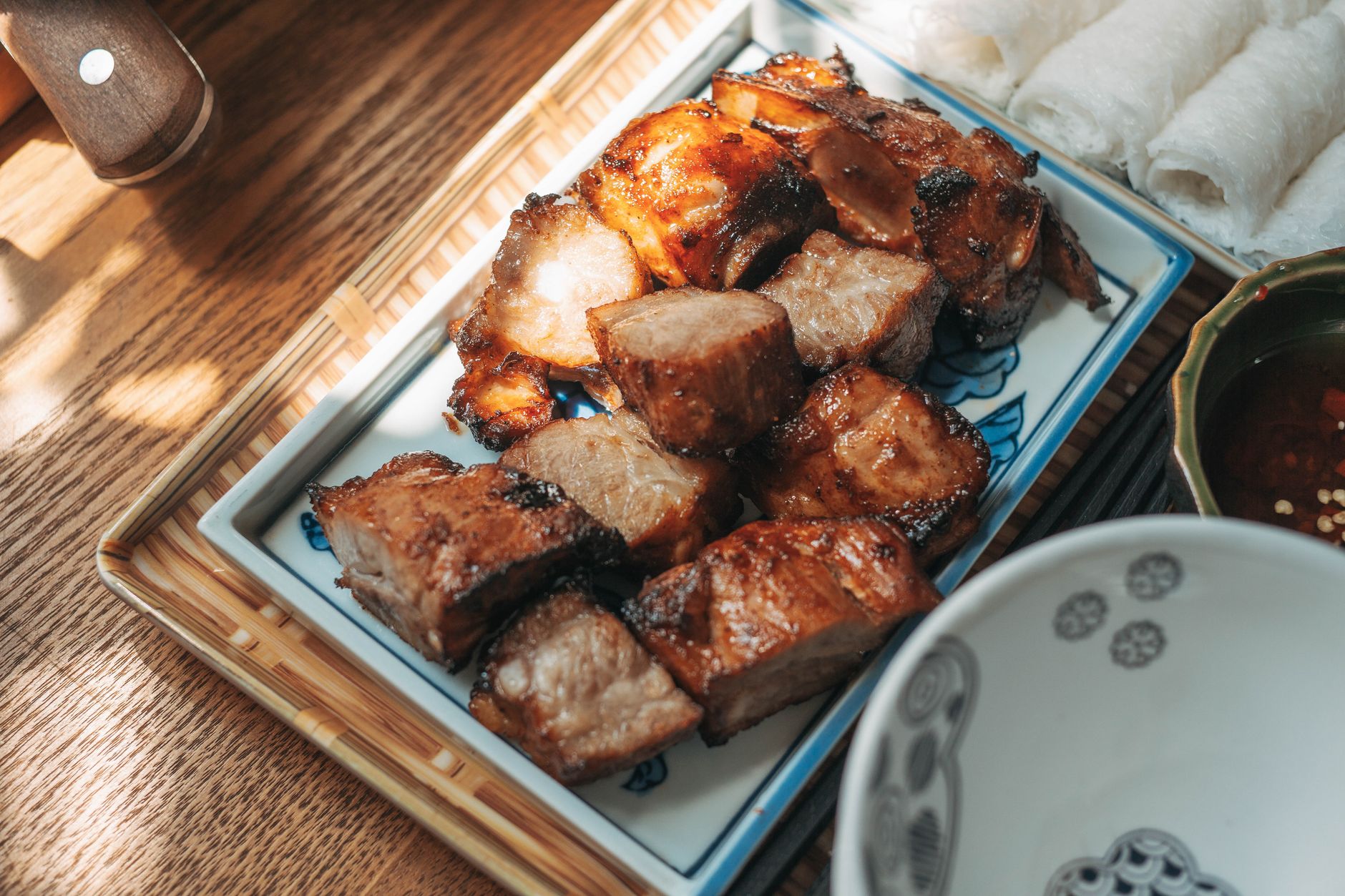
Photo by FOX ^.ᆽ.^= ∫ on Pexels
Specialties You Should Try
Com lam (bamboo-tube rice): Rice cooked inside a bamboo segment over an open flame. It smells like hay and smoke and tastes subtly sweet from the bamboo. You'll find this at morning markets or from vendors near the town entrance. 15,000–20,000 VND for a segment. Eat it with grilled meat or a boiled egg.
Thit chua (sour pork): Pork preserved in salt and spices, then grilled. The flavor is funky, tangy, and concentrated—not for everyone, but worth a small taste. 60,000–80,000 VND per plate.
Mam tom (fermented shrimp paste): A condiment, not a dish. It's pungent, fishy, and adds depth to rice and grilled vegetables. Travelers often recoil. Locals apply it sparingly to everything. It costs very little and lasts forever in your bag.
Dua cai (pickled greens): Sour, salty, sometimes spicy. Served on the side of grilled meats to cut through richness. Market vendors sell bags for 15,000–20,000 VND.
What Not to Order (and Why)
Skip tourist-focused "ethnic dishes" labeled as H'Mong or Dao specialties in guesthouses. They're usually pale imitations, made for foreign palates and charged at inflated rates (200,000+ VND per dish). If you want to eat minority cuisine, hire a local guide and visit a village—but understand you're a guest, not a customer, and the experience should involve hospitality and a relationship, not a transaction.
Avoid anything described as "exotic" or "traditional secret recipe"—these are marketing flags in mountain towns. Authentic food here is daily, boring, and cheap.
Markets and Street Eating
Lai Chau Central Market (near the town clock) and Ban Phu Market (south of town) are the real supply hubs. Vendors set up stalls in early morning; by 10 AM, the energy drops. If you want to observe and eat, arrive between 6:30–8 AM. Breakfast stalls cluster around the entrance; lunch setups are along the back rows.
Hygiene is a fair question. Stalls with high turnover and visible charcoal flames are safer bets than those with pre-cooked, sitting food. Watch the vendor handle money—if they immediately prep your food without washing hands, move on.

Photo by Quang Nguyen Vinh on Pexels
Cost Expectations
A full meal (protein + rice + vegetable side) at a local stall: 60,000–100,000 VND (USD 2.40–4).
Breakfast (pho or banh mi + coffee): 45,000–60,000 VND.
Groceries (if you're self-catering): eggs 35,000/dozen, rice 50,000 per kg, pork 80,000–120,000 per kg depending on cut.
Restaurant meals (the kind with printed menus and air-con): 150,000–250,000 VND. Not worth it.
Coffee
Lai Chau isn't a coffee-growing region, but local vendors serve "ca phe sua da" (iced coffee with sweetened condensed milk) and black coffee. Expect it to be instant Nescafé or a coarse drip, not specialty. 15,000–20,000 VND for a cup. Morning stalls often serve it alongside breakfast.
Practical Notes
Lai Chau town has improved infrastructure, but it's still remote—options shrink after 3 PM outside markets. Eat your main meal mid-morning or around noon. Cash only at stalls; ATMs are near the main square but sometimes run out. Bring a phrasebook or photos on your phone if you don't speak Vietnamese; English is rare outside guesthouses. Water from stalls is safe (boiled), but buy sealed bottles if you're uncertain.
Going to Vietnam? Eat and travel smarter.
Monthly: new dishes, off-the-beaten-path destinations, and itineraries — straight to your inbox. No spam. Unsubscribe anytime.
Join 0 expats. (We just launched.)
More from lai-chau
Other articles covering this city.
Lai Chau Best Time to Visit: A Traveler's Guide
Lai Chau's remote northern location means weather swings hard between seasons. Here's when to go based on what you want to see and endure.
How to Get to Lai Chau: Transport Options from Hanoi, Da Nang & Beyond
Lai Chau sits in the far northwest, 400 km from Hanoi. Here's how to reach it by bus, motorbike, or occasional flights—with costs, duration, and where to stay once you arrive.
More from Northern Vietnam
Other articles covering the same region.

Hoa Lu Ancient Capital: Vietnam's First Kingdom and How to Visit from Ninh Binh
Hoa Lu was Vietnam's first royal capital, and the two temple complexes that survive are among the most atmospheric historical sites in the north.

Hoan Kiem Lake: The Sword Legend, Ngoc Son Temple, and When to Visit
Hoan Kiem Lake sits at the center of Hanoi's Old Quarter — here's the legend behind it, how to walk it properly, and when the streets actually belong to you.

Lung Cu Flag Tower: Vietnam's Northernmost Point
The drive to Lung Cu Flag Tower takes you to Vietnam's northernmost point at 1,500 metres. It's a half-day trip from Dong Van with a steep climb, mountain views, and nearby Hmong villages.
More in Destinations
More articles from the same category.

Landmark 81 Saigon: Observation Deck, Ice Rink, and Getting There from District 1
Landmark 81 is Vietnam's tallest building and Saigon's most visible skyline anchor. Here's what's actually inside and whether it's worth the trip.

Bitexco Financial Tower: Skydeck, Helipad Bar, and Whether the Ticket Is Worth It
Saigon's most recognizable skyscraper charges 250,000 VND to ride up to the 49th floor — here's what you actually see, and whether you should bother.

Notre Dame Cathedral Saigon: French Colonial Centerpiece in the Heart of HCMC
Saigon's Notre Dame Cathedral has been wrapped in scaffolding for years, but the square in front of it remains one of the best starting points for a colonial-era walking tour of District 1.

Paradise Cave, Quang Binh: The 31km Marble Cave That Beats Phong Nha for Photographers
Paradise Cave runs 31km through Quang Binh's karst and delivers the kind of cathedral-scale formations that Phong Nha's boat tour simply can't match. Here's how to see it properly.

Son Doong Cave: What the $3,000 Oxalis Expedition Actually Includes
Son Doong is the world's largest cave and only one operator is legally allowed to take you inside. Here is what the permit-only expedition covers and whether it is worth it.

Phong Nha Cave: Wet Cave, Dry Cave, and How to Choose
Phong Nha has two main caves worth your time — one you reach by river boat, one on foot. Here's how to pick, what each costs, and when to go.
Comments
Loading…