The Five Tastes
Vietnamese cuisine rests on a single principle: balance. Every dish aims to hit five fundamental tastes—sweet, salty, bitter, sour, and spicy—in proportion. This means lemongrass, ginger, mint, "rau ram" (Vietnamese mint), brown sugar, long coriander, Saigon cinnamon, bird's eye chili, soy sauce, lime, and Thai basil show up constantly. The result is food that feels light without tasting thin: rice noodles instead of wheat, rice paper wrappers instead of dough, fresh herbs instead of cream. Many dishes are naturally gluten-free.
The balancing act shows up in the dipping sauces most clearly. "Nuoc cham"—the fish-sauce-based condiment served alongside almost everything—combines sour (lime), sweet (sugar), salty (fish sauce), and spicy (chili) in a single small bowl. Every family has a slightly different ratio. Restaurants in Hanoi tend toward saltier versions; southern kitchens around Ho Chi Minh City lean sweeter. That one condiment tells you where you are on the map.
Chinese Culinary Inheritance
Centuries of contact left their mark. The Chinese introduced wontons ("banh hoai"), char siu pork ("xa xiu"), har gow dumplings ("ha cao"), shahe fen noodles ("hu tieu"), fried dough ("banh quay"), and steamed buns ("banh bao"). Even northern ethnic minorities—the Tay and Nung in Lang Son province—adopted roasted pork and braised pork belly from Chinese kitchens. Chili peppers and corn arrived the same way, via Ming-era trade.
Yet the Vietnamese didn't copy. They adapted. A wonton became something else entirely once filled with Vietnamese shrimp and coriander. That's the pattern: take the template, rebuild it with local tastes. You can taste this most directly in Hoi An's "cao lau," a noodle dish that borrows from Japanese, Chinese, and Cham cooking yet belongs to no one but Hoi An itself. The thick noodles, the pork, the herbs, the crispy croutons—it exists only there, made with water from a specific local well, or so the locals insist.
The French Mark: Bread and Coffee
The French colonial period left two gifts that still define modern Vietnam: the baguette and coffee. The baguette became "banh mi"—the bread itself—and today "banh mi thit" is the national sandwich. Butter, pate, croissants ("banh sung trau"), and flan entered the Vietnamese table. Onions became "hanh tay" (western shallots), asparagus "mang tay" (western bamboo shoots), potatoes "khoai tay" (western yams). The naming convention says everything: these were foreign, and the Vietnamese made that explicit.
French techniques brought omelettes ("op let"), rotisserie chicken ("roti"), beefsteak ("bit tet"), and wine-based sauces ("sot vang"). Dairy, rarely used before, found its way into Vietnamese-French fusion dishes. Laos, Vietnam, and Cambodia share certain legacies—baguettes, coffee culture—because they share colonial history.
Coffee deserves its own mention. Vietnam is the world's second-largest coffee producer, and the drink culture here is nothing like a Western cafe. "Ca phe sua da" (iced coffee with condensed milk) is the default order in the south. In Hanoi, "egg coffee" ("ca phe trung")—a whipped egg yolk and condensed milk cap over dark coffee—was invented at Cafe Giang near Hoan Kiem Lake in 1946 and is still served there today for around 35,000 VND. If you order "ca phe den" you get black coffee; "ca phe sua" gets you condensed milk. Know these phrases and you skip the pointing-at-menus routine.

Image by Paul R. Burley via Wikimedia Commons (CC BY-SA)
Southeast Asian and Spice-Route Influences
Cham cuisine gave Vietnam "banh khot"—mini savory pancakes made with coconut. Malay and Indian traders brought curry spices; while rare in the north, "ca ri" (curry) dominates central and southern tables, especially chicken curry at weddings and funerals. The Vietnamese eat curry with bread, steamed rice, or rice vermicelli noodles, much like Cambodia does.
From the Khmer south came "mam bo hoc" (prahok), a fermented fish paste essential to "bun nuoc leo"—a rice noodle soup born in Vietnamese Khmer communities and distinct from the Cambodian version. More recent contact with Eastern Europe introduced stuffed cabbage soup, "sa lat Nga" (Olivier salad), and Czech beer.
The Indian-influenced spice trade also left traces in "banh xeo," the sizzling turmeric crepe stuffed with shrimp, pork, and bean sprouts. The turmeric gives it that unmistakable yellow color. In Saigon, banh xeo comes plate-sized; in Hue and Da Nang, they're smaller, crispier, and served in stacks. A good banh xeo at a street stall in District 1 runs 30,000-50,000 VND.
North: Subtlety and Seafood
Northern Vietnam's colder climate historically limited spices. Black pepper replaced chili as the main heat source. The cuisine prioritizes balance through understated combinations rather than bold dominant notes. Freshwater fish, crustaceans, and mollusks—prawns, shrimp, squid, crabs, clams, mussels—mattered more than meat. Many iconic northern dishes are crab-centered: "bun rieu" (crab noodle soup) being the most famous.
As the cradle of Vietnamese civilization, the north sent its dishes south through migration. Hanoi remains the center: "bun cha" (rice noodles with grilled marinated pork), "pho ga" (chicken noodle soup), "cha ca La Vong" (grilled fish with turmeric and dill), "banh cuon" (steamed rice rolls).
Hanoi (하노이 / 河内 / ハノイ)'s Old Quarter is the best classroom. Along Hang Ga and Hang Chieu streets you can eat bun cha for 40,000-60,000 VND at lunch, then walk two blocks for banh cuon at roughly 25,000-35,000 VND. "Bun thang"—a delicate rice vermicelli soup with shredded chicken, egg, and pork—is harder to find but worth tracking down near Dong Xuan Market.

Image by Syced via Wikimedia Commons (CC BY-SA)
Central: Spice and Imperial Technique
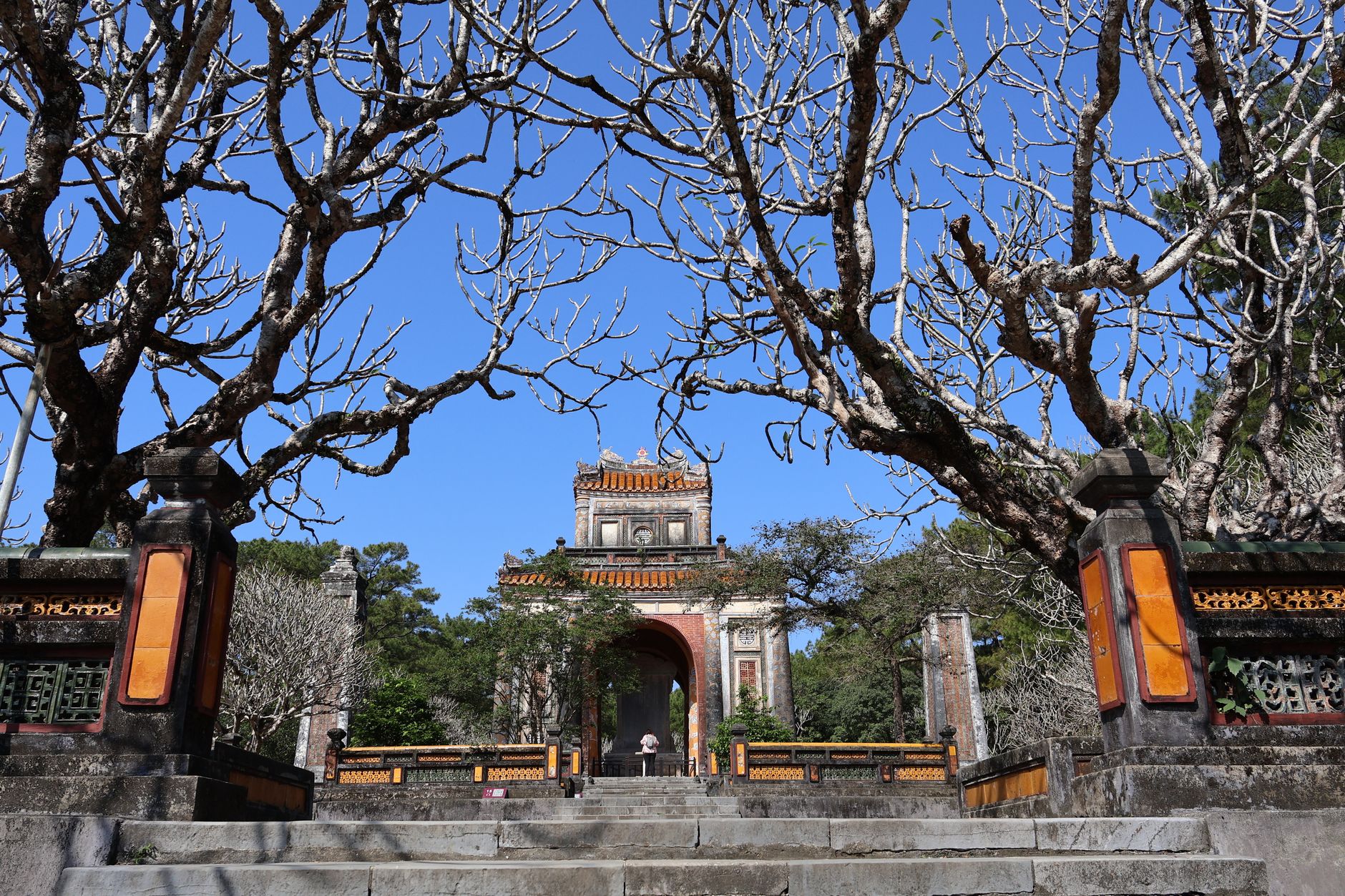
The mountains of central Vietnam grow abundant spice, and the food reflects it. Dishes here run hotter than north or south. Hue, the old imperial capital, is known for highly decorated, ornate cuisine that echoes ancient royal kitchens. Meals are sophisticated, built from multiple complex dishes. The Imperial Citadel area and Dong Ba Market are good starting points for eating your way through the city.
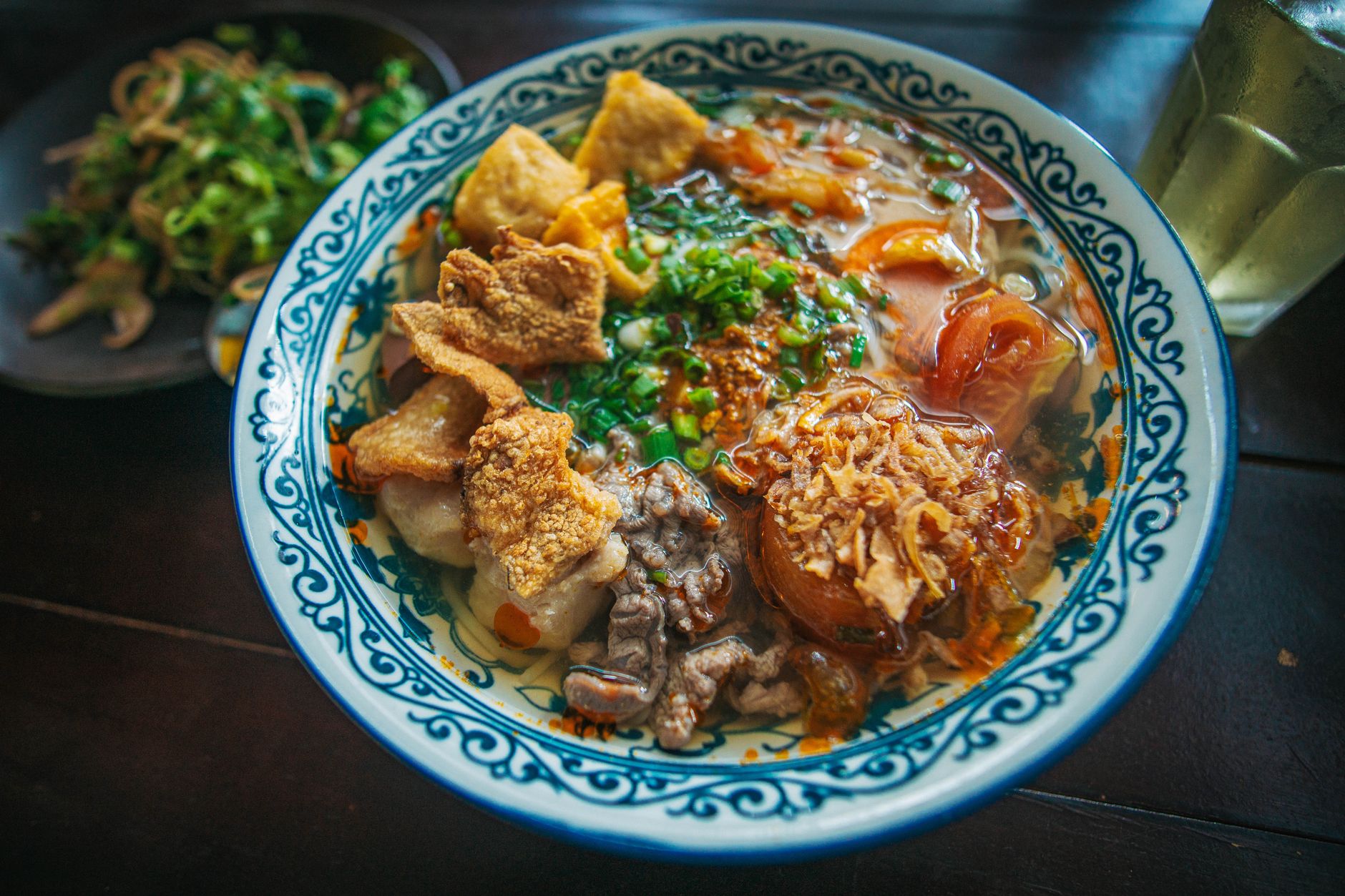
"Bun bo Hue"—a spicy beef noodle soup—defines the region. So does "mi Quang" (turmeric noodles with various toppings), a specialty of Da Nang and Quang Nam province that you'll find nowhere else made the same way. In Hue, expect to pay 30,000-45,000 VND for a bowl of bun bo Hue at a street stall. In Da Nang, mi Quang runs about the same. Both cities are compact enough that you can walk between food spots without needing a taxi.
South: Sugar and Tropical Abundance
The Mekong Delta's warm climate and fertile soil mean abundance: more sugar, more coconut milk, more tropical fruit, more fresh herbs. Southern food tastes sweetest, the climate allowing year-round cultivation. Abundance shapes flavor—recipes use more of everything because there's more to use.
"Com tam" (broken rice) is the workhorse meal of Saigon—grilled pork chop, a fried egg, pickled vegetables, fish sauce, and broken rice grains that were once considered waste. It costs 35,000-55,000 VND at most sidewalk joints and is eaten for breakfast, lunch, or dinner. "Goi cuon" (fresh spring rolls) filled with shrimp, pork, herbs, and vermicelli are another southern staple, served with a peanut dipping sauce. Ben Thanh Market in District 1 is the tourist-friendly entry point, though locals tend to eat at smaller stalls in Districts 3, 4, and Binh Thanh.
Further south and into the delta, Phu Quoc island produces some of Vietnam's best fish sauce ("nuoc mam"), and the island's night market has grilled seafood at prices well below Saigon—grilled squid from 80,000 VND, sea urchin from 30,000 VND per piece.
Street Food Culture and Where It Happens
Vietnamese food culture lives on the sidewalk. Plastic stools, knee-height tables, a charcoal grill, a pot of broth—that is the restaurant. Most street stalls specialize in a single dish. The sign often IS the dish: a place called "Bun Cha Huong Lien" sells bun cha. A place called "Pho Thin" sells pho. No menus needed.
Prices at street stalls across the country generally fall between 25,000 and 60,000 VND for a main dish. A full street-food meal with a drink rarely exceeds 80,000 VND (about $3.20 USD). "Bia hoi"—fresh draft beer brewed daily—costs as little as 8,000-12,000 VND per glass in Hanoi's Old Quarter, especially around the Bia Hoi Corner at the intersection of Ta Hien and Luong Ngoc Quyen streets.
In Da Lat, the night market is the center of street food life: grilled rice paper ("banh trang nuong"), soy milk, and avocado ice cream. In Da Nang, head to the streets around Con Market. In Hoi An, the central market opens before dawn and winds down by 9 AM—get there early for "cao lau" and banh mi from Madam Khanh (known as the Banh Mi Queen), usually 20,000-30,000 VND.
How to Eat Vietnamese Food
The philosophy extends to the table itself. Vietnamese meals aren't courses; they're all at once. Rice sits in the center. Around it: a soup, a stir-fry, maybe grilled fish, always fresh herbs on a separate plate. You build each bite: rice, herb, sauce, protein, repeat. This approach—assembling flavor yourself—is why "fresh" matters so much. The cook doesn't seal the taste in sauce. You do, by choice, at the table.
Chopsticks are the default utensil. Soup spoons handle broth. Hands are fine for spring rolls and banh mi. Communal plates are normal—everyone eats from shared dishes, using chopsticks to transfer food to their own rice bowl first. Slurping noodle soup is not rude; it is expected.
Common Mistakes Foreigners Make
- Skipping the herbs. That plate of greens on the side is not decoration. Tear the leaves, add them to your bowl. They are half the flavor.
- Ordering pho for every meal. Pho is one dish among hundreds. Eating only pho in Vietnam is like eating only pizza in Italy. Branch out to bun cha, bun bo Hue, mi Quang, banh canh, or com tam.
- Adding hoisin and sriracha to pho before tasting. Northern pho purists will wince. Taste the broth first. In Hanoi, pho is served clean—just broth, noodles, meat, and herbs. Hoisin sauce on the table is mostly a southern habit.
- Eating at tourist-zone restaurants only. Prices triple and quality drops. Walk two blocks off the main tourist strip in any city and the food improves immediately.
- Assuming all "cha gio" (fried spring rolls) are the same. Northern cha gio use wheat-flour wrappers; southern ones use rice paper that puffs and blisters when fried. Different textures, different fillings, different dipping sauces.
- Not knowing basic ordering phrases. "Cho toi mot..." (give me one...) followed by the dish name gets you far. "Khong cay" means not spicy. "Tinh tien" means check, please.
Quick Reference: Vietnamese Food at a Glance
- National dish: Pho (beef or chicken rice noodle soup)
- Signature sandwich: Banh mi thit (baguette with pate, cold cuts, pickled vegetables, herbs)
- Street food price range: 25,000-60,000 VND per dish ($1-2.50 USD)
- Default drink (south): Ca phe sua da (iced coffee with condensed milk)
- Default drink (north): Ca phe nong (hot black coffee) or tra da (iced tea, often free)
- Tipping: Not expected at street stalls. 5-10% at sit-down restaurants if service charge isn't included.
- Peak street food hours: 6-8 AM (breakfast), 11 AM-1 PM (lunch), 5-8 PM (dinner)
- Useful phrase: "An gi day?" — "What should I eat here?" (works surprisingly well when said to a vendor with a smile)
- Fish sauce (nuoc mam): The backbone of Vietnamese seasoning. Phu Quoc and Phan Thiet produce the most respected varieties.
- Vegetarian options: Look for "com chay" (vegetarian rice) restaurants, common near Buddhist pagodas. Most cities have several.
Frequently Asked Questions
How is Vietnamese coffee different from what I am used to at home?
Vietnam is the world's second-largest coffee producer, and the culture differs sharply from Western cafes. The default southern order is ca phe sua da — iced coffee with condensed milk. In Hanoi, egg coffee (ca phe trung) layers whipped egg yolk and condensed milk over dark coffee; it was invented at Cafe Giang near Hoan Kiem Lake in 1946 and still sells for around 35,000 VND. Order ca phe den for black, ca phe sua for condensed milk.
What foreign influences shaped Vietnamese cuisine over the centuries?
Two major outside forces shaped the food. Centuries of Chinese contact introduced wontons, char siu pork, steamed buns, and noodles like hu tieu, which Vietnamese cooks then rebuilt with local herbs and shrimp. French colonialism added baguettes, pate, butter, flan, rotisserie chicken, and beefsteak. The Vietnamese named these imports explicitly — potatoes became khoai tay (western yams) — signaling that foreign ingredients were absorbed rather than simply copied.
When visiting Hoi An, what makes cao lau different from other noodle dishes?
Cao lau is specific to Hoi An and borrows from Japanese, Chinese, and Cham cooking while belonging to none of them. It combines thick noodles, pork, fresh herbs, and crispy croutons. Locals insist it can only be made authentically with water drawn from a specific well in the city. No other place replicates it, making it one dish genuinely tied to a single location rather than a regional style found across the country.
Bottom Line
Vietnamese food makes sense once you stop thinking of it as a single cuisine. It is at least three—north, central, south—layered with Chinese technique, French ingredients, and Southeast Asian spice, all filtered through a philosophy of balance and freshness. The best way to understand it is not to read about it but to sit on a plastic stool, point at what the person next to you is eating, and start assembling your own plate. The food will teach you the rest.
Last updated · May 29, 2026 · independently researched, never sponsored.